Sign In
 Free Newsletter

Gerrymandering ruling leaves Md. in familiar political gridlock


 Listen to this article
The U.S. Supreme Court’s ruling Thursday leaves in place Maryland’s controversial congressional districts and appears to ensure, at least for the short term, that the state will continue to reapportion those districts as it always has.
The 5-4 ruling punts the issue back to states and Congress. In Maryland, it has the effect of placing Republican Gov. Larry Hogan with the liberal minority of the court while leading Democrats find themselves applauding the decision of the conservative majority.
“The court said states have the power, and certainly Hogan will use that, but prior to the outcome of the 2020 election I don’t see anything to motivate Maryland Democrats to do anything,” said Todd Eberly, a political science professor at St. Mary’s College of Maryland. “Just as I am sure Republicans will not be lining up to accept Justice (Elena) Kagan’s scathing dissent and say, ‘We’re ready to change.’ It’s hard to convince people with power to give up that power.”
But Eberly said Hogan can use the bully pulpit and his own commission to attempt to shame if not pressure Democrats to change.
“He can present his own maps with clear lines that ignore incumbents and party registration and then let the General Assembly offer up their own that looks like they gave a 4-year-old caffeine and a crayon and said ‘create a map,'” said Eberly. “They’ve (Democrats) got the votes to pass their map, but it would be a public relations nightmare.”
The court majority and dissenting opinions in cases involving Republican redistricting in North Carolina and Democratic Party efforts in Maryland’s 6th Congressional District each expressed concerns about hyper-partisan redistricting.
The conservative majority, led by Chief Justice John G. Roberts Jr., said gerrymandering raises political questions that the court cannot address.
“The practice was known in the Colonies prior to Independence, and the Framers were familiar with it at the time of the drafting and ratification of the Constitution,” Roberts wrote for the majority. “At no point was there a suggestion that the federal courts had a role to play. Nor was there any indication that the Framers had ever heard of courts doing such a thing.”
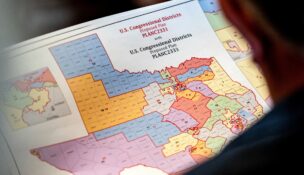
Maryland, where Democrats outnumber Republicans roughly 2-1, once evenly split its eight congressional seats between the two parties. Then-Democratic Gov. Parris Glendening tilted that distribution 6-2 in favor of his own party nearly two decades ago.
Glendening has since publicly called for national redistricting reform.
In 2011, then-Gov. Martin O’Malley and a Democratic legislature tasked a redistricting commission with protecting the current set of Democratic incumbents and finding a way to flip one more seat from red to blue — the 6th District in Western Maryland that had been reliably Republican.
After the 2011 remapping, voters in that district challenged the map on the basis that it violated their First Amendment rights, a claim ultimately rejected by the majority of the Supreme Court.
Kagan, writing for the dissenters, agreed with the plaintiffs and expressed concerns for future redistricting efforts given the growing influence of technology, saying: “These are not your grandfather’s — let alone the Framers’ — gerrymanders. ”
“What was possible with paper and pen — or even with Windows 95 — doesn’t hold a candle (or an LED bulb?) to what will become possible with developments like machine learning. And someplace along this road, “we the people” become sovereign no longer,” Kagan wrote.
The decision was quickly applauded by Democrats, many of whom were in the legislature at the time the maps were drawn and approved.
“From the beginning of this process, we have said that while our map is constitutional, this is still an issue that requires a national solution,” Senate President Thomas V. Mike Miller Jr. said in a statement. “The Supreme Court ruling only strengthens the need for Congress and the president to work together to create a set of rules across the country, and I renew our call on Congress to present a set of rules and for the President to sign it. With this lawsuit over, I hope we can put the issue of the 2011 Redistricting to rest and focus on the many pressing issues facing all Marylanders.”
Miller has repeated pooh-poohed calls for a Maryland solution to hyperpartisan gerrymandering as did the House Speaker Michael Busch, who died earlier this year.
Current Speaker of the House Adrienne Jones also expressed disappointment in the decision but echoed the position of her predecessor.
“We will take some time to digest the decision and speak with our members and the attorney general about our next steps towards the 2021 redistricting,” said Jones. “We are disappointed that the Supreme Court didn’t offer a national solution to what is clearly a national problem.”
Hogan, bolstered by the majority’s opinion that states have the power to craft a solution, said he remains committed to his proposal to create an independent redistricting commission.
“The Supreme Court agrees that this is a matter for states and legislatures to address,” Hogan said in a statement.
The legislature, however, has repeatedly killed his bills on the issue.
Hogan will get to propose new state legislative and congressional district maps in 2021. The legislature can substitute its own maps, setting the stage for a potential veto and override vote.
“Gerrymandering is wrong, and both parties are guilty. It stifles real political debate, contributes to our bitter partisan polarization, and deprives citizens of meaningful choices,” said Hogan. “The voters should pick their representatives, not the other way around. I will do everything in my power to restore free and fair elections for the people.”