Sign In
 Free Newsletter

Report: Md. falling short in combating problem gambling


Maryland is falling short of expectations and national standards in helping people suffering from a gambling problem, a legislative report shows.
An estimated 405,000 people in Maryland — or 8.6% of all adult residents in the state — had experienced a gambling disorder in their life as of 2020, the study states. The national mean was 4% to 5%.
From 2020 to 2022, roughly 2% of the total number of people believed to have had a gambling problem during their life sought help from the state’s resources.
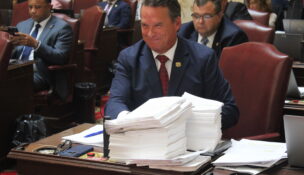
“We didn’t know how deep the problem was,” said Sen. Clarence Lam, chair of the legislature’s joint Audit and Evaluation Committee, which requested the report be conducted. “We have a long way to go to address this problem.”
The report evaluated state-funded prevention and services for problem gambling and the Maryland Center of Excellence on Problem Gambling, which the state established about a decade ago to help those with a gambling disorder. The center is part of the University of Maryland School of Medicine and funded by the Maryland Department of Health.
While Maryland has spent more on problem gambling than most states, it trailed Massachusetts, which experts in the field point to as the standard for publicly funded problem gambling programs.
While Maryland spent $0.82 per resident two fiscal years ago, Massachusetts spent $1.43, according to the National Council on Problem Gambling.
The amount of money spent on gambling in each state was similar, but the total amount of public funding for problem gambling services in Massachusetts was about 2.5 times the amount in Maryland.
With Maryland’s implementation of legal sports betting in 2021, the convenience of mobile gambling, and the prospect of state lawmakers soon legalizing iGaming, the push for help is expected to grow.
Mary Drexler, program director at The Maryland Center of Excellence on Problem Gambling, said the report didn’t capture the effect that mobile sports betting, in particular, is expected to have on problem gambling, especially among young people.
She said the center is conducting a report to document the impact of mobile and online sports betting, but it won’t be out until 2025.
“By then, iGaming will probably be in place,” Drexler said.
Among the report’s recommendations is one stating the state government should diversify the types of gambling that contribute money to the problem gambling fund.
The fund, which received an average of $4.7 million annually the last few years, pays for a 24-hour helpline, an outreach program that includes a voluntary exclusion list, and treatment and prevention programs offered for free or at a reduced cost.
Lawmakers shied away last session from a proposal to contribute 1% of state proceeds from sports wagering to the problem gambling fund because it would have redirected money from the Blueprint for Maryland’s Future, which increases funding for schools by $3.8 billion each year over the course of a decade.
Lawmakers and advocates said that next legislative session they plan to find another way to direct more revenue to the fund, but they don’t yet know how.
“We’re still looking into it,” Drexler said. “Is there another approach? At this point, I don’t know.
“We’re hoping legislators take a good look at this,” she said.
One of the lawmakers leading the proposal said next year’s bill won’t be identical to the one that failed.
“I definitely don’t want to do anything that will take money from the Blueprint,” said Del. Nick Allen, a Baltimore County Democrat.
Each sportsbook contributes 15% of its taxable win to a state fund for the Blueprint. In more than a year and a half, sportsbooks have generated $28 million for the education plan.
Under Allen’s proposal, the state would have diverted about $480,000 from the Blueprint fund to the problem gambling fund this fiscal year, which began July 1. In four years, the amount would have been about $850,000.
While a funding stream for problem gambling was part of the legalization of slot machines and table games at the state’s six casinos, lawmakers left it out when implementing sports wagering.
Instead, lawmakers directed money from expired prizes to the problem gambling fund. But mobile wagering, which comprises most sports bets, automatically pays out winners.
The National Council on Problem Gambling recommends that state direct revenue from each type of gambling to a problem gambling fund to keep pace with need.
While slot machines and table games contribute annual fees to problem gambling, lottery gambling, racetracks, fantasy sports betting and bingo gambling do not.
But, Lam said, subtracting revenue from long-established pillars in these industries, like Pimlico Race Course, home to the Preakness Stakes and part of thoroughbred racing’s Triple Crown, could present a challenge.