Sign In
 Free Newsletter


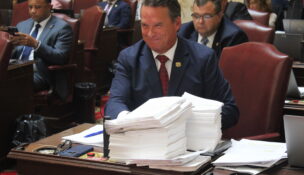
Del. C.T. Wilson, a Charles County Democrat, said judges should be able to take the bench knowing their children are safe and that nothing they do will jeopardize their children's safety. (AP Photo/File)
Md. lawmakers consider letting judges’ children attend neighboring schools


ANNAPOLIS — State lawmakers are considering whether to allow judges to send their children to public schools outside the jurisdiction in which they live.
Proponents say the measure would both protect children from harm and maintain the judicial system’s integrity by limiting opportunities for intimidation.
House Economic Matters Committee Chair C.T. Wilson, who’s sponsoring the proposal, said judges should be able to take the bench knowing their children are safe and that nothing they do will jeopardize their children’s safety.
“This is something that several of my friends in the judiciary asked me to just bring up because they’re fearful for the lives of their children. Especially those who do juvenile cases,” Wilson said during a House Ways and Means Committee hearing Wednesday.
A spokesperson for the Maryland Judiciary declined to comment.
Lawmakers this session have also advanced a proposal to increase privacy for judges and their families, an issue that took on new urgency after Washington County Circuit Judge Andrew Wilkinson was shot to death outside his home in October.
Wilkinson had just granted the wife of the accused shooter, Pedro Argote, a divorce and full custody of the couple’s four children. After the killing, a week-long search for Argote ensued, and law enforcement officers eventually found the suspect’s body in a wooded area near Maryland’s border with West Virginia.
Beyond ensuring the physical safety of judges’ children, Wilson said, protecting judges’ families from harm or intimidation is key to maintaining public trust in the judicial system and in judges’ ability to make rulings free from influence outside the courtroom.
The proposed policy would allow Maryland’s roughly 320 judges, including from the state’s Supreme Court, Appellate Court, District Court and Circuit Court to — free of any fees — send their children to a public school in a county adjacent to the one in which they live.
It’s likely that just a fraction of the state’s judges have school-aged children who might take advantage of the proposed policy.
Students generally have to attend public school in the county where they live, and parents or guardians who violate the law may have to pay a fee based on how long their child attended school in the wrong jurisdiction, according to the Department of Legislative Services.
Local boards of education can allow students to attend a school outside the jurisdiction where they live under certain circumstances, including because of hardship, child care needs, to relieve classroom overcrowding or for access to certain programs.
State law requires that school systems arrange transportation to and from school for all public school students. Wilson said that, under his proposal, judges and their families would be responsible for getting their children to and from school if they attend outside their home county.
The bill wouldn’t apply to elected office holders, though Wilson, who has represented Charles County in the House of Delegates since 2011, said the issue is personal to him.
“My children went through the public school system, and everybody knew who their father was,” he said. “It seems cool, but it’s also a burden.”
Judges, he said, may adjudicate criminal cases in the same county in which their children attend school. In cases of juvenile crime, a judge’s children may be at school with witnesses, victims and defendants in a matter they’re overseeing.
Cashenna Cross, the mayor of Glenarden, a city of roughly 6,400 people in Prince George’s County, called for lawmakers to extend the option to all public officials.
“As a mayor, my children have been bullied just because of some of the policy positions that I take,” Cross said during virtual testimony Wednesday.
Wilson, though, said that public officials should “have to live within the laws that we create” and that judges, who are appointed for set terms, don’t have many of the same obligations that elected office holders do.
It would also extend the policy to an “immense” number of people, said state Del. Eric Ebersole, a Baltimore County Democrat and chair of a subcommittee on education.