Sign In
 Free Newsletter

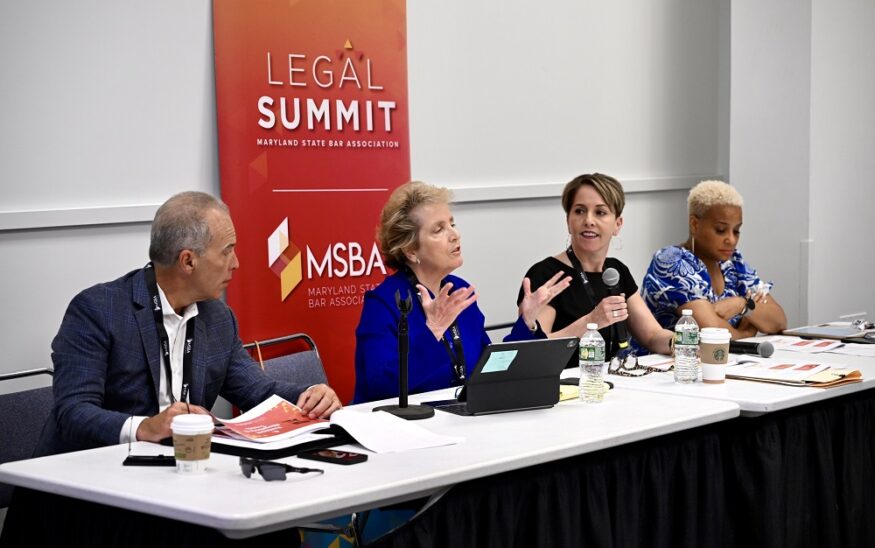
From left, Hon. Mark Chandlee, Hon. Anne Albright, Tanya Bernstein and Kendra Jolivet present "Top 10 Things to Know about Judicial Ethics" during the Maryland State Bar Association's Legal Summit on June 6, 2024 in Ocean City. (Maximilian Franz/MSBA)
What do judges need to know about ethics? MD disciplinary commission weighs in


OCEAN CITY — Members and staff of the Maryland Commission on Judicial Disabilities highlighted on Thursday the top items that attorneys seeking to become judges — and judges themselves — need to know about judicial ethics.
Beyond the governing laws that apply to Maryland judges and judicial candidates, judges and judicial prospects must also remember who the rules apply to, Judge Anne Albright, chair of the Maryland Commission on Judicial Disabilities, said during a discussion about judicial ethics at the Maryland State Bar Association’s legal summit.
Albright said the state’s disciplinary authority and judicial conduct code apply not only to sitting judges, but also to senior judges on recall and to judicial applicants.
“What this means is if you may have done something that may be sanctionable prior to becoming a judge, if you then become a judge, that conduct is something … that [the Commission] may look at when there’s a complaint when you become a judge,” Albright said, noting these rules apply to conduct both inside and outside the courtroom.
One of the goals of the state’s judiciary is to appear unbiased, impartial and fair, said Judge Mark Chandlee, chair of the board for the commission, noting that some of the most frequent allegations against judges criticize the bench’s demeanor or allege bias or partiality.
RELATED: Using AI in law practice: Legal, legislative experts discuss considerations and concerns
If the commission determines an investigation into a judge’s conduct is warranted, it will review hours of courtroom recordings, much like an NFL play review, Chandlee said.
“Judges certainly have body language that’s reviewed, and it can impact litigants who are before the court,” Chandlee said.
Tanya Bernstein, director and investigative counsel for the commission, said she performs the first threshold review of a complaint, where the commission has the option to dismiss a complaint without conducting an investigation. This could occur where a complaint is submitted about a judge’s decision but does not allege the occurrence of any sanctionable conduct, Bernstein said.
“We are not an appellate court, so we do not review legal decisions — unless, of course, there’s some sort of additional allegation,” Bernstein said of the commission’s jurisdiction.
Bernstein also noted that judges will not necessarily be notified of complaints or the existence of an investigation into their conduct, unless the judge has opted in to receive notice or in other circumstances where notification is warranted.
RELATED: Incoming MSBA president seeks to grow membership, promote inclusivity
Throughout the investigative and judicial disciplinary process, confidentiality is important to the commission, said Kendra Jolivet, executive counsel for the commission.
In addition to protecting against the misuse of information that may reach the public, Jolivet said maintaining confidentiality also helps in the cooperation of potential witnesses, where some individuals are reluctant to cooperate with investigative counsel out of a fear of facing retaliation or intimidation from the judge or staff.
Safety is also a goal of the commission, Albright said, noting the judiciary has formed a judicial threat management unit to manage and track threats directed toward the judiciary.
Just last year, a father who lost custody of his children fatally shot Washington County Circuit Judge Andrew Wilkinson outside his home.
Above all, Albright said the commission aims to improve Maryland’s judiciary.
“What we typically find is that when we bring [a complaint] to the judge’s attention, really the vast majority of the time they are interested in improving, acknowledging the behavior, and learning how to get better and how to avoid the behavior in the future,” Albright said.
Chandlee said it’s not the crime, but the coverup and judges’ refusal to cooperate with investigative counsel that is sometimes more damaging than the alleged conduct.
In addition to a lack of cooperation, Chandlee said the commission has experienced a current trend of complaints involving judges’ social media activity, political activity and “off the bench” behavior, as well as litigation against the commission.
After removal from the bench following a commission investigation and hearing, former Prince George’s County circuit Judge April T. Ademiluyi filed a federal lawsuit against the commission.