Sign In
Upcoming Event
 Free Newsletter

Supreme Court grapples with ‘geofence’ warrants in crime probes

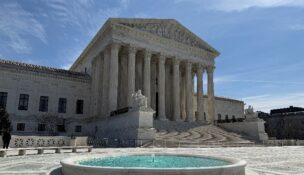
A view of the U.S. Supreme Court in Washington, July 1, 2024. (REUTERS/Kevin Mohatt/File Photo)
Supreme Court grapples with ‘geofence’ warrants in crime probes


 Listen to this article
Key takeaways:
- Supreme Court hears appeal by defendant Okello Chatrie
- Geofence warrant used location data from Google near crime scene
- Justice Samuel Alito supports law enforcement use of data
- Justice Neil Gorsuch questions scope of geofence warrants
WASHINGTON – The U.S. Supreme Court wrestled on Monday with the question of whether law enforcement’s use of a “geofence” warrant to nab data from cellphones near the scene of a Virginia armed robbery violated the U.S. Constitution‘s Fourth Amendment bar on unreasonable searches.
Court-approved geofence warrants compel third-party companies – such as Alphabet’s Google in the case now before the justices – to search customer location data for mobile devices that were near a crime scene.
The justices heard arguments in an appeal by defendant Okello Chatrie, who conditionally pleaded guilty in 2022 to robbing a Midlothian, Virginia credit union while reserving his right to make his case for suppressing evidence gleaned from what he argues was an illegal search.
Authorities in Chatrie’s case had exhausted all other leads when they sought a court-approved geofence warrant based on footage of the robber using a cellphone at the credit union. President Donald Trump’s administration defended the investigative method that helped secure Chatrie’s sentence of nearly 12 years in prison for brandishing a gun and making off with $195,000.
Investigators are typically handed an anonymized list to start with, before it is narrowed down in a multistep process culminating with a company providing account holder information to police for potential leads on suspects.
During arguments, the justices posed sharp questions to lawyers representing Chatrie and the Trump administration.
The dispute highlights tensions between an 18th century constitutional provision that safeguards the “right of the people to be secure in their persons, houses, papers and effects, against unreasonable searches and seizures” and digital-age technology that is transforming how crime is investigated.
Location history
Google location data placed Chatrie at the crime scene along with 18 other users who, like Chatrie, had opted in to the company’s “location history” feature and were within a 150-meter radius of the credit union within a one-hour window of the May 2019 robbery. Google is not a party to the case.
During a subsequent investigation of residences linked to Chatrie, authorities discovered what the prosecution described as two “robbery-style demand notes” in his bedroom, a pistol and nearly $100,000 that included bills wrapped in bands signed by the credit union teller who was targeted in the robbery.
Adam Unikowsky, a lawyer for Chatrie, argued that geofencing amounts to an overly broad search that exposes mass amounts of private information to the government and lacks the specificity required by the Fourth Amendment.
Conservative Justice Samuel Alito appeared to side strongly with the actions of law enforcement in this case, emphasizing that the location data feature had to be activated by users themselves.
“It’s a question of turning it on, and according to the government, your client had to go through multiple steps in order to turn it on,” Alito told Unikowsky. “So he voluntarily disclosed to Google the information about where he was going to be.”
Conservative Chief Justice John Roberts noted that the feature can be turned off, comparing it to closing the shades on one’s windows.
“You don’t have to have that feature on your phone. So what’s the issue?” Roberts asked.
Unikowsky said smartphone users should not have to deactivate the location service in order to avoid government surveillance.
“I think that one should be permitted to hand over data to a third party without assuming the government is going to look at it,” Unikowsky said. “Geofence warrants mostly ensnare innocent people,” Unikowsky added.
A hypothetical stolen necklace
Eric Feigin, a Justice Department lawyer, contended that Chatrie’s opting in to Google’s location history stripped him of any expectation that his data would remain private.
Conservative Justice Neil Gorsuch expressed skepticism over the validity of the warrant. Gorsuch challenged Feigin to comment on whether the government could search all the rooms in a hotel for a gun, or all of the storage units in a storage facility for particular contraband, or all the safe deposit boxes at a bank for a hypothetical stolen pearl necklace.
“What’s the difference between those cases and this case?” Gorsuch asked.
The Supreme Court in 2018 imposed limits on the ability of police to obtain cellphone data pinpointing the past location of criminal suspects.
Virginia-based U.S. District Judge Mary Lauck found that the geofence warrant used in Chatrie’s case violated the Fourth Amendment but denied his evidence suppression request. The Richmond-based Fourth U.S. Circuit Court of Appeals affirmed Lauck’s decision.
In Chatrie’s case, the justices agreed to decide whether geofence warrants are unconstitutional but declined to hear his evidence-exclusion claim. If Chatrie wins the constitutional argument, his case would likely be returned to the district court for further proceedings.
The Supreme Court is expected to rule by around the end of June.
Reporting by John Kruzel; editing by Will Dunham.