Sign In
 Free Newsletter

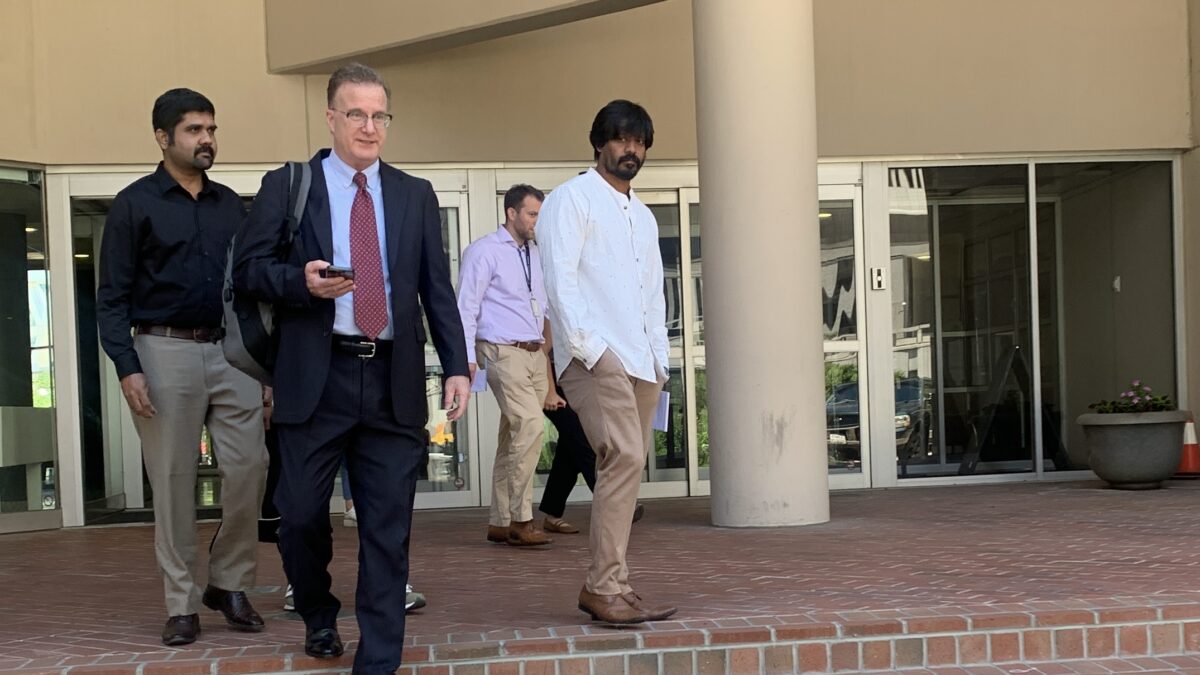
With his clients following behind, Shaun Clarke, an attorney representing seafarers from two ships managed by the same firm as the Dali, leaves the U.S. District Court for Maryland's courthouse in Baltimore following a scheduling hearing. His clients, as well as several of the Dali's crewmembers, have been bound by a security agreement with federal authorities since the March 26, 2024, bridge collapse. (Dan Belson/The Daily Record)
Key Bridge criminal case going to trial in fall 2027


A judge ruled Tuesday that the criminal conspiracy case against the manager of the ship that crashed into Baltimore‘s Francis Scott Key Bridge will go to trial in more than a year.
The criminal trial, which federal prosecutors have described as possibly the most complex case that Department of Justice attorneys have handled in Maryland, is now scheduled to commence Oct. 4, 2027, set to continue through late November, U.S. District Judge James K. Bredar ruled.
In setting the trial for late 2027, Bredar rejected arguments by attorneys for Synergy Marine Group — the Dali’s manager and the main defendants in the criminal case — who sought the conspiracy case to be tried much sooner. They aimed for a trial commencing closer to the start of the new year, arguing that over a dozen foreign seafarers from the Dali cargo ship and its two sister vessels have already spent more than two years bound by a security agreement that largely keeps them on U.S. soil.
Most of the 14 remaining crewmembers from the Synergy-managed ships have left Maryland for travel at least once since the March 26, 2024, collapse that killed six men, but a handful have not, and all are bound by the security agreement.
The crewmembers can request federal approval of travel plans, but because some could be called as witnesses, the government can seek a material witness warrant and obtain a deposition if they object to any travel, according to a letter filed by prosecutors. Although attorneys and federal officials have mentioned the agreement throughout the past two years of litigation, most of its contents didn’t become public until Monday, when prosecutors filed it on the public docket.
Synergy attorneys argued in a court filing that the seafarers “have been required to be away from their children, wives, parents, and other loved ones for extraordinarily long periods of time as a direct result of the agreements and to facilitate” the criminal investigation. They also argued that the criminal case shouldn’t be dragged out until next fall because the now-paused civil litigation over the collapse “involved the same exact facts.”
“While some seafarers have been permitted to return home briefly, [the 14 crewmembers] have otherwise been isolated from everything they know – they have been living in hotels in a foreign country unable to work; their skill sets are dwindling; and their livelihoods are in danger,” attorneys for Synergy wrote.
Key Bridge: Everything you need to know
Assistant U.S. Attorney Matthew Phelps argued that because the defense held firm to the request for a speedy trial, travel requests for five crewmembers who sought to travel after the indictment was unsealed wouldn’t be approved because “we’d be going to trial” in just a few months.
Although the government would be able to obtain depositions from material witnesses, Phelps said prosecutors aim to get “as many witnesses at trial, in the witness box as possible.”
In court, Bredar brushed off arguments by Synergy regarding the crewmembers, instead noting that the seafarers had their own attorneys separate from their employer who could file a motion in their interests.
Attorneys representing all 14 crewmembers were in the courtroom, according to Synergy attorney Kierstan Lee Carlson, though Bredar did not ask to hear from them. One of the lawyers, Shaun Clarke, declined to comment outside the courthouse.
The sprawling case accuses Synergy of concealing potential onboard hazards, presenting misleading compliance paperwork to Coast Guard officials, and making false statements to federal investigators after the crash. The charges largely stem from the maritime firm’s use of fuel-flushing pumps, rather than an approved fuel supply, to feed generators aboard the Dali, a maneuver that National Transportation Safety Board investigators said prevented the cargo ship from regaining power and steering before it hit a bridge support column.
The indictment also includes charges against a shoreside Synergy employee who remains in India. A second employee, the Dali’s chief engineer, was charged Monday afternoon, though the Justice Department said he had entered a deferred prosecution agreement.
Phelps said Tuesday that the Justice Department had already provided over two terabytes of discovery to the defense, though they would have to now work out how to provide data from “in excess of 100” electronic devices seized from the ships during the criminal investigation. He told Bredar that although Synergy’s lawyers have already seen some evidence due to the civil litigation over the collapse, the discovery materials in the criminal case are “a mixed bag” that included evidence subpoenaed by a grand jury.
Bredar said that when scheduling large, sprawling cases, he prefers to provide an ample amount of time and “essentially set the schedule in stone” to reduce the drain caused by repeat trial postponements. He said he held the same philosophy with the civil case, which had long been set to begin this month but was indefinitely paused on the first day of trial.