Sign In
 Free Newsletter

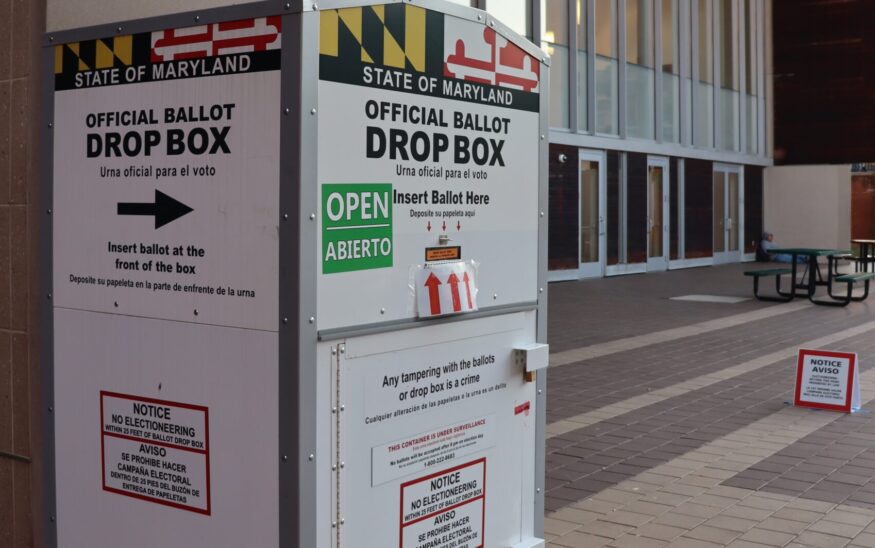
A mail-in ballot drop box outside of the Civic Building in Silver Spring during early voting for the 2024 general election. (Caley Fox Shannon/Capital News Service)
Primary election: MD requests 77K more mail-in ballots than in 2022


 Listen to this article
As state officials deal with the fallout of a mistake with mail-in ballots, Marylanders requested far more of them for Tuesday’s primary election than they did in 2022, state data shows.
The Maryland State Board of Elections reports that 442,705 mail-in ballot requests were submitted for the July 19, 2022, primary election, compared to 519,823 this year.
As of Friday, the latest data available, 44,144, or about 8.5%, of the mail-in ballots have been returned.
Marylanders likely won’t know the full extent of this year’s mail-in voting base until July. In total, 345,230, or 78%, of the 2022 mail-in ballots were returned.
The 519,823 mail-in ballot requests from this year don’t include the replacement ones that had to be sent out after the state’s mail-in ballot vendor, Taylor Print & Visual Impressions Inc., underwent an error, causing some Maryland voters to receive the wrong party ballot for the primary election.
At the cost of the contractor, the state elections board sent a new batch of mail-in ballots — at least 447,000 — to voters who might have received incorrect ballots initially. The board requested that the original mail-in ballots be destroyed and that voters send in their replacement ballots to be counted.
Although the snafu could shake the confidence of some voters, Flavio Hickel Jr., a professor of political science at Washington College, said he’s unsure if “this particular event is going to herald a big change.” But Maryland could see a decline in mail-in voting in future elections, he said.
“Even in 2022, the conspiracies about mail-in voting that were initiated by [President Donald] Trump, those had already kind of taken hold,” Hickel said. ”I don’t know that you have new people who are growing concerned about it since then.”
In mid-May, Trump posted to social media that “Maryland just had 500,000 Fake Mail-In Ballots revealed” as a way to advocate for stronger voting restrictions.
In response, Maryland Elections Administrator Jared DeMarinis posted that “NO Fake Mail-in ballots were distributed” and that the language used by the president seeks to “mislead, sow distrust and create misinformation.”
Mail-in ballots for 2026 can still be submitted to drop boxes, early voting centers, local boards of elections or through the mail as long as they are postmarked by June 23. Mail-in ballots can also be submitted at polling places on Election Day.
In-person polling places will be open across the state from 7 a.m. to 8 p.m. Tuesday.
“Whether voting in person or returning a mail-in ballot, June 23 is the final day to cast your vote in the primary election,” DeMarinis said in a statement Monday. “Make a plan to show up, vote, and shape Maryland’s future.”
Voters can determine that they are using the replacement ballots after the mistake through lettering on their return envelopes that reads “Replacement Ballot Inside.” The envelopes of the original envelopes simply read “Return Envelope.” If returned, original ballots will not be considered for canvass until 10 a.m. on July 6.
Protocol was approved at a mid-June emergency meeting of the elections board to determine how local elections boards should handle mail-in ballot canvassing if voters submit only their original ballots or both their original and replacement ballots, or if a mail-in ballot is returned but a voter chooses to also submit a provisional ballot at the polls.
According to a document from the June 9 meeting, original mail-ins have been voided in the state’s voter registration system if a voter also received a replacement ballot. This will prohibit the original from being marked as received when the barcode on the return envelope is scanned, ensuring only one vote will be counted. Local elections boards will then separate the original ballots from any replacement ballots that are returned.
If voters return both the original and replacement, the replacement is the only one that will be counted. If only the original mail-in ballot is returned, it will be counted if canvassers determine that it coincides with the voter’s party affiliation.
Should voters submit the wrong party ballot, only their selections in nonpartisan races will be duplicated on a new ballot and will be counted. If there are no nonpartisan races on the ballot, those ballots will be thrown out.
In Maryland, the only nonpartisan races are for membership of boards of education.
If voters return their original ballots and also vote with a provisional ballot, the provisional ballot will be counted. If a replacement ballot is returned and a voter still chooses to vote provisionally at a polling location, the first legally sufficient ballot is the one that will be counted.