Sign In
 Free Newsletter

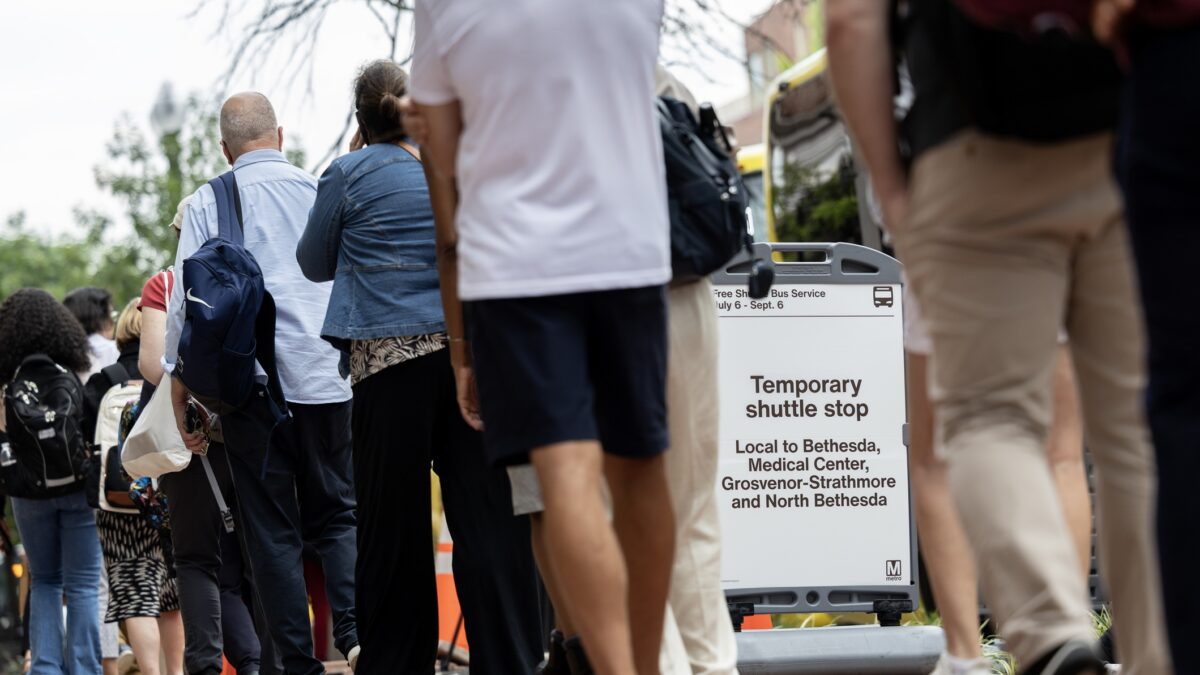
Commuters wait in line July 7, 2026, for shuttle buses outside the Friendship Heights station. (Christine Kao/The Washington Post)
DC Metro’s Red Line commuters face a summer slog amid station shutdowns


Key takeaways:
- Three Red Line stations closed for mezzanine and track work
- Metro operates 145 shuttles during peak hours with 3-5 minute intervals
- Shuttle travel time up to 26 minutes versus 10 minutes by train
- MARC offers discounted fares during Red Line closure
They had coffees in their hands and grimaces on their faces. Such is life for many Washington commuters this summer.
For the next two months, longer travel times will be the norm for tens of thousands of Red Line commuters due to construction that has shut down three stations on Washington’s oldest Metro line.
Monday was the first day of the inconvenience, and that afternoon’s commute brought lines that stretched down the block in Friendship Heights as people waited for free shuttles to take them to North Bethesda station. Until Sept. 6, Metro trains will not run between the two stations, a length that spans about six miles.
By Tuesday evening, the lines didn’t appear as long, but as many as 100 people at a time waited on the sidewalk outside Trader Joe’s to board shuttles. Almost as soon as one horde was whisked away, a new one took its place. Commuters said they were concerned about the hassle of switching from Metro to bus and back to Metro – plus longer travel times.
That morning, commuters at North Bethesda station were still getting the hang of their new trek to work.
“I’m nervous about how long it’s going to take,” said Kyoko Miki, a research analyst who works in D.C. “I’m hoping just 30 extra minutes.”
Grosvenor-Strathmore, Medical Center and Bethesda stations are closed for mezzanine construction and track work, according to the Washington Metropolitan Area Transit Agency. Construction at Bethesda station will also integrate the belated Purple Line into the Red Line. Metro could not single-track during construction due to the scale of the work, a transit agency spokesperson said.
The transit agency said it has about 145 shuttles operating during peak times, with shuttles arriving every 3 to 5 minutes during Metro Rail operating hours.
The express shuttle at North Bethesda takes about 26 minutes to get to Friendship Heights, WMATA said. It would take about 10 minutes on the Metro.
Meanwhile, the local shuttle will stop at North Bethesda, Grosvenor-Strathmore, Medical Center, Bethesda, and Friendship Heights, with an estimated travel time of 10 minutes between each station, according to WMATA.
Customers will tap in and out at each Metro station, but they will only pay for one trip as long as they use the same payment method, the agency spokesperson said. They added that Metro moved about 15,000 people on shuttle buses Monday.
When a wave of commuters exited the North Bethesda station Tuesday morning, the lines for buses stretched dozens of people long, but they boarded within minutes and continued their trip.
Nick Morello said he uses the Red Line every day to travel from Northern Virginia to Maryland for his job. On a normal day, Morello said his commute lasts about 75 minutes, but he expects the shuttles to extend his commute to about two hours.
Morello, who works in the legal field, said he thought Metro workers were doing the best they could to make the shuttles run smoothly. “I’m not upset at them. I’m just upset with the commute time,” he said. “That’s what really irks me.”
Ava Jones said the shuttle lines were better in the morning than in the afternoon. On Monday evening, Jones said she waited at least 15 minutes for a shuttle to take her from Friendship Heights to North Bethesda station. “Trying to get home was a disaster,” the 42-year-old said.
In Friendship Heights on Tuesday evening, the nonprofit Friendship Heights Alliance had set up a table by the shuttles, offering free sunscreen and water to commuters.
“We knew that this would be rough for some people, so we want to make it as nice as we can,” said Rachel Davis, the group’s marketing director. The group is also offering recommendations for restaurants and bars in the neighborhood. “Now that you’re coming here, you might as well explore,” Davis said.
Shannon Greene commutes from West Virginia to work at a law firm in D.C., so she said the construction is making her long commute even longer. On Tuesday, shortly before 5 p.m., she said she hoped to get home by 8:30 p.m.
Andrew Atkinson commutes every day from Gaithersburg to D.C. for his job at the U.S. Navy. What was an hour-long commute is now a little over 90 minutes, he said.
“This is a nightmare,” he said while waiting to board a shuttle. “I’m hoping that they can figure something else out and tweak it a bit.”
The WMATA spokesperson said the agency was working on adjustments to the routing and number of buses to help address afternoon lines.
“In past shutdown experiences, shuttle operations improved over time as operators and customers got accustomed to a new routine,” the spokesperson said in a statement. “Customers will likely experience lines as buses do not have the same capacity as trains.”
Some commuters said they’re thinking about alternative modes of transportation.
Tim Fennell, who commutes from the Flower Hill area of Maryland into D.C., said he understood that the shuttles were necessary. “Worst-case scenario, I might start riding the MARC,” the 42-year-old said, referring to the Maryland Area Rail Commuter.
During the Red Line closure, MARC Train is offering discounted fares from Rockville and Garrett Park to Silver Spring and Union Station. Capital Bikeshare, meanwhile, is offering Montgomery County residents a free 30-day membership.
To get to her job at a vitamin shop in Bethesda, Natalie Cogan said she typically rides the Red Line from Rockville to Medical Center, and then takes a bus. Cogan said she appreciated that the shuttles ran frequently, but she wasn’t sure that she wanted to deal with them every day for the next couple months.
“I’m probably going to fix my scooter,” she said.
Liam Scott is a reporter on the Metro desk covering transportation and breaking news.