Sign In
 Free Newsletter

Douglass, Tubman take their place of honor in the Md. State House


ANNAPOLIS — Bronze statues of two Maryland-born former slaves and leaders of the abolition movement Monday night joined a bronze likeness of George Washington in the Maryland State House.
The statues of Harriet Tubman and Frederick Douglass take their places within the historic Old House Chamber as part of an permanent interpretive history display designed to bring attention to their roles in freeing slaves and ending the practice of slavery in the United States.
Chris Haley, director of the Maryland State Archives Study of the Legacy of Slavery in Maryland, said the goal is to give people a sense “of inclusivity here in Maryland. So much about the Maryland State House is about the most important people to the history of this state. Two of the most important people to the history of this state as well as to African Americans nationwide are Frederick Douglass and Harriett Tubman, who are native-born to Maryland.”
Elaine Rice Bachmann, deputy state archivist, said the event is meant to help people think differently about emancipation in Maryland.
“We realize what we are depicting is an imagined event,” said Bachmann. “What we are hoping is that visitors encountering them in this space will think about what it would have meant to (Douglass and Tubman) to have emancipation come to their home state.”
Monday night’s event before a joint session of the Maryland General Assembly is one of two programs commemorating the statues. A second program, open to the public, is scheduled for 10 a.m to 2 p.m. Saturday and will include a first-person interpretation of Tubman as well as Ken Morris, the great, great, great grandson of Douglass and a descendant of Booker T. Washington.
Bringing the statues to the chamber is the end of a process that began in 2016 after a proposal from then House Speaker Michael Busch and then-Senate President Thomas V. Mike Miller Jr. The addition of the statues began a year earlier than the removal of a statue of Roger B. Taney, the Supreme Court justice who authored the 1857 Dred Scott decision that denied citizenship to African Americans and declared slaves were property and not people.
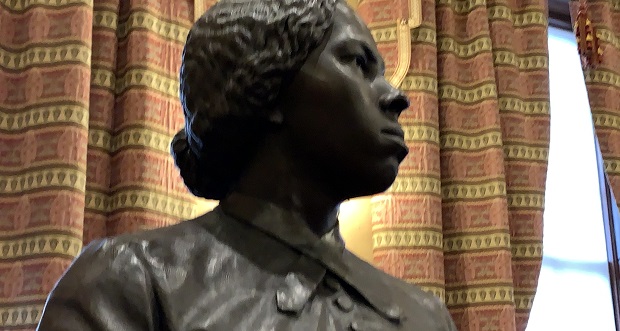
Bachmann said the statues, which are life-sized and historically accurate based on photographs and historical descriptions, were meant to give “a pose and a feeling of encountering these two individuals in this room” on Nov. 1, 1864 — the day the state legislature ratified the abolition of slavery. The chamber was restored several years ago to look as historians believe it appeared in the 19th century.
The vote was needed in Maryland because the Emancipation Proclamation only applied to secessionist states, said Bachmann.
“Now with these figures, we will really be able to focus on the most significant event to occur here, which was the abolition of slavery,” she said.
Historically, Douglass and Tubman were not present on that date. At the time, both would have been considered fugitive slaves in Maryland.
In 1864, Douglass and Tubman were living different lives while battling slavery.
Douglass, at 46, had been living as a free man for 26 years after escaping slavery in Baltimore. He traveled through the north and in England and Scotland, advocating not only for the end of slavery but also for women’s suffrage. He did not set foot in his home state of Maryland until Nov. 17, 1864 — 16 days after the end of slavery in Maryland — when he delivered a speech at Bethel AME Church.
Tubman, then 42, was considered a fugitive after she escaped slavery in 1849 and fled to Philadelphia. She continually returned to Maryland to assist others in escaping slavery to freedom. Though she could not read or write, her knowledge of the terrain in slave states was invaluable to Union soldiers.
During one mission in South Carolina, she was credited with freeing up to 750 slaves.
Douglass did visit the state capitol building in 1874. Currently, it is not believed that Tubman ever visited the State House, but state historians said evidence of Douglass’ visit, a newspaper account, were only recently discovered.
“Much like all of slavery’s history, we’re constantly learning about individuals,” said Maya Davis, a research archivist with the Study of the Legacy of Slavery in Maryland.
The statue of Douglass, standing over 6 feet tall, is oriented to face slightly out of the chamber looking into the hallway. He is holding a copy of his newspaper, the Douglass Monthly, from 1864. An article in that newspaper was titled “The Sentiment for Emancipation in Maryland.”
“Douglass was really monitoring what was happening in his own state,” said Bachmann.
The hands of the statue were modeled on the hands of Morris, his descendant.
Tubman, 4-feet 11-inches, faces toward the front of the chamber.
The statues were created by Brooklyn New York-based StudioEIS, the same company that created the life-size statue of George Washington. That statue is placed inside the historic old Senate Chamber as part of an exhibit commemorating Washington’s appearance before the Continental Congress, where he resigned as head of the Continental Army.
Bachmann said it was very important to place the statues in the historic House chamber in a way that the public could interact with them in the same way they can with Washington. But placing them required additional work to build supports in the floor of the 250-year-old chamber to support the two statues, which weigh in at about 500 pounds each.
The statues become the latest to enshrine African Americans in the oldest state capitol building in continuous legislative use. At one time, only one African American was honored inside the State House — a plaque recognizing Matthew Henson, a Charles County native who was the first African American to reach the North Pole. That plaque was put up in 1961.
A statue of Supreme Court Justice Thurgood Marshall stood in Lawyers Mall outside the State House until it was temporarily removed in 2018 as part of a project to replace aging and damaged steam pipes. The statue was relocated to the front of the nearby Robert C. Murphy Courts of Appeal building. It is currently expected that the Marshall statue will be returned to the mall following the completion of the work.
The State House now features portraits of prominent African-American legislators.
A portrait of Sen. Clarence Blount, a Democrat who became the first African American to become Senate Majority leader, is on the wall.
A portrait of Sen. Verda Welcome, another Democrat, was placed on the back wall of the Senate chamber on the same night as one of Miller, the longtime Senate leader. Welcome was the first African-American woman elected to the Maryland Senate.