Sign In
 Free Newsletter


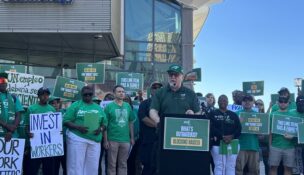
Del. Jheanelle Wilkins, chair of the nation’s largest Legislative Black Caucus and sponsor of the bill, said that formerly incarcerated people eligible to vote shouldn’t face barriers to registering when they’re released. (The Daily Record/Jack Hogan)
Automatic voter registration for released prisoners stalled in MD Senate


Despite passing in the House of Delegates, a push for Maryland to become just the second state to include automatic voter registration in the prison release process stalled in the state Senate.
Proponents, including Del. Jheanelle Wilkins, chair of the nation’s largest Legislative Black Caucus and sponsor of the bill that passed along party lines in the House, have said that formerly incarcerated people eligible to vote shouldn’t face barriers to registering when they’re released.
“It’s a pretty common-sense provision,” Wilkins said in a phone interview. “I’m not sure why the Senate didn’t bring it up.”
The proposal didn’t appear during the legislative session that ended April 8 to face any organized public pushback in Annapolis, where Democrats hold a supermajority in both chambers.
Michigan Democratic Gov. Gretchen Whitmer last year signed a bill to expand her state’s automatic voter registration system to include the corrections department. The law takes effect in 2025, though the department has been working with the secretary of state to register returning citizens since 2020, according to an NPR report.
Organizations that have advocated for the policy change in Maryland, which includes the option to opt out of being registered, this week called out senators for letting “politics get in the way” of registering returning eligible voters, some of whom may not know their voting rights have been restored.
“Voting is a fundamental human right in America, not a privilege for a select group of citizens,” Nicole D. Porter, the senior director of advocacy at The Sentencing Project, a Washington, D.C.-based nonprofit, said in a statement.
“It is a shame that Maryland lawmakers chose not to advance this legislation, which would both make our democracy more representative and make our communities safer by promoting community involvement and integration,” Porter said.
Joanne Antoine, executive director of the pro-democracy organization Common Cause Maryland, said in a statement that the Senate “failed those voters, most of whom are Black, by choosing to take no action on a reform that was unopposed.”
Sen. Brian Feldman, a Montgomery County Democrat who chairs the Senate Education, Energy and the Environment Committee in which the bill stalled, could not be reached for comment by email on Friday.
Feldman’s vice chair — and fellow Montgomery County Democrat — Sen. Cheryl Kagan said in a phone interview Friday that she supported including voter registration in the release process, but that the volume of legislation the committee had this session hindered the bill’s chance.
Senate President Bill Ferguson, a Baltimore City Democrat, said multiple times during the 90-day session that his chamber faced a “crushing” volume of legislation that was sure to sideline important issues.
Returning citizens currently have to go through a waiting period between their release and when they visit the Motor Vehicle Administration for a voter registration form.
The state cancels an individual’s voter registration if they are convicted of a felony and sentenced to time in prison, according to the Office of the Attorney General.
While those who’ve completed their sentence can re-register, they may forget to do so while navigating a return to life outside of a correctional facility, a spokesperson for the attorney general wrote to lawmakers.
“When the time comes to vote, the person finds they are not registered to vote and have missed crucial deadlines that would have allowed them to vote,” Tiffany Johnson Clark, chief counsel for legislative affairs in the attorney general’s office, wrote in February.
The Motor Vehicle Administration, the Maryland Health Benefit Exchange, local departments of social services and the Mobility Certification Office in the Maryland Transit Administration use automatic voter registration in certain transactions.
Wilkins’s bill, which the delegate plans to reintroduce next session, would have required the service in the Department of Public Safety and Correctional Services, which operates 13 correctional facilities housing people incarcerated for 18 months or longer, and five sites in Baltimore for pretrial detainees and those serving sentences of 18 months or less.
The legislature in 2021 required the Department of Public Safety and Correctional Services to provide people released from correctional facilities with a voter registration application and documentation that their right to vote has been restored.
The law also requires the State Board of Elections to establish a program for informing people who are incarcerated and eligible to vote about how they can exercise their right.
An informational letter to lawmakers from the Department of Public Safety and Correctional Services stated that the department has a “robust” voter program in place and works with state and local elections boards to help people vote.
(This story has been updated to include a comment from Del. Jheanelle Wilkins.)