Sign In
 Free Newsletter


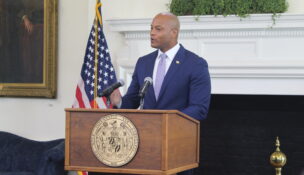
Gov. Wes Moore has maintained solid approval ratings from Maryland voters during a budget crunch, but more respondents in a new poll express misgivings about the state's future. (Daily Record file photo)
Moore maintains solid poll ratings, but murmurs of concern grow


Gov. Wes Moore has maintained a solid approval rating of 52% among Maryland voters in recent weeks, even as he and the state legislature navigate tough budget decisions and react to what they see as a democratic crisis unfolding in Washington, D.C.
But an increasing number of Marylanders also express concern that the state is headed in the wrong direction.
Support for Moore, a Democrat, is buoyed by his political base in deep-blue Maryland, according to poll results released Tuesday from the University of Maryland, Baltimore County.
Nearly 80% of Democratic voters who responded to the poll said they approve of the job Moore is doing as governor, compared to 16% of Republicans and 37% of unaffiliated or independent voters.
Mileah Kromer, a longtime Maryland pollster and director of the UMBC Institute of Politics, said Moore — who is eyeing reelection in 2026 — has a “very secure base” in a state where Democratic voters outnumber Republicans 2-1.
Moore’s approval rating decreased 2 percentage points from September, when UMBC released its last poll.
There was also a larger percentage of respondents who disapproved of the governor — 40% in February compared to 32% last September. Republicans comprise the bulk of disapproving voters.
Kromer said the trend isn’t a surprise considering the level of concern that poll respondents have had about the economy.
“The governor, although he doesn’t have the singular power to fix all the things, he is the leader of the state. So any time there is any sort of frustration with the state in general, the governor typically is going to get dinged a little bit for it,” Kromer said in a phone interview Monday.
A spokesman for the governor didn’t respond to a request for comment in time for publication.
Republican state Sen. Justin Ready, the minority whip in his chamber, said it’s also important to note whether Marylanders feel the state is heading in the right direction.
In the latest UMBC poll, 49% of respondents said the state is heading in the wrong direction. In September, 39% of respondents had that view.
With a slight decrease in approval, an increase in disapproval and nearly half of respondents saying they disagree with the state’s trajectory, Ready said the poll should serve as a warning for Moore’s agenda and an indication that his administration should pivot away from the “Maryland liberal Democrat solutions” and toward a more moderate approach of cutting “wasteful spending” without hiking taxes, among other measures.
“I would look at this as a warning that Marylanders are getting very restless with the way that the state government has positioned itself,” Ready said in a phone interview.
Maryland is facing a nearly $3 billion budget deficit for next fiscal year, which begins July 1.
Moore has said that the budget he submitted to the General Assembly includes $2 billion in proposed cuts. The governor has also proposed a sweeping tax reform plan as part of a solution to generate hundreds of millions of dollars in revenue and balance the budget.
Moore has said that his plan will deliver “tax relief to the majority of the people of this state,” and that 18% of earners will see an increase in their income tax rate, while 82% will either see a cut or no change.
The tax plan, though, also includes eliminating itemized deductions, doubling the standard deduction, eliminating the standard deduction penalty and Child Tax Credit limit, ending the inheritance tax, lowering the estate tax exemption and implementing a 1% surcharge on capital gains income.
Top Democrats in the legislature have said they won’t adopt the tax plan as Moore proposed. It remains to be seen what changes they’ll make.
Top Democrats have also said they oppose several cuts the governor and his team proposed, including freezes on grant spending levels for community schools in areas of concentrated poverty.