Sign In
 Free Newsletter

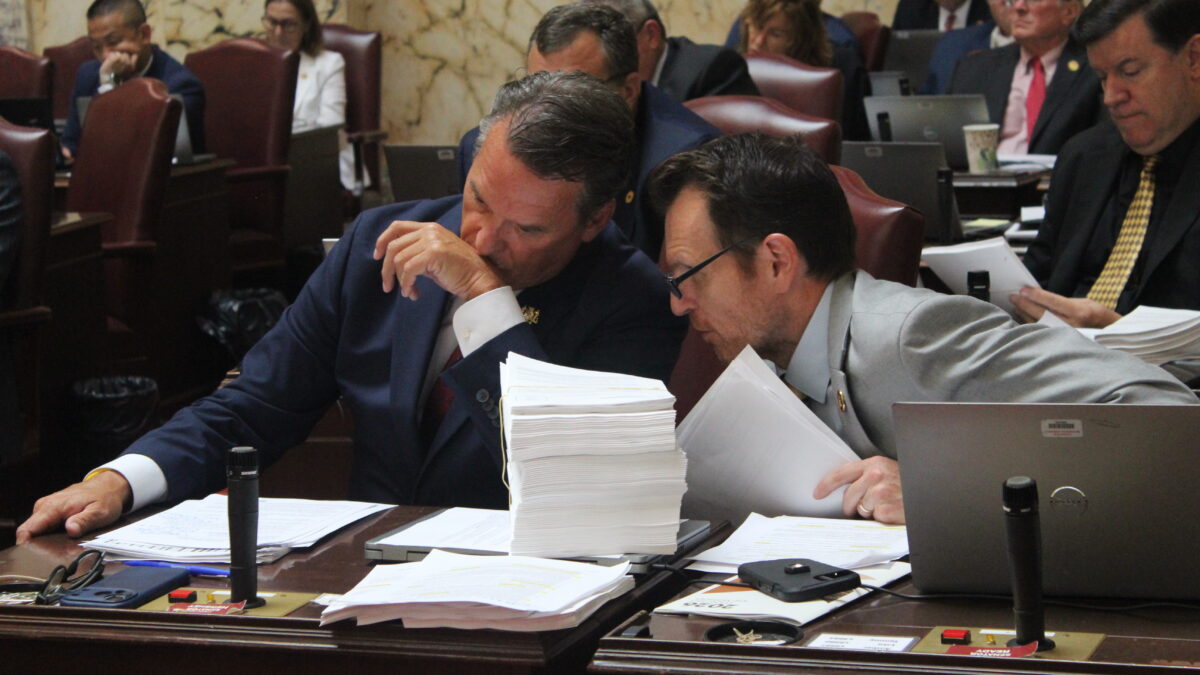
Senate Minority Leader Stephen S. Hershey Jr. and Minority Whip Justin Ready prepare amendments before debating legislation to allow voters to decide if they will alter the standards for congressional redistricting, on Aug. 4, 2026. (Hannah Gaskill/The Daily Record)
Redistricting referendum passes in MD House, Senate


Key takeaways:
- Maryland House passes redistricting ballot question Tuesday morning
- Senate passes it hours later
- Del. Thomas S. Hutchinson proposes Eastern Shore secession amendment
- House Minority Leader Jason Buckel criticizes special session purpose
ANNAPOLIS — After hours of debate, both chambers of the Maryland General Assembly approved a question for the November ballot to clarify in the state constitution the process for congressional redistricting.
The General Assembly convened for a special legislative session this week to debate the redistricting referendum. The House passed it on a vote of 96-38. In the Senate hours later, the bill passed, 32-13, with nine amendments failing to go through.
In a statement after the bill was passed, Gov. Wes Moore, a Democrat who had pushed for midcycle redistricting for nearly a year, said he believes that there needs to be federal reform in this arena, but the moment required state action.
“I look forward to working together to pass the amendment with a strong YES vote in November,” Moore said of the General Assembly. Ballot referendums don’t need the governor’s signature, but he plans to sign it anyway.
As House Speaker Joseline Peña-Melnyk, D-Anne Arundel and Prince George’s, said during a news conference after the vote, “The next decisions belong to the people.”
If the referendum is approved by voters on Nov. 3, the General Assembly would have sole authority over the configuration of Maryland’s congressional districts as long as they follow federal guidelines.
Maps could still be challenged, but the legislature would have the authority to directly send any lawsuits up to the state Supreme Court.
Before casting his opposition vote, Sen. Jason Gallion, R-Cecil and Harford, said the bill was “rammed through” and that the General Assembly reminds him of professional wrestling.
“There’s a lot of parallels with professional wrestling because the action and the debates are real, but many times the outcome is predetermined, and that’s where we’re finding with this debate today,” said Gallion.
Sen. Johnny Mautz, R-Middle Eastern Shore, said the General Assembly’s Eastern Shore Delegation voted unanimously Tuesday morning the reject the ballot question when they hit the House and Senate floors.
“I’m going to be blunt: Rural Maryland is not treated the same as urban Maryland across the board, issue by issue,” Mautz said. “It’s blatant, it’s well-known, and it’s well-understood that urban Maryland has more political power.”
The House passed the constitutional amendment largely along a party-line vote Tuesday morning but not before nearly six hours of debate and 20 failed amendments were lobbed at the bill the night before. They included a measure that would have banned midcycle redistricting in Maryland altogether, another that would have required ID when voting and one that would have started the process to allow the Eastern Shore to secede.
Brought forth by Del. Thomas S. Hutchinson, R-Lower Eastern Shore, the latter would have placed an additional question on the ballot to allow residents of Caroline, Cecil, Dorchester, Kent, Queen Anne’s, Somerset, Talbot, Wicomico and Worcester counties to determine whether they would like to create their own state.
The question would have been nonbinding because it would take both an act of the General Assembly and Congress to enact.
Brandishing a blue, crab-emblazoned flag, Hutchinson said that — were the amendment successful — he would recommend that the peninsula be named “Mardelva because we do think we’d be able to convince lower Delaware and the Eastern Shore of Virginia to join us as well.”
The amendment failed on a voice vote, but the conversation surrounding what Republicans call the potential disenfranchisement of Eastern Shore voters continued.
“This is a bill that affects us and specifically us,” Del. Christopher T. Adams, a Republican and the chair of the Eastern Shore Delegation, said Tuesday morning.
Adams said that U.S. Rep. Andy Harris, the lone Republican in Maryland’s congressional delegation whose seat would be in question if the legislature were to adopt an 8-0 map, was elected because “he was an authentic, realistic, pragmatic fighter for Eastern Shore Values.”
“The net effectiveness of this bill is to say that the citizens — the Republicans, the Democrats, the Independents — are not going to be granted the ability to communicate through vote who they want to represent themselves in Washington, D.C.,” Adams said. “What I’m saying is that we are saying to the citizens that because we can gerrymander out a congressional representative, we really don’t care how you vote.”
In response, House Majority Leader David Moon, D-Montgomery, said the bill has “nothing to do with maps or the Eastern Shore.”
“That is a future debate, future maps, future process, future decision,” Moon said. “None of that has been decided, and I do believe people are of mixed minds as to when — if ever — we should entertain new maps for the mid-decade cycle that we are currently in.”
House Minority Leader Jason Buckel, R-Allegany, then asked what the purpose of the special session was if no new map will come of it, reminding the Democratic supermajority that the chamber handily passed a new map during the regular legislative session earlier this year.
That map was never taken up in the Senate.
“Baloney. You’re going to do it, and if you don’t do it, you’re crazy,” Buckel said. “You proposed a map. We voted on a map four months ago. We saw what the map was.”
After the chamber adjourned the special legislative session, Senate Minority Leader Stephen S. Hershey Jr., R-Upper Eastern Shore, and Minority Whip Justin Ready, R-Carroll and Frederick, said they believe a lawsuit will be filed in state court Wednesday in an attempt to further delay the question’s ability to get on the ballot.
This story has been updated.