Sign In
 Free Newsletter

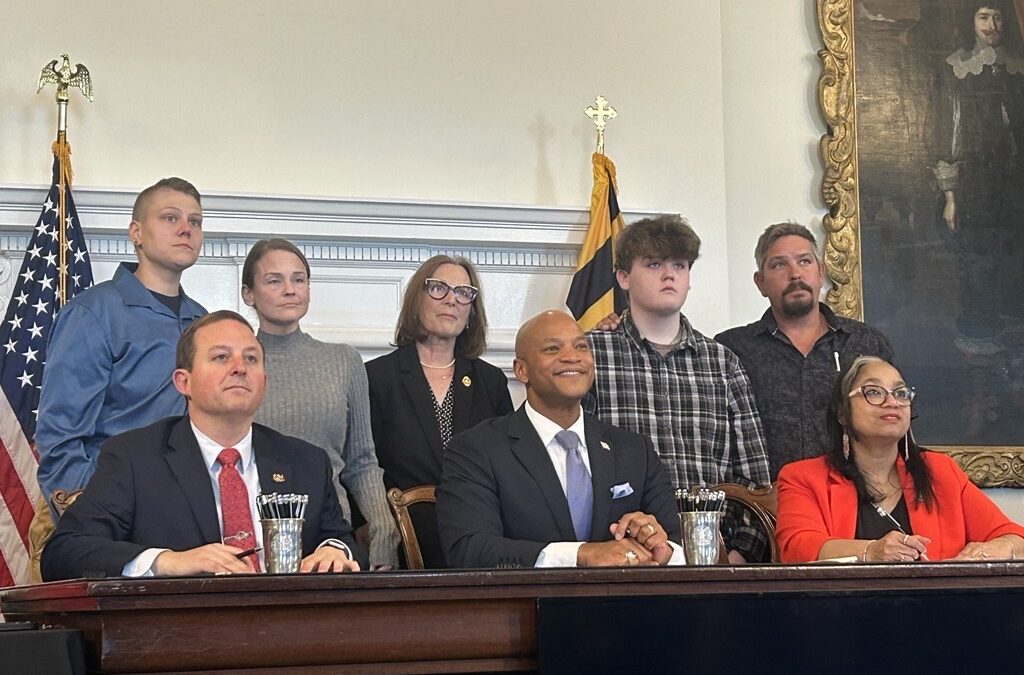
Senate President Bill Ferguson, Gov. Wes Moore and House Speaker Joseline Peña-Melnyk pose with the family of Mason Kearns, a 13-year-old Mount Airy boy who died last July when he was swept into an open storm drain, after signing legislation in his honor on May 12, 2026. (Hannah Gaskill/The Daily Record)
Moore signs bills on storm infrastructure, energy, rap lyrics


 Listen to this article
ANNAPOLIS — A broad range of legislation was signed into law Tuesday, including bills to lower skyrocketing utility bills, make rap lyrics inadmissible in most criminal proceedings and implement infrastructure updates to protect Maryland children.
“Today we’re here to celebrate a number of bills and pieces of legislation that are incredibly important and focused on the pain that too many Maryland families are facing,” Senate President Bill Ferguson, D-Baltimore City, said at the Annapolis bill-signing ceremony.
Ferguson, Gov. Wes Moore and House Speaker Joseline Peña-Melnyk, all Democrats, signed legislation Tuesday in honor of Mason Kearns, a 13-year-old Mount Airy boy who died after he was swept into an open storm drain during a July flash flood.
The law, which will go into effect Oct. 1, requires municipalities across Maryland to establish an inventory of the number of open public and private storm drains and establish a prioritization plan to improve them.
Municipalities are to bear the cost of updating their storm drains but can apply to the Maryland Department of the Environment‘s Comprehensive Flood Management Grant Program to share the cost with the state. The Department of the Environment must allocate $250,000 in funds through the program for this purpose between fiscal years 2029 and 2031.
Moving forward, any newly installed storm drains must have approved grating systems.
“The Kearns family, in their grief, made a choice that I believe is one of the most extraordinary acts of love and kindness that any family can make,” Moore said. “They chose to advocate, and they chose to turn their pain into purpose and say, ‘We’re going to make sure this does not happen again.’ ”
Mason’s mother, Erica Kearns, wept quietly in the front row of the governor’s reception room and embraced Moore as he handed her the first ceremonial pen.
Addressing Kearns’ family, Ferguson said, “I can’t stop thinking of my own 13-year-old.”
“It’s hard to even imagine getting up the next day, and not only have you done that, you’ve taken this extraordinary pain and found a way to prevent other families like my own from having to deal with the suffering that you are,” he said. “I am so, so unbelievably sorry and thankful to you so that you can prevent this pain for future and other families.”
Referencing a saying she holds dear, Peña-Melnyk faced Erica Kearns and said: “You do not die when you’re buried or when you’re cremated. You die when the last deed you have performed on Earth is forgotten.”
“Through your work and dedication, Mason will live forever,” she said.
Moore, Ferguson and Peña-Melnyk also signed the Utility Reducing Energy Load Inflation for Everyday Families, or RELIEF, Act, which was passed with the intention of alleviate utility customers’ skyrocketing energy bills.
Under the sweeping law, which went into effect when pen hit paper Tuesday, ratepayers are expected to see lower energy bills in the immediate largely through rollbacks of the Maryland EmPOWER program, which mandates that utility companies incentivize their consumers to save power and money through discounted energy audits, weatherization projects and efficient appliances.
EmPOWER fees appear as a line-item on residents’ utility bills. With these cuts to the program, utility customers are expected to save a minimum of $150 annually.
The Utility RELIEF Act also prohibits utility companies like Baltimore Gas and Electric Co. and the Potomac Electric Power Company from pursuing forecast-based energy bill increases for one year, among other measures.
The legislation was sent to Moore’s desk on the final day of the 2026 legislative session.
Because of the bill’s passage, Pepco, which serves Washington, D.C., and its Maryland suburbs, informed the Maryland Public Service Commission that it was withdrawing a request to raise energy prices that would have been based on projected revenues, expenses and capital expenditures, prompting Peña-Melnyk to call for a permanent ban on the practice.
“My House leadership and I were determined with the Senate and the governor that we would not leave Annapolis without a bill that was not just ceremonial — I was not interested in that at all. That really made a difference,” Peña-Melnyk said. “That’s why I’m proud to say that the Utility RELIEF Act we’re signing today does that.”
But Republicans who argued throughout the 90-day legislative session that the bill does not go far enough to provide financial relief to utility customers statewide maintained that sentiment Tuesday.
“Energy was one of the defining issues of this legislative session, and after all the rhetoric and promises, Marylanders ended up with a rushed, last-minute bill that preserves the same failed policies that created this problem in the first place and provides no real relief,” Senate Minority Whip Justin Ready, R-Carroll and Frederick, said in a statement.
Additionally, Moore, Ferguson and Peña-Melnyk signed the Protecting Artists’ Creative Expression, or PACE, Act into law, which will prevent rap lyrics and other works of creative expression from being admissible in criminal or juvenile court proceedings.
In a statement Tuesday morning, Maryland Public Defender Natasha Dartigue said the state has “taken meaningful steps toward a more just and humane system” by signing the bill into law.
Under the law, which goes into effect on Oct. 1, artistic works will still be admissible in court if the defendant’s intent was for the expression to be literal. If the expression is derivative, the court must determine that the intent was to adopt the literal meaning as their own.
Creative expression will also be admissible if referring to the direct facts of the case, or if they are relevant to a disputed issue of fact.
“Since the 1980s, hip-hop lyrics have been used against defendants in more than 820 criminal cases. Going back to the 1950s, lyrics from every other musical genre combined have been used the same way four times,” Moore said. “This is not a coincidence. This is bias.”
This story has been updated.