Sign In
 Free Newsletter

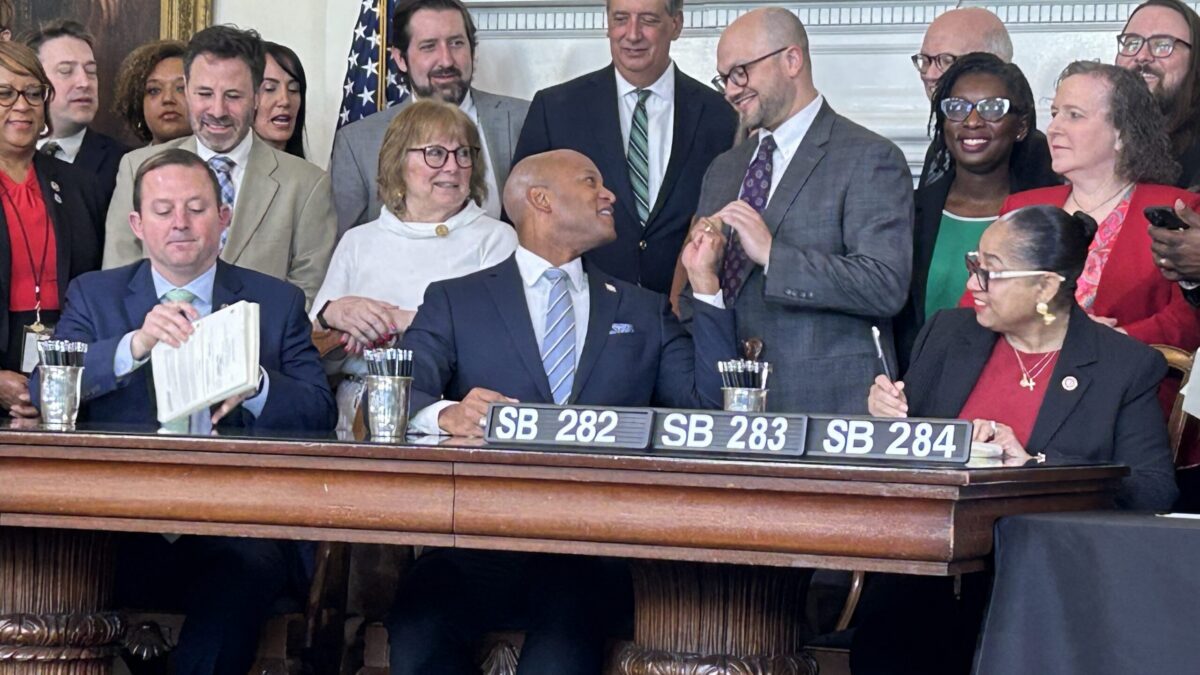
Senate President Bill Ferguson, Gov. Wes Moore and House Speaker Joseline Peña-Melnyk sign the fiscal year 2027 budget on April 8, 2026. (Hannah Gaskill/The Daily Record)
Budget, vaccines, judicial ethics: 6 key MD laws going into effect July 1


Key takeaways:
- Maryland’s $70.8 billion budget for fiscal year 2027 enacted
- Vax Act grants Maryland health secretary vaccine recommendation authority
- Judicial ethics financial disclosures supervised by Administrative Office of the Courts
- Cannabis advertising restrictions tightened
Maryland Gov. Wes Moore signed nearly 900 bills passed during the 2026 legislative session. A series of them have already gone into effect, but Wednesday marks the next round of new laws in Maryland.
Here are some key policies that take effect July 1, from the new budget to women’s healthcare.
New fiscal year, new budget
With July 1 comes a new fiscal year in Maryland and, as such, a newly enacted budget.
On Wednesday, the $70.8 billion budget for the 2027 fiscal year will go into effect, including $124 million for local law enforcement, $100 million in utility relief, $100 million in tax cuts for businesses, $73 million for energy efficiency, $384 million in low-income rental assistance and $1.7 billion for Supplemental Nutrition Assistance Program funding.
The budget Moore, Senate President Bill Ferguson and House Speaker Joseline Peña-Melnyk, all Democrats, signed in early April will also leave a $250 million surplus with $2.2 billion left in the state’s Rainy Day Fund.
But cuts are coming alongside the investments and surplus — notably to the Developmental Disabilities Administration.
Hundreds of families and members of the disability community who receive services ascended upon Annapolis throughout the session to rally against what ultimately became $127 million in cuts to the agency.
When members of the Republican Party made a last-ditch effort to restore the administration’s funding, Del. Emily Shetty, D-Montgomery, said a federal cost provision would put the people who utilize the agency’s services in jeopardy of being institutionalized if the money were to be put back into the budget bill.
A state vaccine schedule
The Vax Act will give the Maryland Secretary of Health the authority to issue recommendations regarding vaccines for infants, children and adults in accordance with accepted scientific consensus with the American Academy of Pediatrics, the American College of Obstetricians and Gynecologists, and the American Academy of Family Physicians.
Under the law brought on behalf of the Moore administration, the recommendations must also consider the guidance of the Maryland Statewide Advisory Commission on Immunizations, the U.S. Department of Health and Human Services, the U.S. Centers for Disease Control and Prevention, the U.S. Food and Drug Administration and the U.S. Preventative Services Taskforce.
Should the secretary recommend preventative services that are not vaccinations and have not received a recommendation from the Department of Health and Human Services, there must be a 30-day comment period with an analysis from the Maryland Health Care Commission and citations from authoritative medical organizations which recommend the practice.
Administration over judicial ethics disclosures
The Administrative Office of the Courts, which supports the Maryland Judiciary, will supervise financial disclosures for members of the judicial branch and those seeking to be elected to it under the public ethics law. Those records are to be available for public inspection.
This change, brought forth on behalf of the Maryland Ethics Commission, removes the responsibility of maintaining those records from the Commission on Judicial Disabilities, which investigates complaints against judges, and the Judicial Ethics Committee, which gives guidance related to the state code of judicial conduct. However, both are still responsible for administering the conflict of interest provisions of the public ethics law.
Students in civic engagement
Local school boards will be required to update their student attendance policies to allow for excused absences when their students participate in civic engagement activities. That can mean testifying in front of government officials at public meetings, aiding in policy, meeting with public servants or participating in the Maryland General Assembly‘s student page program.
Student protests, common in recent months in response to U.S. Immigration and Customs Enforcement actions, were included in the bill’s debate but not the final legislation. It was sponsored by House Ways and Means Chair Jheanelle Wilkins, D-Montgomery.
Contraception for college students
Under a law sponsored in the House by Del. Stephanie Smith, D-Baltimore City, and in the Senate by Education, Energy and the Environment Chair Brian Feldman and Vice Chair Cheryl Kagan, both D-Montgomery, public universities and community colleges must provide their students with all methods of over-the-counter contraception.
The institutions must also compile regular reports detailing access and amounts, as well as how students and student organizations have been informed that these products are available.
Feminine hygiene in higher education
Similar to the contraception law, all Maryland colleges and universities that provide on-campus housing must offer free menstrual hygiene products, including tampons and sanitary napkins, in their student health centers. Sponsored by Del. Jessica Feldmark, D-Howard, the law gives the schools until Aug. 1, 2028.