Sign In
 Free Newsletter

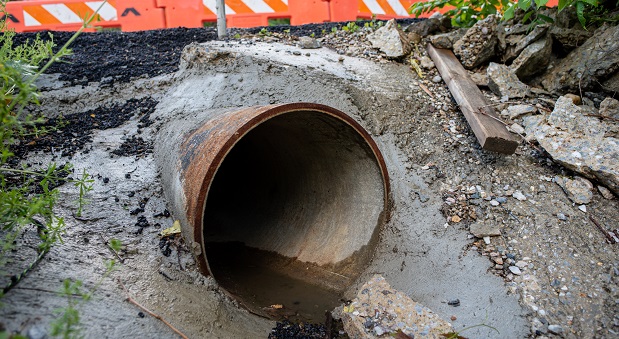
A sewer relief structure on Falls Road, near the Baltimore Streetcar Museum. Millions of gallons of sewage mixed with water flowed from structures like these into Jones Falls in 2020. (Capital News Service/Matt McDonald)
MD Supreme Court flushes private nuisance verdict in sewage case


Key takeaways:
- Maryland Supreme Court reverses Baltimore sewage backup verdict
- Court requires wrongful act for private nuisance claims
- City awarded judgment despite 17-hour sewage backup
- Dissenting justices argue nuisance claims are traditionally viewed as strict liability
The Maryland Supreme Court reversed a jury verdict for a residential sewage backup in Baltimore in a ruling last week that makes it harder for plaintiffs to win private nuisance claims.
Sewage backups have been a chronic issue in Baltimore for years. Basements frequently flood with raw sewage after heavy rainfall, due to maintenance issues or when the sewer main gets clogged with grease, rags, wet wipes and other materials. These backups cause thousands of dollars in damage, present health risks and often leave odors that linger for months.
The city has spent millions of dollars on upgrades to its sewer system under a consent decree with the U.S. Environmental Protection Agency, including closing dozens of overflow valves, which send raw sewage into open waterways. A Baltimore Department of Public Works official told WYPR in 2016 that the closure of those valves led to more residential backups.
Southwest Baltimore residents Theresa and Christopher Abel sued the city after a December 2019 backup. The Maryland Supreme Court quoted Theresa Abel as saying the backup caused the house to smell like “the hippo house at the zoo.” A jury found the city liable for private nuisance — but not for negligence — and awarded them $18,240 in March 2024.
A 5-2 majority of the Maryland Supreme Court agreed with the city that private nuisance requires a wrongful act. It ordered that judgment be entered in the city’s favor, not that the case be remanded for a new trial.
The court ruled that the trial judge should have granted the city’s motion for judgment and was wrong to ask the jury whether there was a “continuous intrusion” into the Abels’ home. The city had requested the jury be asked that question.
Justice Brynja Booth wrote that in the absence of a negligence finding against the defendant, the plaintiff must show that there was a “continuous or recurring” invasion of sewage to their property.
In this case, Booth wrote, there was “no evidence of wrongful conduct by the City that satisfies the requirement for liability for private nuisance.” Their backup, which lasted 17 hours, did not meet the “continuous or recurring” standard, Booth wrote.
“The City is not an absolute insurer for any damage arising from a user’s connection to its system,” she wrote.
“To hold the City liable for private nuisance for any invasion that is not caused by intentional and unreasonable, negligent, reckless, or abnormally dangerous activity by the City in connection with its operation of a city sewer system would expose the City to liability for unlimited and unavoidable intrusions caused by any user of the system, who, in turn, causes harm to any property connected to the system.”
“The City is pleased to see that the Supreme Court of Maryland’s opinion rejected a strict liability standard when it comes to sewer backups,” Baltimore City Law Department said in a statement provided by a spokesperson for Mayor Brandon Scott.
“While every sewer backup is awful, and the City works hard to help avoid and to respond to these problems, Maryland law has never allowed municipalities to be held strictly liable (in nuisance or otherwise) whenever a backup occurs.”
The high court overturned a 2025 decision by the Maryland Appellate Court, which upheld the Abels’ verdict. That court ruled that nuisance “is determined by the injury caused by the condition and not by the conduct of the party creating the condition.”
The Abels’ lawyer, Matthew Vocci, of Santoni, Vocci, & Ortega in Timonium, said he agreed with the dissenting opinions and wished the case would have been remanded rather than decided by the high court.
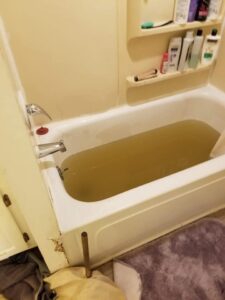
“I believe this opinion will be interpreted to make claims harder for a first backup,” Vocci said in an interview. “It seemed to me to be the perfect thing for a jury to decide: Is 17 hours reasonable? Is it continuous enough?”
Justices Shirley Watts and Peter Killough dissented. Both wrote that the majority was imposing a higher standard for nuisance claims, which, they argued, have traditionally been viewed as “strict liability” actions that do not require proof of fault.
“The single error the Majority finds is that the trial judge, having heard the evidence, permitted the jury to decide whether the invasion was continuous — a question that is ordinarily the jury’s to decide,” Killough wrote. “That is not an error of law. It is the Majority’s disagreement with the jury’s answer, restated as a criticism of the judge who let the jury give it.”
Watts wrote that the case should have been remanded for a jury to decide whether the backup was “continuous or recurring,” noting that the Abels failed to meet a burden “that they did not know about.”
“The City’s argument that wrongful conduct or a wrongful act is part of private nuisance law is, at bottom, a request to raise the standard of proof,” Watts wrote. “Whether the Majority will admit it or not, with its decision, it plainly has imposed new elements of proof for the tort of private nuisance.”