Sign In
 Free Newsletter

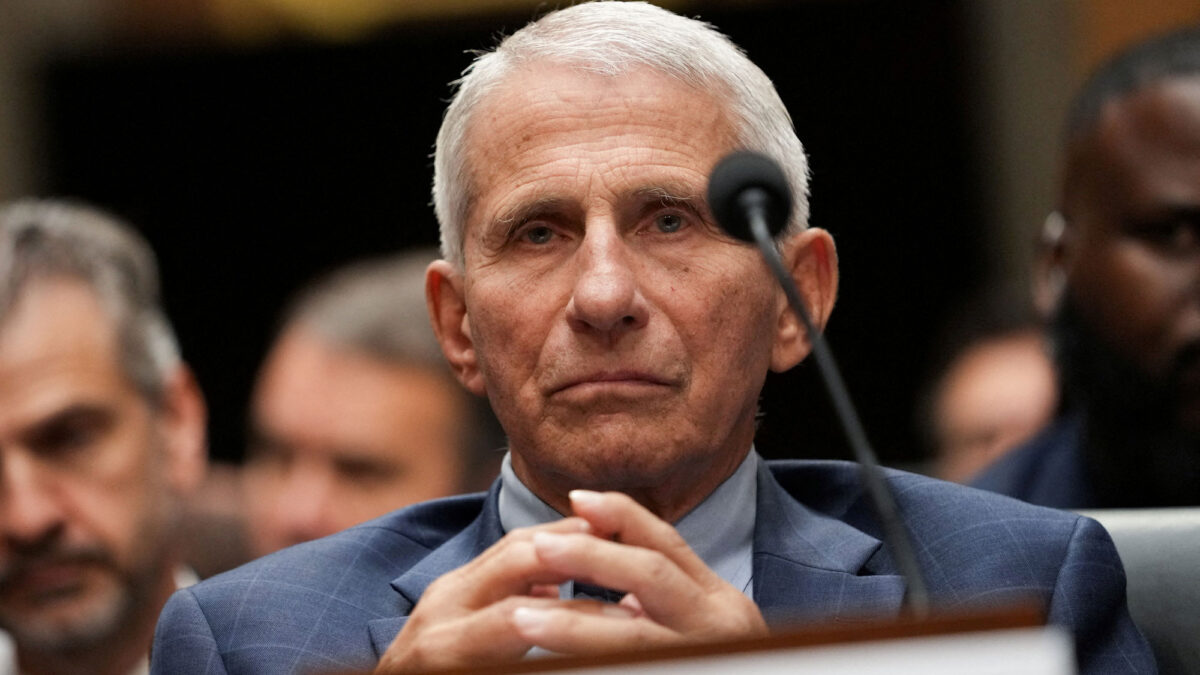
Anthony Fauci, the former Director of the National Institute of Allergy and Infectious Diseases (NIAID) and medical advisor to several U.S. presidents, attends a U.S. Senate Homeland Security and Governmental Affairs Committee on Capitol Hill in Washington, D.C., U.S., July 29, 2026. Anthony Fauci declined to answer questions, invoking his Fifth Amendment right against self-incrimination. (REUTERS/Nathan Howard/File Photo)
Senate panel votes to hold Fauci in contempt of Congress


Key takeaways:
- Senate committee votes 8-7 to hold Fauci in contempt
- Fauci invoked fifth amendment over 100 times in hearing
- Rand Paul leads referral amid years-long investigation
- Former president Biden pardoned Fauci in January 2025
WASHINGTON – A U.S. Senate committee voted on Thursday to hold Dr. Anthony Fauci in contempt of Congress after the former top U.S. infectious disease official refused to answer questions about his handling of the COVID-19 pandemic.
The Homeland Security and Governmental Affairs Committee approved a referral pushed by its Republican Chair Rand Paul of Kentucky, a longtime Fauci antagonist, on a party-line vote of 8-7. The vote followed a hearing last week where Fauci, who is 85 and retired in 2022, invoked the Fifth Amendment, the right to remain silent, more than 100 times.
The vote is the sharpest escalation yet in a broad Republican and Trump administration campaign to re-litigate the pandemic and hold accountable the officials who ran the U.S. response.
Paul has pursued a years-long investigation to try to prove his and other Republicans’ conviction that Fauci orchestrated a cover-up of the coronavirus’ origins.
U.S. Health Secretary Robert F. Kennedy Jr. has upended federal health policy around distrust of pandemic-era science, casting his overhaul of the health agencies as a reckoning with what the administration calls the coercive mandates of the COVID-19 response.
Both men blame Fauci and have written books criticizing him.
Democrat delay efforts fail
Democrats introduced five motions to postpone the vote, all of which failed along party lines. One, offered by the committee’s top Democrat, Senator Gary Peters of Michigan, sought to have Paul commit not to bypass a full Senate vote by referring the matter directly to the Justice Department.
Fauci, who led the National Institute of Allergy and Infectious Diseases for 38 years, became the face of the U.S. pandemic response and a primary target of anger over measures taken against a virus that killed more than 1.1 million Americans.
President Donald Trump and many conservatives criticized him over lockdowns, mask and social-distancing guidance, and his promotion of vaccines, which became heavily politicized despite being shown safe and effective. Fauci and public health officials worldwide backed the measures based on scientific evidence available at the time.
David Schertler, an attorney for Fauci, called the vote “a crude political stunt intended to punish Dr. Fauci for exercising his constitutional rights” and urged the Senate to reject what he called a “meritless and politically motivated contempt resolution.”
“For years, Senator Paul has proclaimed to anyone who would listen that Dr. Fauci should be prosecuted and put in prison. Dr. Fauci has committed no crime — and Senator Paul knows it,” Schertler said, describing the resolution as a continuation of a “personal vendetta.”
Former President Joe Biden preemptively pardoned Fauci in January 2025, to guard against “unjustified and politically motivated prosecutions” related to COVID or his role in the response. The pardon does not cover subsequent conduct.
Paul said Fauci had no valid Fifth Amendment claim because the pardon nullified it and because Fauci waived any remaining protection by testifying.
Fauci told the panel last week Paul had summoned him only to force testimony backing the senator’s repeated public pledges to see him imprisoned.
The Wall Street Journal reported late Wednesday that the committee had obtained a backup copy of Fauci’s iPhone from his tenure as NIAID director, including his period fronting the first Trump administration’s pandemic response in 2020.
Senator Ron Johnson, a Wisconsin Republican who chairs the committee’s Permanent Subcommittee on Investigations, told the Journal he had obtained the copy, which was transferred by the U.S. Department of Health and Human Services.
A contempt referral typically must be approved by a congressional committee and then the full Senate, which would likely need a 60-vote majority, requiring Democratic support, highly unlikely given the party’s defense of Fauci.
But Paul has suggested that vote may be unnecessary, telling Fox News he could send the referral directly to the Justice Department with a legal brief.
Paul’s office did not respond to a request for comment.
Peters called the probe a one-sided, rushed investigation and said punishing a witness would undermine the committee’s credibility.
Democrats also complained they had been denied adequate access to relevant documents, a charge Paul rejected.
If the referral proceeds, the U.S. Attorney’s Office in Washington, run by Trump ally Jeanine Pirro, would review it and decide whether to seek a grand jury indictment.
Fauci also faces state-level scrutiny, with West Virginia joining Louisiana, Florida and Alabama in investigating his pandemic conduct. A federal pardon does not preclude state charges.
(Reporting for Reuters by Ahmed Aboulenein; Additional reporting by Doina Chiacu Editing by Lisa Shumaker and Rod Nickel).