Sign In
 Free Newsletter

Sen. Raskin worked through his busiest legislative session despite battling cancer


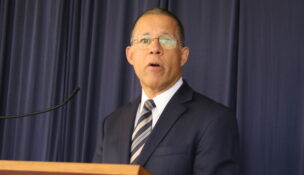
 State Sen. Jamin B. “Jamie” Raskin, Harvard Law School grad and tenured constitutional law professor, admits to having had a bit of an ego and a sarcastic streak during his first four years in the General Assembly.
These qualities may have been fed by his reputation in the Senate as the go-to guy on federal constitutional issues, such as whether a campaign finance bill violates freedom of speech or if a business-related proposal complies with the Interstate Commerce Clause.
But any hubris ended for the 48-year-old husband and father of three teenagers last April when he was diagnosed with colon cancer and began what he called “my year of living dangerously.”
Six weeks of daily radiation treatments began in May, followed by seven hours of surgery at Johns Hopkins Hospital in Baltimore on Sept. 17, Constitution Day, said Raskin, D-Montgomery. From November to March, he received chemotherapy treatments every other Thursday.
Six of his nine chemotherapy sessions occurred during the General Assembly term — Raskin’s fifth — which ended last Monday. The senator said his prognosis is “sunny,” though the possibility of a recurrence remains.
Raskin, though frequently fatigued, endured his busiest legislative session this year. He led the Senate floor debate on bills that would have permitted same-sex couples to marry in Maryland and prohibited discrimination against transgendered individuals in employment, housing and credit.
These issues, dear to the self-described liberal, might have brought out the characteristic sarcasm of Raskin’s early Senate years but for his battle against cancer.
“It has made me a much less partisan person,” Raskin said the day after the General Assembly session ended.
“For the first time, I had no sarcastic edge in my voice,” he added. “It helped me to proceed with no rancor.”
Both bills failed in the General Assembly this year. The House of Delegates declined to vote on the same-sex marriage legislation, Senate Bill 116, after the Senate passed it by a 25-21 vote on Feb. 24. The Senate, in turn, did not vote on the transgender measure, House Bill 235, after the House had passed it 86-52 on March 25.
Temperance and moderation
Sen. Nancy Jacobs, R-Cecil and Harford, who opposed Raskin on both measures, said she noticed the softening in her colleague’s rhetoric this session.
“He’s not as on-the-surface extremely liberal, [though] he might feel exactly the same way,” said Jacobs, the Senate minority leader. “His speech has been tempered.”
Jacobs said the change was most apparent when she faced off against Raskin during the Senate floor debate over same-sex marriage, a hot-button issue that — like the death penalty or abortion — can fray nerves and turn discussions into verbal attacks. But Raskin, as floor leader, acted like “a statesman” and maintained civility among the senators, she said.
Raskin, during the debate, summed up the bill’s goal as ensuring that same-sex couples have the same legal protections, benefits and title of “marriage” that heterosexual couples possess. “These people aren’t asking, ‘Will you same-sex marry me?’” Raskin said.
Jacobs, in opposition, said permitting same-sex marriage could violate the “sincerely held religious beliefs” of court clerks who would be duty-bound to sign marriage licenses.
The morning after the Senate voted in favor of the same-sex marriage bill, Raskin delivered bagels to Jacobs’ office, a gesture Jacobs said she much appreciated.
Jacobs, a 12-year Senate veteran, attributed Raskin’s change not only to his illness but also to his maturity as a senator.
“You learn to moderate yourself,” Jacobs said. “It’s important to maintain good, strong relationships with your colleagues. I think he and I have both done that.”
Medical marijuana laws
Meanwhile, Senate Majority Leader Robert J. Garagiola, D-Montgomery, said Raskin might be too hard on himself.
“A little bit of wit and sarcasm can be a good thing,” said Garagiola, who was chief sponsor of the same-sex marriage bill.
Raskin, who teaches a course on legislative process and political rhetoric, directed a bit of wit and sarcasm at himself in explaining the same-sex marriage bill’s success in the Senate, where he led the floor fight, and its ultimate failure in the House, where he lobbied for the measure from the sidelines.
“My problem is that I know a lot more about political rhetoric than legislative process,” said Raskin, who teaches at American University’s Washington College of Law.
In contrast to these legislative defeats, the General Assembly passed Raskin-sponsored legislation to permit people being tried for marijuana possession to present a defense that they were using the drug to treat an illness or ailment. These defendants must present testimony from a licensed physician stating that their marijuana use is necessary to bring them therapeutic or palliative relief for their illness or ailment.
“The triumph here is that we’re not going to treat medical marijuana users as criminals,” Raskin said.
The senator said he hopes the measure, SB 308, will soon lead to a law permitting cancer victims and others with chronic ailments to use marijuana legally at the recommendation of a licensed physician. Marijuana, an illegal drug under federal and state law, is widely regarded as an effective palliative to the nausea and pain associated with many diseases and ailments, including cancer and the side effects of its treatment.
Raskin said he never considered using marijuana — even during his early bouts with nausea — due to a family history of respiratory disease and the effectiveness of prescription medication.
“The standard drugs worked for me,” he said.
Portable chemotheraphy
But the chemotherapy did take a toll, particularly in March as the treatments concluded.
Raskin said he would “get more and more tired” during morning Senate sessions but revive himself with a nap on his office couch before the start of afternoon hearings at the Senate Judicial Proceedings Committee, on which he sits.
“I didn’t have much of an appetite,” Raskin said. “I would take a nap instead of eating lunch.”
But naps can only accomplish so much.
“It [the fatigue] made it tough to keep my eyes open when we were going through the minutiae of the budget bills,” he said.
Shortly after his September surgery, Raskin served on Maryland Attorney General Douglas F. Gansler’s advisory committee that in early January suggested changes to the state’s campaign laws. The 12-member committee recommended, and the General Assembly passed this session, HB 93, requiring individuals and groups to disclose their names if they spend at least $10,000 in campaigning for the election or defeat of a candidate.
Gansler said he has seen no evidence that Raskin was slowed by the disease or its treatment.
“He’ll never mellow, not at all, not even in the least,” Gansler said.
Sen. Brian E. Frosh, who chairs the Judicial Proceedings Committee, said the only concession he made to Raskin’s illness was changing the panel’s day for voting on bills from Thursday to Wednesday every other week to accommodate Raskin’s Thursday chemotherapy sessions at Anne Arundel Medical Center in Annapolis.
Raskin received chemotherapy medication through a port surgically placed into his chest. Each treatment lasted 48 hours.
So that he would not miss Friday Senate sessions, Raskin discreetly held or kept the medicine bag in a suit pocket as the medication from the bag flowed through a tube and dripped into the port.
Frosh praised as “heroic” Raskin’s attendance at these Friday sessions with his medicine in tow.
“None of us wants to go through what he was going through,” said Frosh, D-Montgomery. “He really soldiered through the session.”
Raskin, in turn, credits Frosh with helping to provide the “best therapy” by letting him take the lead on legislation that cleared the committee, such as the same-sex marriage and transgender-discrimination bills.
“I was so deeply into the constitutional and political issues [that] I was focused on the body politic and not my own body,” Raskin said.
Raskin did not suspect a deadly disease when he went to his doctor last spring, complaining of reflux. The physician recommended a colonoscopy, which revealed the cancer.
The September surgery occurred just weeks before Raskin won re-election. Raskin, who in 2006 defeated incumbent Ida G. Ruben, a Democrat, ran unopposed last year.
“I [had] an internal opponent this time,” he said.
Citing his experience, Raskin strongly urges that people follow the advice of doctors who recommend a potentially life-saving colonoscopy for them.
“Get it,” he said. “Compared with what you will go through if you don’t, it’s a piece of cake. Don’t be a wimp.”