Sign In
 Free Newsletter

Maryland officials celebrate landing FBI headquarters, blast director’s criticisms


Maryland state and federal officials, celebrating plans for the FBI‘s new headquarters to be in Greenbelt during a Friday press conference, blasted FBI Director Christopher Wray’s criticism of the federal site-selection process.
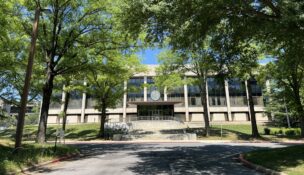
While Wray has said that his concerns about a “potential conflict of interest” went unresolved, Maryland officials, gathered at the Greenbelt Municipal Building, said the General Services Administration’s decision is “a done deal,” and that the Washington, D.C., suburb was an obvious choice over Springfield, Virginia.
The officials all lauded U.S. Rep. Steny Hoyer, the former House majority leader who since 2009 has led the charge for Maryland to be the new home of the FBI, which the government has housed blocks from the White House in the aging J. Edgar Hoover Building since the mid-1970s.
“I’m proud to stand here. Obviously, this is a huge victory,” Hoyer said during the press conference. “Bob Mueller, the (former) director of the FBI, 14 years ago came into my office and he said, ‘Our building is falling down.’”
Hoyer said the GSA decided Greenbelt was the most transit-accessible option, provided the quickest development timeline and cost more than $1 billion less than building in Springfield.
Republican former Gov. Larry Hogan led years of state-level advocacy for the FBI headquarters, though securing the new headquarters represents a significant win for Democratic Gov. Wes Moore, whom federal officials said was instrumental in outlining the state’s case and landing the project.
Hoyer claimed a Virginia lawmaker said to him that the battle over the FBI headquarters became an “unfair competition … you had Moore, we had (Republican Virginia Gov. Glenn) Youngkin,” landing some laughs from the audience of officials and staffers.
Virginia’s state and federal officials, meanwhile, have contended that political manipulation tainted the site-selection process and called for a reversal of the GSA’s decision.
In questioning the process, Wray has asserted that a senior GSA executive, who once worked for the Washington Metropolitan Area Transit Authority, which owns the Greenbelt site, went against a board of GSA and FBI representatives who unanimously agreed on Springfield, according to The Associated Press.
Maryland officials denounced the director’s claims.
“The statements (Wray) made about that public servant were just over the line, and there was no factual basis for it, none at all. And he knew that she wouldn’t have a platform to respond to that kind of thing,” said U.S. Rep. Glenn Ivey, whose district covers most of Prince George’s County. “I don’t think the American taxpayers should have to spend an extra $1 billion so some FBI officials can have a shorter commute to the office every day.”
The White House has stood behind the decision, and GSA Administrator Robin Carnahan said that “any suggestion that there was inappropriate interference is unfounded,” according to The Associated Press.
Maryland officials also took digs at former President Donald Trump, who after taking office in 2016 abandoned Congress‘s plans for the bureau’s headquarters to be in either Maryland or Virginia and personally pushed for a new building in Washington, D.C.
“We thought we would be attending a meeting like this in 2016,” said Democratic state Sen. Ben Cardin.
FBI officials had recommended that the agency’s aging home be demolished and a new building erected in D.C.
But the state’s federal delegation, members of which have held key positions in Congressional spending committees, prevented the approval of any money for new headquarters in Washington, D.C., maintaining that the bureau needed a suburban facility, Cardin said.
Some House Republicans, arguing that the Biden administration has politicized the bureau, have sought to cut funding for the project. But Maryland junior Sen. Chris Van Hollen, a Democrat and a member of the Senate Appropriations Committee, said Congress has secured the funding necessary to move the project forward.