Sign In
 Free Newsletter


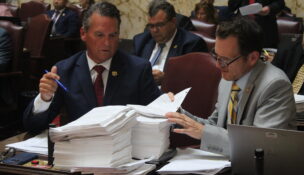
Senate Budget and Taxation Committee Chair Guy Guzzone said the budget needed the cuts to the increase in developmental disabilities programs to help reach a balanced budget this year. (The Daily Record file photo/Jack Hogan)
Session of uncertainty prolonged for MD developmental disabilities community


ANNAPOLIS — After months of beating back spending cuts, Maryland’s developmental disabilities community found itself back in the crosshairs in the legislative session’s final days as lawmakers and officials finalized the state’s next budget amid daunting fiscal headwinds.
Service providers for people with intellectual and developmental disabilities weren’t expected to receive the 1% rate increase they had hoped for in the budget.
The elimination of the rate increase was the latest, and likely final, twist in this year’s budget process for advocates and caregivers for the roughly 18,000 people with intellectual and developmental disabilities who live and work in Maryland.
Gov. Wes Moore and his team introduced a measure to eliminate the rate increase as part of their second supplemental spending proposal to balance the budget, and top Senate Democrats on Friday indicated that the change would be part of the final budget.
“We need those changes,” Senate Budget and Taxation Committee Chair Guy Guzzone said of the administration’s supplemental budget during a press conference on Friday. “They’re tough, they’re really tough. But we gotta get out of here with a balanced budget.”
Guzzone and other top Democrats have said the 2025 session was one defined by difficult choices in the budget. Lawmakers must pass a balanced spending plan, and they began the 90-day session facing projects of a roughly $3 billion shortfall.
The proposal to eliminate the rate increase — a $14 million decrease in state spending and an equal amount in federal matching money — was met with frustration and disappointment among members of the developmental disabilities community, who have spent the last three months pushing back on deep cuts to the agency that helps community members in Maryland cover and provide care and services.
The governor and his team have said that cuts are necessary to slow spending at the Developmental Disabilities Administration, which, according to state analysts, has failed to predict the rate of growth for certain programs.
In the Moore administration’s initial budget proposal, the agency was facing nearly $460 million in total spending cuts, $235 million of which was state funding.
Advocates and caregivers said the cuts, which represented nearly a quarter of the agency’s budget, would have devastated the support network on which people with developmental disabilities and their family and caregivers have relied.
The governor and his team presented an initial supplemental budget in early March that included about $300 million in new funding for the agency to account for updated cost projections and to delay cuts to programs and services.
Members of the developmental disabilities community were under the impression that the remaining cut for next fiscal year wouldn’t be increased in the session’s final weeks.
“I understand the pressures on the state budget and appreciate the work that was done to restore hundreds of millions of dollars in proposed cuts. That said, I trusted that we would be shielded from any additional funding reductions,” Ande Kolp, executive director of The Arc Maryland, said in a recent statement. “I am concerned about what today’s announcement will mean for people with developmental disabilities and their families.”