Sign In
 Free Newsletter

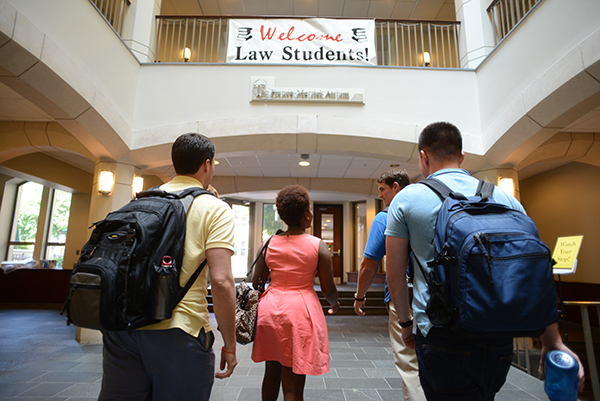
First-year students arrive at the University of Maryland Francis King Carey School of Law on the first day of classes in August 2013. This year’s incoming class is expected to be around 200 students. (Maximilian Franz/The Daily Record)
AI creates gray area for MD law schools, students


As the capabilities and risks of artificial intelligence continue to emerge, Maryland law students and educators are struggling to reach a consensus about its place in the classroom.
A United Nations Educational, Scientific and Cultural Organization survey published in September found that two-thirds of responding higher education institutions have or are already developing guidance on the use of AI. Policies at law schools differ across the country, with some prohibiting its use entirely and others encouraging it in certain circumstances.
Donald Tobin, the Gordon, Wolf & Carney Professor of Law at the University of Maryland Francis King Carey School of Law, co-authored a July article in Jurist pushing back against a new policy prohibiting the use of artificial intelligence at UC Berkeley School of Law.

“AI is here to stay, and AI is going to be an essential tool,” Tobin wrote. “To try to close your eyes and say … ‘We’re going to pretend it’s not here so we can maintain our pedagogy the exact same way we’ve been doing for the last 100 years,’ I think, is a huge mistake.”
Also at UMD, law professor Andrew Blair-Stanek said that he has prohibited the use of artificial intelligence in his classes. Although he added that there is “no reliable way” to enforce a full ban, he said his policies facilitate curiosity and engagement in class.
“I want them to actually learn and answer questions without the help of any sort of AI,” he said. “I think that it’s almost stealing some of their own learning experiences.”
The opinions of law students on how and when to use AI are just as disparate. UMD rising second-year law student Abigail Fry said she does not use AI, especially after learning about instances in which it has “hallucinated” legal citations and cases.
“As a student, my opinion is that what you’re going to do now is building the foundation of what you’re going to do in your future practice,” she said. “Seeing situations like those, I don’t want to rely on AI until maybe the technology is more reliable and less scary.”

Samuel Irwin, who co-authored the Jurist article, said AI does have some practical uses for a law student, including organizing and parsing notes, as well as reviewing spelling and grammar in written assignments, when permitted by a professor.
“It can make you more prepared in a course,” he added. “It can really help with … tedious tasks that don’t require a whole lot of thinking.”
But teaching students how to use the technology responsibly, argued University of Baltimore Venable Professor of Law Michele Gilman, is also a pressing concern.
“I can look at (AI) outputs and make very considered judgments about what is acceptable,” she said. “My students don’t have that experience or perspective.”
With this in mind, multiple professors warned against using AI in legal writing. Tobin often asks students to analyze a large language model’s response to a prompt and instructs them to identify three things about which the engine was incorrect.
“How do we teach them to be critical of the product they get? That’s my first goal,” Tobin said. “The second goal is to help them think about what AI is good at and not good at.”
The legal industry as a whole has also begun to integrate AI into its practices. It is important, Gilman said, for educators to prepare students for this phenomenon.

“There’s a real tension here because on the one hand, students do need to learn how to use AI effectively. Their future employers expect that, and the law profession expects that,” she said. “At the same time, if students are over-reliant on AI, they will not learn how to be lawyers.”
When she was studying at UMD, Class of 2025 alumna Katherine Sylva said that AI was frequently “villainized” when she was in school. As she continues to prepare for a career in technology law, she wonders how artificial intelligence policies will continue to evolve.
“Going into firms, a lot of them are expecting you to use AI,” she said. “Becoming comfortable with those AI tools before being in a firm environment, I think, would have been nice.”
But determining the place of AI in law pedagogy, Gilman said, is “a work in progress.”
“I’ve been teaching for almost 30 years, and … nothing has been as transformative as generative AI,” she said. “We’re all learning about how to use AI effectively and ethically, but we haven’t solved it yet.”