Sign In
 Free Newsletter

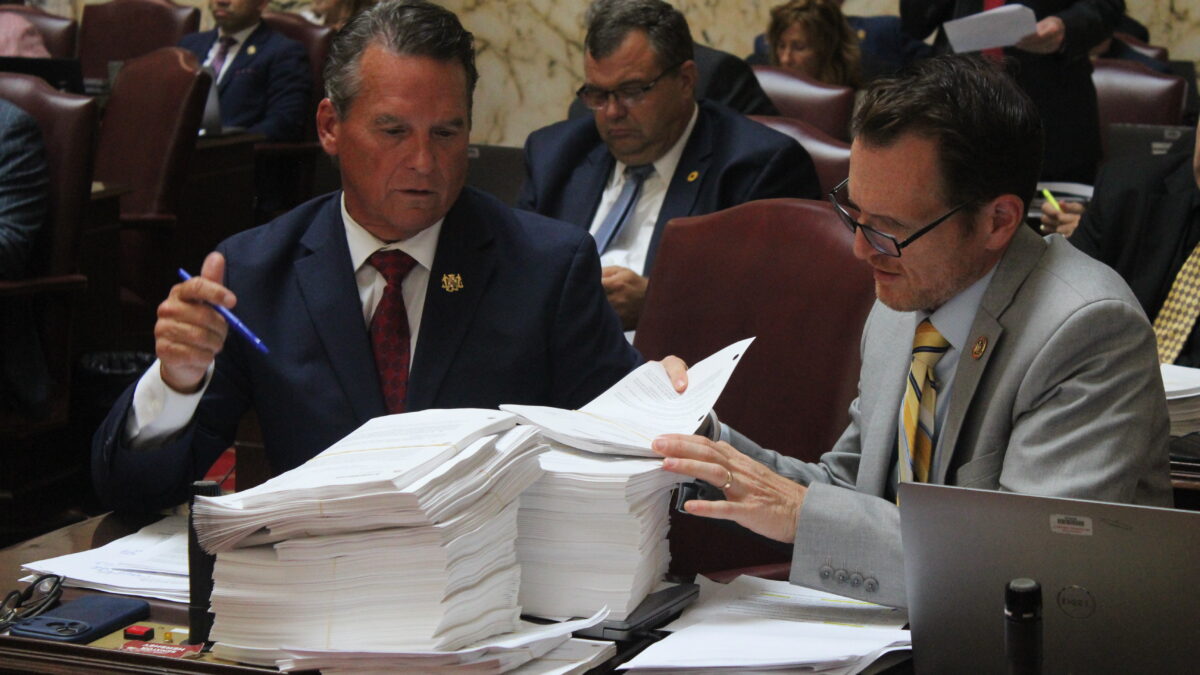
Senate Minority Leader Stephen S. Hershey Jr. and Minority Whip Justin Ready prepare amendments efore debating legislation to allow voters to decide if they will alter the standards for congressional redistricting on Aug. 4, 2026. (Hannah Gaskill/The Daily Record)
Redistricting referendum barred from MD ballots, judge rules


The Maryland State Board of Elections is barred from placing a ballot question to specify the terms of congressional redistricting before voters in November, Anne Arundel County Circuit Court Judge Robert J. Thompson ruled Wednesday.
The execution of Thompson’s injunction is stayed pending an appeal to the Maryland Supreme Court. Gov. Wes Moore‘s office confirmed Wednesday that an appeal has already been filed.
In a Wednesday memorandum, the judge wrote that the state constitution and Declaration of Rights hold that those with legislative and executive powers “are the Trustees of the Public, and, as such, accountable for their conduct …”
“The General Assembly of Maryland, working within the confines of the Maryland Constitution, has enacted certain laws which cover the means, mode, and method of proposing ballot referenda for the purposes of amending the very Constitution under which it operates,” Thompson continued. “With this understanding, the legislature itself must follow the means and methods those laws describe when it chooses to refer ballot question to vote by the citizens at general election.”
Additionally, Thompson wrote that although he doesn’t believe the Maryland Constitution imposes a timeframe limiting the legislature’s ability to propose ballot questions, “from a practical standpoint, the calendar will.”
In a post to the social media platform X on Wednesday, U.S. Rep. Andy Harris, the lone Republican in Maryland’s congressional delegation, wrote that Thompson’s decision was a “victory for Maryland voters and the rule of law.”
“Marylanders deserve fair representation, not politicians changing the rules to eliminate a congressional seat they cannot win at the ballot box,” he said.
Senate President Bill Ferguson said in a statement Wednesday afternoon that he is “confident” that the General Assembly acted within its constitutional authority and believes the courts “will ultimately affirm that authority.”
“Marylanders deserve the right to vote on this question,” he said. “I expect this case to receive prompt review, and I look forward to a clear ruling that affirms the General Assembly’s constitutional authority.”
House Speaker Joseline Peña-Melnyk, D-Anne Arundel and Prince George’s, said the legislature passed the ballot question during a special session because it believed that voters should have the ability to determine if these standards should be enshrined in the Maryland Constitution.
“Today’s ruling has been stayed pending appeal, and we will allow that legal process to proceed,” she said in a statement.
Senate Minority Leader Stephen S. Hershey Jr., a Republican representing the Upper Eastern Shore and a plaintiff in the lawsuit, said the case has “never been about preventing Marylanders from having a voice.”
“It has been about ensuring that before voters are asked to amend our Constitution, the State first complies with the Constitution and the election procedures established by law,” he said in a statement.
Del. Ryan Nawrocki, a Baltimore County Republican and another plaintiff, stated Wednesday that the General Assembly’s Democratic supermajority holds a philosophy of “rules for thee, but not for we.”
“Annapolis Democrats wrote the deadlines, expected everyone else to follow them, and then ignored their own law the moment it was inconvenient,” he said. “Today the court said that doesn’t fly.”
Another similar lawsuit against the ballot question is also pending in Dorchester County.
Jeffrey B. Clark Sr., the attorney representing Mike Howell of the Oversight Project, a conservative nonprofit, and a cadre of Republicans from the Maryland House of Delegates and Senate, verbally went toe-to-toe against Assistant Attorney General Daniel M. Kobrin for hours in Anne Arundel Circuit Court on Tuesday.
Among several of his points, Clark argued that the Maryland General Assembly’s Democratic supermajority sidestepped a law it had passed during the regular 2026 legislative session in an effort to oust Harris from office.
In early August, the General Assembly convened a two-day special legislative session, during which it passed legislation to place a referendum on the ballot during the general election to clarify in the state constitution that the borders of Maryland’s congressional districts do not need to be “geographically contiguous” and “compact,” as a judge ruled in 2022 is required of congressional districts.
The ballot question approved by the General Assembly does not implement a new congressional map but prevents the State House from facing significant legal challenges in the future should that be the case.
Before it was passed, the bill proposing the ballot question was amended to exempt it from the constraints of Senate Bill 29, which mandates that all referendums be written in plain language, prepared and certified by government entities by July 1, and open for a 15-day public comment period. The referendum in question was late in its publication by two days.
Kobrin argued in return that the legislature wields the authority of the Maryland Constitution, which gives it the power to delegate that authority through laws when it so chooses. Election laws like SB29 are implementations of delegated authority, he said.
In his rebuttal, Clark said the state constitution doesn’t provide the General Assembly the ability to overlook laws it has passed. SB29 went into effect June 1.
Although he didn’t issue a ruling at the close of Tuesday’s hearing, Thompson said he was troubled that the legislature, the sole body charged with making state laws, is attempting to overlook legislation it recently passed in an attempt to push a new priority forward.
In a statement after the decision, Clark said he and his legal team “will proceed with energy and this wind at our backs as we go up to defend this victory on appeal before the Maryland Supreme Court.”
This story has and will be updated.