Sign In
 Free Newsletter


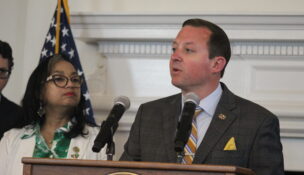
Mayor Brandon Scott speaks at the opening of a Safe Streets violence prevention site in November 2025. (J.J. McQueen/Courtesy Mayor's Office)
Collaboration, investment credited for Baltimore’s homicide decline


Politicians and advocates credit a menagerie of violence interruption resources — including reduction organizations, selective prosecution and smarter policing — for Baltimore‘s dramatic drop in homicides last year.
“It’s an all-of-the-above approach, and I think that’s what makes this moment so special,” Adam Rosenberg, the vice president of violence intervention and prevention for LifeBridge Health, said in an interview with The Daily Record on Friday. “None of us could do this on our own, and each element has been incredibly contributory.”
According to Mayor Brandon Scott‘s office, Baltimore saw 133 homicides in 2025 — a 31.44% decrease over 2024’s rate.
In a joint statement with Baltimore Police Commissioner Richard Worley and Mayor’s Office of Neighborhood Safety and Engagement Director Stefanie Mavronis, Scott, a Democrat, agreed that collaboration enabled the steep decline.
“133 homicides is still 133 too many. But we are seeing the positive impact of our work each and every day—not just in the data, but in the lives of the residents we serve,” all three said in an announcement Thursday. “It takes all of us to build on this progress as we mark the beginning of another year and reaffirm our commitment to ending violence in our city.”
The Scott administration partnered with police and State’s Attorney Ivan Bates’ office to launch its Group Violence Reduction Strategy program in 2022. The initiative aimed to target resources toward individuals who are most at risk of being involved in gun violence. According to the Mayor’s Office of Neighborhood Safety and Engagement website, gun violence reduction strategies are nationally recognized as the approach to homicide and non-fatal shooting reduction with the most successful formal evaluation record.
Through this program, Scott has activated violence interruption programs like those at LifeBridge Health’s Center for Hope, which runs several of the city’s Safe Streets sites. Safe Streets enlists a team of violence interrupters to enter neighborhoods to detect potential shootings and identify individuals most at risk. The interrupters serve as mediators among interpersonal conflicts, attempt to prevent instances of retaliation and change the behaviors of those who tend to turn to violence.
Besides the collaboration between Scott, Bates, Worley and Mavronis, others attributed the drop to investment on behalf of state and federal officials.
Scott had buy-in from Gov. Wes Moore, a Democrat whose administration reinstated a city-state partnership to better coordinate the Baltimore Police Department, and Maryland State Police and the Transportation Authority in targeting crime.
“[E]ven though Baltimore City is seeing some of the most impressive crime drops in the entire country, the work is far from over,” Moore said in a statement when the partnership was initiated in September. “We can, and will, do more on public safety, because our people deserve nothing less.”
State Sen. Cory McCray, D-Baltimore City, said that federal and state support helped Baltimore “reverse decades of underinvestment.”
“In my district alone, four new rec centers are open or opening — the first new public library in Baltimore City in fifteen years just opened, a new public school football stadium is underway, major housing developments are rising with a real focus on home ownership, and Baltimore remains the fastest urban school district in America building new school buildings,” McCray said in a text message Friday. “When you increase resources and decrease the conditions that create poverty, violence goes down.”
“What you’re seeing now is what happens when leadership is aligned, investments are intentional and opportunity is placed within reach of every neighborhood,” he wrote.
In the realm of public safety, LifeBridge Health’s Rosenberg pointed to the influx of federal dollars from 2022’s bipartisan Safer Communities Act, which concentrated on reducing and protecting communities across the country from gun violence.
But President Donald Trump’s administration pulled funding for that program in April, leaving violence interruption organizations concerned about how the progress will continue rather than watching the city backslide.
“That’s sort of the punchline of all of this. We’re on the precipice of all of us not having the funds to continue it,” Rosenberg said. “I think that we’ve built a good infrastructure, and we’re all trying very hard to continue this work, but our organization lost $1.2 million in April.”
“This is not money that easily gets recouped, and so we’re going to try,” he added. “But the risk is very real.”