Sign In
 Free Newsletter


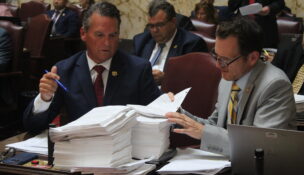
Baltimore Inspector General Isabel Mercedes Cumming is fighting the city law department's decision to treat her subpoenas like Maryland Public Information Act requests. Shown here are documents that she says the city's law department gave her in response to her subpoena. (Courtesy of Isabel Cumming)
MD inspectors general call for change to public records law


All four of Maryland’s local inspectors general are calling for an amendment to the state’s public records law that would clarify that they have direct access to government documents.
The four IGs — from Baltimore City and Howard, Montgomery and Baltimore counties — on Thursday expressed “profound concern” about an advice letter from the Maryland Office of the Attorney General to the administration of Baltimore Mayor Brandon Scott.
An OAG official argued their requests for documents are equivalent to civilians’ and reporters’ requests under the Maryland Public Information Act — and therefore require personnel and financial information to be redacted.
The OAG letter supported Scott’s recent move to restrict Inspector General Isabel Mercedes Cumming’s access to records, rendering an investigation into the Mayor’s Office of Neighborhood Safety and Engagement essentially impossible, as it did not provide her with enough information to “follow the money.”
It was the first time Cumming has ever had records redacted in her eight years on the job.
“This letter has the potential to incapacitate our offices and diminish our ability to root out fraud, waste and abuse in our respective jurisdictions,” the inspectors general wrote.
Their letter was signed by Cumming, Montgomery County IG Megan Davey Limarzi, Howard County IG Kelly Madigan and Baltimore County Deputy IG Steve Quisenberry.
In the letter of advice, Assistant Attorney General Shaunee Harrison argued that the MPIA supersedes an inspector general’s right of direct access to all city or county records — even if the IG orders disclosure via a subpoena.
“[I]t makes no difference whether the legal mandate to disclose the records takes the form of a subpoena authorized by local law, or appears in the local law itself,” Harrison wrote. “If the authority for the request stems from local law, it cannot overcome a State law prohibition on disclosure.”
At a Feb. 10 meeting of Baltimore’s OIG Advisory Board, Cumming said 104 of the 324 investigations she’s conducted have relied on information that would be redacted under the new rule. Those investigations identified just under $39 million in fraud or wasteful spending, she said. The board gave her permission to hire a pro bono attorney to sue the city to enforce the subpoena.
Cumming told The Daily Record that the letter was historic, marking the first time all of Maryland’s local inspectors general have issued a joint statement.
They argue that the MPIA has never applied to their work, but that an amendment would remove all doubt. They noted that they are obligated to redact protected information in their public reports. Cumming recently published an opinion arguing that her office is a “co-custodian” of city records.
“As a result of the OAG’s letter, such records could be withheld from us in whole or redacted to the point that they are essentially rendered useless from an evidentiary standpoint,” they wrote.
“To be clear, once such records are in our possession, we have now, and have always had, the same responsibility as our employers — to not disclose to the public records that are otherwise protected.”
In a statement, an OAG spokesperson stressed that there is a difference between an “advice letter” and a “formal opinion,” saying the advice wasn’t “intended to determine how any particular office should operate.”
“Advice letters from the OAG are intended primarily to assist legislators in carrying out their legislative responsibilities,” the spokesperson said. “In this case, the letter explained the law at a broad level and did not apply those principles to any specific local government matter or investigation. It was not a formal opinion and was not intended to determine how any particular office should operate. We have no further comment on this matter.”
The OAG “encourages transparency and accountability in government,” but declined to comment on the proposed MPIA amendment.
This story has been updated.