Sign In
 Free Newsletter


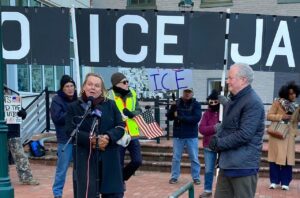
Dawn Didion of Hagerstown holds a sign during a Washington County Indivisible protest against U.S. Immigration and Customs Enforcement outside the Washington County Administration Building on Feb. 24, 2026. (USA TODAY Network via Reuters Connect)
MD challenges ICE warehouse purchase over environmental, health concerns


Key takeaways:
- Maryland’s attorney general filed a lawsuit against Homeland Security and ICE regarding a Washington County warehouse purchase.
- The suit claims violations of the National Environmental Policy Act and Administrative Procedure Act.
- The warehouse, purchased for $102.4 million, is planned for conversion into a 1,500-bed immigrant detention center by September 2026.
- Maryland officials express concerns over environmental impact, wastewater capacity, traffic and public service burdens from the detention facility.
Public health and environmental concerns are among the reasons cited by the State of Maryland’s lawsuit that asks a federal court to vacate the U.S. Department of Homeland Security’s purchase of a Washington County warehouse to serve as an immigrant detention center.
The lawsuit was filed in U.S. District Court in Baltimore on Monday, Feb. 23, by the Maryland Attorney General’s office.
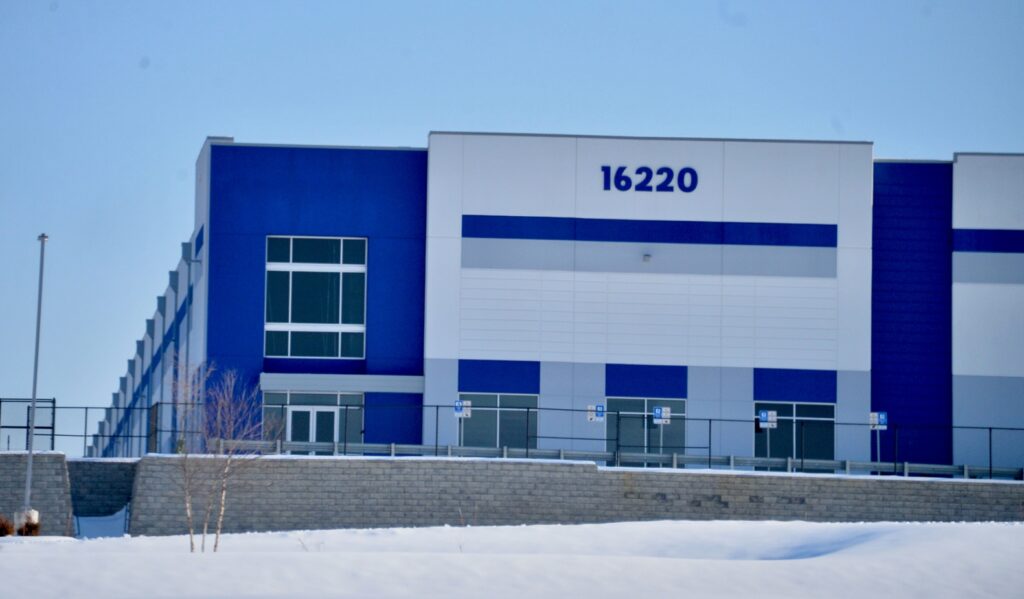
It concerns an 825,620-square-foot mega warehouse at 16220 Wright Road near Williamsport that Homeland Security and ICE purchased on Jan. 16 for $102.4 million from FRIND-Hopewell LLC with an address in Washington, D.C., according to the Maryland Department of Assessments and Taxation’s website.
In a Jan. 28 response to The Herald-Mail, an ICE spokesperson said that while there were no new detention centers to announce at the time, “These will not be warehouses — they will be very well structured detention facilities meeting our regular detention standards.”
ICE could be planning to convert the Wright Road warehouse for its use by September 2026, according to the state’s lawsuit.
News reports about ICE’s plans for an immigrant detention center in Washington County, and then the publicizing of the warehouse purchase, have led to local protests against ICE. Washington County Indivisible has organized several such protests, including one on Tuesday morning, Feb. 24, outside the Washington County Administration Building in downtown Hagerstown, and one on Jan. 20 at Public Square that was attended by Sen. Chris Van Hollen, D-Md., and Rep. April McClain Delaney, D-6th.
What does the Maryland Attorney General’s lawsuit against Homeland Security say?
The state’s lawsuit says the defendants “have run roughshod over federal law and trampled on the State’s interests” in “their zeal to purchase” the Wright Road warehouse to convert it into an immigrant detention facility.
The defendants are Homeland Security, ICE, Homeland Security Secretary Kristi Noem and Acting ICE Director Todd Lyons.
The state alleges federal authorities disregarded requirements of both the National Environmental Policy Act (NEPA) and the Administrative Procedure Act (APA), which “serve to ensure federal agencies act in a transparent manner, engage in reasoned decision-making, and analyze feasible alternatives.”
“Specifically, NEPA requires federal agencies to prepare a detailed statement of environmental impacts before taking final action, ensuring both that environmental considerations are integrated into the decision-making process and that States, interested parties, and members of the public have access to relevant information so they may play an informed role in the decision-making process and implementation. Likewise, the APA requires reasoned decision-making, including consideration of reasonable alternatives,” the lawsuit states.
The lawsuit accuses Homeland Security and ICE of not conducting a “public NEPA review of the Project’s likely impacts on the environment” before buying the warehouse to convert it into an immigration detention center.
Little information has been provided to the state about plans for the property, which keeps the state from being able to fully assess the “harm” the project could have on the state’s “sovereign interests,” the lawsuit states.
The lawsuit includes a copy of a Jan. 12 letter a Homeland Security official sent to the Maryland Historical Trust that the lawsuit states includes a “general, non-exhaustive list of possible” improvements to convert the warehouse into a detention facility.
According to Homeland Security’s letter, the potential improvements include:
- Installing, upgrading, or rehabilitating existing parking areas, fencing, site lighting, landscaping, drainage/stormwater, recreation areas, and cameras
- Possibly installing tentage and a guard shack
- Painting or sealing the exterior of the structure
- Installing, removing, or modifying bays (truck bays, window bays, or doors)
- Repairing or replacing the existing roof or cladding materials
- Adding security equipment
- Adding exterior personnel/guest access controls
- Renovating or rebuilding the interior “to support ICE operational requirements, which may include but are not limited to construction of holding and processing spaces, office space, public-facing visitor spaces, and installation of amenities, such as cafeterias, bathrooms, and health care spaces.”
The lawsuit states the historical trust sent a second letter to Homeland Security requesting more information after the trust received comments “calling into question” the project’s scope.
State officials, in the lawsuit, said they expect the detention facility will put “additional burdens on essential public services in light of public reporting of conditions in detention facilities around the country …”
The lawsuit states that converting the warehouse into a detention facility “could overwhelm the existing sewer lines serving the property.”
A 1,500-bed facility could produce 90,000 gallons of wastewater a day, state officials project in the lawsuit. The estimated average daily wastewater flow for the warehouse is 24,768.6 gallons a day.
The state has an interest in protecting its waterways for recreational and environmental reasons, with the lawsuit noting the nearby Semple Run. Semple Run discharges into the Conococheague Creek, a major tributary of the Potomac River.
The lawsuit mentions state-protected aquatic species in waters adjacent to and downstream from the warehouse. The state considers the brook floater mussel and green floater mussel, both found in the Potomac downstream of the Conococheague, to be endangered species. The green floater mussel is proposed to be included on the list of federally threatened species.
Also mentioned are the Allegheny pearl dace and Appalachian springsnail, which the state considers to be “in need of conservation.”
The lawsuit also states that the defendants haven’t provided “any indication of whether they anticipate having to close roads in the area to accommodate traffic to and from the facility” or what other traffic impacts the facility could have.
The Herald-Mail submitted a Public Information Act request with Washington County government on Feb. 10 asking, among other things, if the county received any requests to limit access to the new stretch of Wright Road in front of the warehouse Homeland Security/ICE purchased.
The Herald-Mail, on Feb. 24, received an update from the county saying it would take longer than 10 working days to retrieve, review, and produce the records.
The warehouse sits along a recently relocated section of Wright Road that connects a narrow two-lane stretch of Hopewell Road to an older section of Wright Road that intersects Elliott Parkway. Elliott Parkway is part of a business park.
Semple Run is south of the warehouse and along an older section of Wright Road, south of the newer stretch of Wright Road. A one-lane bridge along nearby Hopewell Road crosses Semple Run.
Homeland Security responds to Maryland lawsuit over warehouse purchase
A Homeland Security spokesperson, via email on the afternoon of Feb. 24, provided The Herald-Mail the following comment regarding the state’s lawsuit.
“Let’s be honest about this. This isn’t about the environment. It’s about trying to stop President Trump from making America safe again. The left didn’t care about the mountains of litter that illegals aliens dropped on ranches and riverbeds during Biden’s border crisis. They’re feigning concern now because they want those same illegal aliens to stay forever and vote here.
“These will not be warehouses — they will be very well-structured detention facilities meeting our regular detention standards. Every day, DHS is conducting law enforcement activities across the country to keep Americans safe. It should not come as news that ICE will be making arrests in states across the U.S. and is actively working to expand detention space.
“Secretary Noem has stated that she is willing to work with officials on both sides of the aisle to expand detention space to help ICE law enforcement carry out the largest deportation effort in American history.
“ICE is targeting criminal illegal aliens including murderers, rapists, pedophiles, gang members and more. 70% of ICE arrests are of illegal aliens charged or convicted of a crime in the U.S. Thanks to the One Big Beautiful Bill, ICE has new funding to expand detention space to keep these criminals off American streets before they are removed for good from our communities.”
What does Washington County government say?
The Washington County Board of Commissioners approved a resolution on Feb. 10 that supports the U.S. Department of Homeland Security, U.S. Immigration and Customs Enforcement, and local law enforcement.
The commissioners voted 4-0 to approve the resolution, to a chorus of boos from the meeting room gallery, according to a YouTube video of the meeting. Commissioner Derek Harvey was absent from that meeting and the one on Feb. 24.
On Tuesday, Feb. 24, County Administrator Michelle Gordon read a statement reinforcing statements the commissioners had previously made regarding the property purchased for ICE, according to a YouTube livestream of the meeting.
“We understand that the community is concerned. Washington County was not involved in the site selection process regarding the new facility that will be opened in Williamsport.
“We were not consulted by the federal government or the private entity involved in the sales transaction of an existing structure. This is now a property owned by the federal government. As such, Washington County government has no jurisdiction and we are not the governing body that will be overseeing this project,” Gordon said.
Gordon was interrupted by a member of the audience who said he had a question, according to a YouTube video of the meeting. Gordon said “This is not an interactive meeting” and Commissioners President John Barr asked the man to leave.
When Gordon continued she said there had been suggestions by noncounty and county residents that compared the Williamsport-area project to a facility in Howard County, Maryland, and two recent actions taken by government in that county.
The Baltimore Banner, on Feb. 2, reported that Howard County revoked a building permit for a private detention facility proposed in Elkridge that is proposed to be used by ICE.
“Those are not a fair comparison,” Gordon said. “The example from Howard County involved a building owned by a private company, which is not the case here in Washington County, where the building is owned by the federal government.”
“The suggestions being made would require a legal opinion and interpretation of the potential liability of all parties involved both for the county and personally for individuals taking potentially adverse actions against another organization.
“Additionally, a legal opinion and interpretation would be needed regarding the hierarchy and interactions between local, state and federal government authority and jurisdiction, all of which we are not able to comment on at this time,” Gordon said.
Gordon noted a Jan. 28 statement from the county and the Feb. 10 resolution the commissioners approved.
The Jan. 28 statement said the county’s Historic District Commission, Washington County Planning and Zoning Department, received a letter on Jan. 14 from Homeland Security. The letter indicated Homeland Security was analyzing the potential purchase of the warehouse at 10900 Hopewell Road (A/K/A 16220 Wright Road).
In the letter, DHS communicated that the undertaking results “in a finding of No Historic Properties Affected”. The federal law in question does not give the County any opportunity to overrule that determination, according to the county statement.
Gordon, on Feb. 24, said the “county has not been provided with any project information from the federal government for their property on Wright Road and Washington County is not going to speculate on future use or development of this site.”
Washington County Indivisible continues anti-ICE protests outside county offices
Washington County Invisible began an anti-ICE protest outside the county building before the start of the Feb. 24 commissioners meeting.
The protest group was not as large recent anti-ICE protests during county meetings. About 10 protestors were outside, though a few more joined shortly later. Eric Schwartz, co-founder of the local Indivisible group, said some members had gone inside for the commissioners meeting.
The temperature was in the mid 20s and the wind chill was around 11 degrees, according to the National Weather Service’s website.
Dawn Didion, a Hagerstown resident and Indivisible member, said her main concern is the “cruelty and inhumanity of ICE and our County Commissioners welcoming them into our community. It’s embarrassing, them not willing to address this openly,” she said standing outside as the meeting was about to begin inside.
Asked what her main concern was, Indivisible member and county resident Sandy Foles said, “Where to start. I guess the government-sanctioned cruelty in our own backyard.”
“We haven’t been able to have a voice (in this),” she said.
A small group from Rapid Response Choir joined the protest and began singing, with its members wearing pink vests.
Choir member Kate Sugarman said the choir “responds to injustice” and sings “joy with resistance.” The group is from Washington, D.C., Maryland and Virginia.
Yellow tape reading “sheriff line do not cross” was seen stretched in front of most of the patio in front of the county administration building, with protestors standing on the sidewalk below.
Sheriff Brian Albert said the tape was installed Tuesday morning, Feb. 24, to keep protestors from blocking fire exits.
Schwartz said protestors had previously stood on the patio.
Regarding an inquiry Feb. 3 about an earlier Indivisible protest outside the county building, county spokesperson Danielle Weaver said at the time that “Washington County respects the public’s right to peacefully assemble and express their views. The rally occurred outside the County Administration Building and did not disrupt county operations or the Board meeting.”
Weaver, on Feb. 24, wrote in an email that the tape “was a precautionary step to maintain public safety and ensure clear ingress and egress for those conducting business inside” the county building.
A K-9 team also was seen patrolling in front of the county building during the Feb. 24 protest.
Hagerstown Fire Marshal Dale Fishack was patrolling with his K-9 partner, Ruby, a black Labrador. Fishack was wearing a patch on his uniform that read “Explosives Canine Certified” and “ATF National Odor Recognition Test,” for Ruby’s certification. Fishack said Ruby is not an ATF dog, but a city-owned dog who tested through ATF.
Albert said Fishack and Ruby were asked to go to the county building for two reasons.
One reason was to enforce how many people can be in the commissioners meeting room and in the hallway because Fishack is a fire marshal, Albert said.
Second, Fishack was asked to patrol with Ruby in case someone brought explosives to the area, according to Fishack and Albert.
No explosives had been detected, Fishack said.
Albert said Fishack had been to the last few protests by the county building.
Hagerstown officials discuss water service for planned ICE facility
During a Feb. 17 Hagerstown mayor and City Council work session, the council discussed with the city’s utility director water service for the Wright Road warehouse since the city provides the public water connection there.
City Administrator Scott Nicewarner, in a Feb. 24 email, said the city hasn’t received a request for additional water service capacity or infrastructure for the 16220 Wright Road property.
Utilities Director Nancy Hausrath, during the work session, said the property had purchased water allocation for 800 gallons a day. That amount would be “very low” if the Wright Road facility uses were to include laundry, food service and showers.
That’s not even a gallon per person a day when considering the possibility of 1,500 people, Hausrath said, referring to reports of the facility accommodating 1,500 beds. For perspective, she said a conversation toilet uses 1.5 gallons of water.
The warehouse has a 2-inch domestic service line that can produce 200 gallons per minute for continuous flow, said Hausrath, according to a YouTube video of the work session.
The property owner would likely need to upgrade the water service if the building is used for housing because that meter would not be sufficient for peak usage, she said.
According to the discussion and confirmed by Nicewarner, the City Council would be required to approve water service under two conditions, neither of which apply regarding the Wright Road property.
Those conditions are:
- When a property is in the Urban Growth Area, which is outside the city’s Medium-Range Growth Area (MRGA).
- When there is a transfer of water allocation from inside city limits, within the MRGA.
The city water department cannot deny an extension of water service or a request to increase water allocation unless the water department has a valid, sufficient reason to deny that service, city officials said during the work session.
Referring to City Code, Councilman Kristin Aleshire said, “When you read that, it doesn’t give us some blanket autonomy to say, ‘We just don’t feel like it today.’ ”
Councilwoman Caroline Anderson asked if the city would have discretion to disconnect water if at some point there is a public health issue.
Hausrath said when utility officials consider terminating a customer’s service, they take into consideration not creating a public health situation.
“I can honestly say I’ve never been put in that situation. I would have to consult with legal counsel to say if this situation occurred, could we terminate water service?” Hausrath said.
Reporting by Julie E. Greene, The Herald-Mail / USA TODAY Network via Reuters Connect.