Sign In
 Free Newsletter

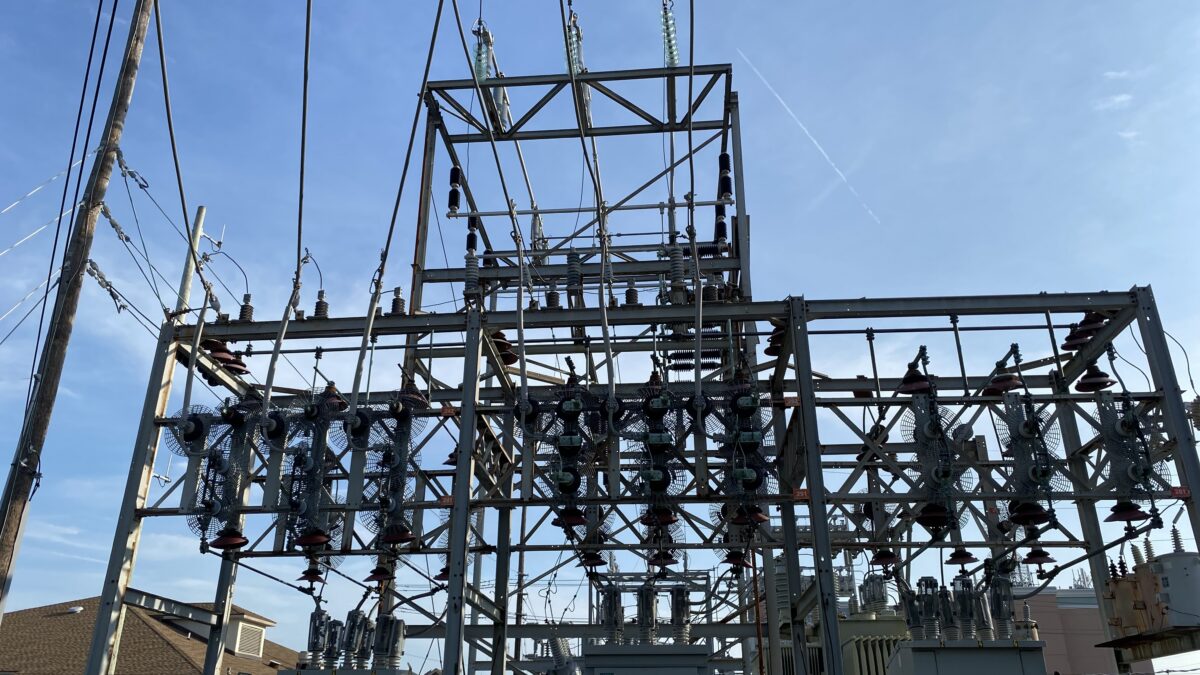
Electric infrastructure for Delmarva Power in Ocean City. (Kendyl Kearly/The Daily Record)
Utility rate-setting is ‘Catch-22,’ MD lawmakers, advocates say


Key takeaways:
- Marylanders have seen high utility bills over recent years
- Del. Andre V. Johnson Jr. sponsors bill to change rate regulations
- Utility companies say the bill would have hurt long-term investment in state
- Advocates say consumers need more protections
- Bill will likely come back in 2027
Across multiple legislative sessions, lawmakers have attempted to lower skyrocketing utility bills for Marylanders, mostly through incremental steps.
“Utility rates are very hard to reduce because a lot of the categories of costs — once they’re approved in rates — they’re very hard to reduce,” said David S. Lapp, the Maryland people’s counsel, a state consumer-protection authority. “But the … one component of rates where the state has a lot of control is the profit level, which is the return on equity, and it can provide an immediate way to give ratepayers substantial relief.”
A bill brought forth this year by Del. Andre V. Johnson Jr., D-Harford, sought to lasso those utility profits.
RELATED: Piedmont power line sparks preliminary eminent domain questions
Johnson’s legislation would have required the Maryland Public Service Commission, a government regulating body, to adjust rates based on actual financial risk to utility companies instead of the estimated market return, an informational letter from the commission reads.
According to the letter, the commission would have to establish base rates that give utility companies the opportunity to receive a fair rate of return on investment, or the weighted average of a utility company’s equity and cost of debt. The cost of equity, also known as the return on equity, for a utility company is based on the potential earnings for investors.
Legal standards for determining fair returns on equity state that the cost must be comparable to returns investors expect for investments of similar risk, assure confidence in the company’s financial integrity and maintain and support the company’s ability to maintain its credit and attract more money.
Johnson said he brought the bill forth as its lead sponsor because utility companies are “playing the market” and “thinking about their return on investment for their shareholders” rather than the financial pain of their ratepayers.
“That was the impetus of the piece of legislation, to make sure that the utility companies are tasked with only being paid for the service that they’re delivering to the ratepayer,” Johnson told The Daily Record.
Johnson ultimately withdrew the bill before the House Environment and Transportation Committee heard it — not just because he wanted to tweak it to better protect ratepayers but also to bring utility companies into the fold to determine why they keep submitting high rates.
He said after working with stakeholders over the interim, he plans to resubmit the bill in 2027.
“I just wanted to make sure that … the community knows I didn’t pull it just to pull it,” he said. “I’m pulling it to make sure that I have everybody on board and that we have the best piece of legislation that we could possibly have.”
RELATED: 100% clean electricity by 2035: Can MD meet climate goals?
Utility companies, including Baltimore Gas and Electric Co., Washington Gas Light Company, Pepco Holdings, Chesapeake Utilities Corporation, Concentric Energy Advisors and Potomac Edison, listed themselves in opposition to the bill, saying it would have potentially undermined the regulatory environment that attracts long-term utility investment in the state.
According to favorable written testimony from Emily Scarr, a senior adviser at the consumer advocacy organization Maryland PIRG, returns on equity for Maryland’s utility companies have consistently risen: BGE‘s base rates were most recently set at 9.45% for gas and 9.5% for electric; Pepco Electric and Washington Gas Light was set at 9.5%.
Exelon, the parent company of BGE, Pepco and Delmarva Power, reported $2.7 billion in profit in 2025, according to Scarr’s letter.
Before it was purchased by Exelon in 2012, BGE was consistently raking in under $150 million per year in profit. Last year, BGE’s profit was $578 million. Profits for Pepco rested at $205 million in 2018, and the company reported $390 million in 2024.
The General Assembly also tackled the high cost of energy costs through the Utility Reducing Energy Load Inflation for Everyday Families, or RELIEF, Act, which prohibits energy companies from pursuing forecast-based energy bill increases for one year, among numerous other measures. The emergency bill went into effect in mid-May.

House Economic Matters Committee Vice Chair Lorig Charkoudian, D-Montgomery, said utilities are a monopoly, and, as such, they make and earn returns on investments.
“So when the shareholders put their capital into building a transmission line, building a substation, building battery storage on that substation, building distribution lines, what is a fair market return for that money?” she asked in an interview.
“That’s the job of the Public Service Commission,” said Charkoudian, who noted that the way that the law is currently written directs the commission to determine reasonable rates of return based on the returns of other utility companies in nearby states.
“So you’re kind of in this Catch-22, where utilities in nearby states are getting, like, 9%, 10%, 11%, and so utilities in Maryland get 9%, 10%, 11%,” she said. “It’s basically this … circular reasoning of everyone just keeps getting 10%.”
RELATED: Maryland’s new energy law intertwines with data center boom
Charkoudian also said that shareholder investments in utility companies are “very, very low-risk” because the Public Service Commission is “almost guaranteed” to approve proposed rates when they are submitted.
“So it really asks a question, like, ‘Gosh, if you look at other stocks on the stock market that are as low of a risk as a utility investment, are any of those other stocks … getting rates of return that are nine, 10, 11%?’” she said. “For the most part, they aren’t.”
Lapp said in an interview that returns for utility companies should be even lower than similar markets because they are lower-risk than competitive firms. He said the legislation would have set “objective benchmarks” from asset-management companies like BlackRock and Morgan Stanley, and have set the upper limit of return for utility companies based on that data.
Unfavorable written testimony on the bill from Potomac Edison stated that the measures under the bill would tie a company’s return on equity to “broad market indicators” instead of the individual needs and reliability obligations unique to Maryland utility companies. And Concentric Energy Advisors wrote that the legislation would “meaningfully distinguish how the rate of return is set for Maryland public service companies from every other state in the U.S. and inhibit utilities from raising the capital needed to make investments for their customers.”
But Scarr said there’s evidence that proves that isn’t the case.
“Because these investments are such low-risk and stable long-term investments, the evidence does not suggest that would actually come to fruition,” she said.
Scarr said profits for utility companies are higher than necessary for their success and do not align with public benefit.
“It’s costing ratepayers hundreds of millions in excessive costs, driving up our bills,” she said. “When profits skyrocket and customer benefits don’t improve or even get worse, there is a serious problem. And profit rates, in particular — a lot of that is driven by their rate of return.”
Scarr conceded that utility companies do need a rate of return in order to attract investors because utilities make investments up front with investor money, which they pay back over time.
“The problem is the rates of return in Maryland and across the country are way higher than they arguably need to be to attract that investment,” she said. “Utilities are a relatively low-risk investment, so they’re attractive to investors; they’re attractive to retirement plans, pensions — all of these things are attracted to utilities not because of their high rate but because of their stable and low-risk investment.”