Sign In
 Free Newsletter

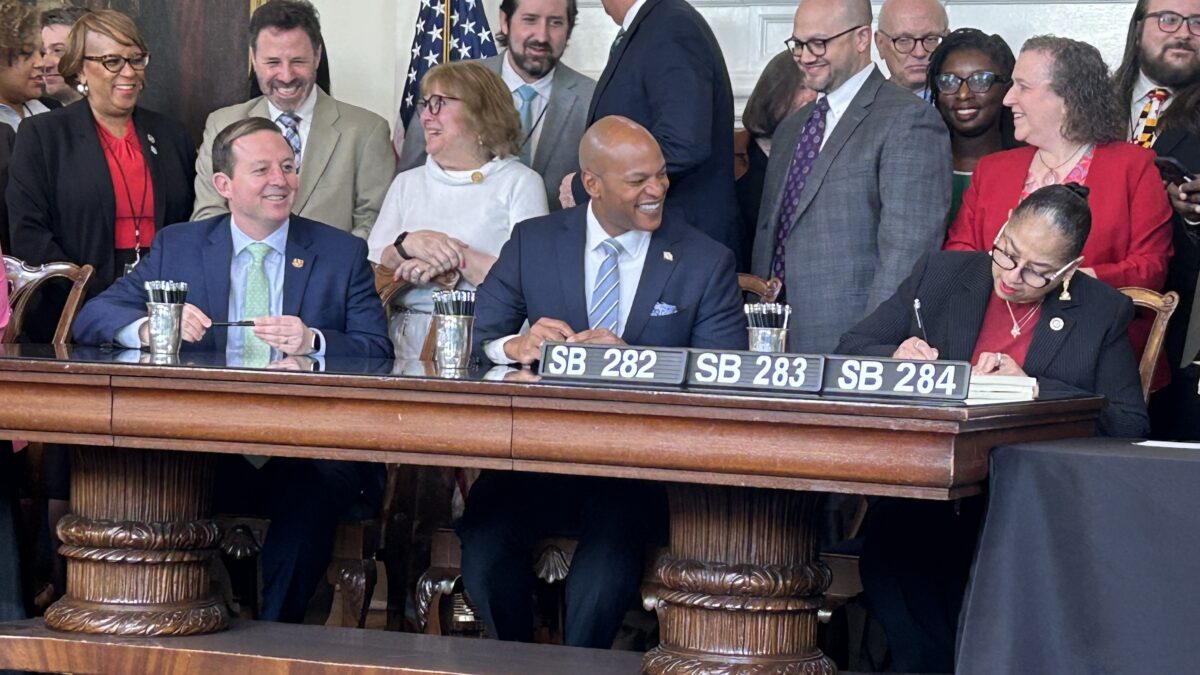
Senate President Bill Ferguson, Gov. Wes Moore and House Speaker Joseline Peña-Melnyk sign the fiscal year 2027 budget on April 8, 2026. (Hannah Gaskill/The Daily Record)
Moore signs $70.8B state budget with surplus


Key takeaways:
- Gov. Wes Moore signed Maryland’s $70.8 billion budget for fiscal year 2027.
- The budget includes $124 million for local law enforcement and $384 million for low-income rental assistance.
- Democrats say the budget maintains fiscal discipline with no new taxes or fees and leaves a $250 million surplus.
- Republican leaders criticized the budget for deferring structural deficit challenges to the next term.
ANNAPOLIS — Gov. Wes Moore signed Maryland’s $70.8 billion budget bill Wednesday, touting investments in public safety, housing, education and affordability for fiscal year 2027.
“A budget is a spending plan, but it’s really a statement of values and priorities,” House Speaker Joseline Peña-Melnyk, D-Anne Arundel and Prince George’s, said at the Annapolis bill-signing. “It is a moral document that tells you a lot about who we are deep inside, and what this budget says is in Maryland, we care about each other, and we care about people regardless of what’s happening at the federal level.”
Before Moore, Peña-Melnyk and Senate President Bill Ferguson, D-Baltimore City, lent their signatures to the operating and capital budgets, as well as the budget’s companion bill, each emphasized their respective highlights, including $124 million for local law enforcement, $100 million in utility relief — contingent on the passage of sweeping energy legislation slated to go to conference committee this week, $100 million in tax cuts for businesses, $73 million for energy efficiency, $384 million in low-income rental assistance and $1.7 billion for SNAP funding.
“And by the way, we did all of these things without losing fiscal discipline,” Moore said. “A balanced budget with no new taxes and no fees.”
The $70.8 billion leaves a $250 million surplus with $2.2 billion left in the state’s Rainy Day Fund.
But the completion of the budget didn’t come without struggle.
“From the very beginning of January, … we were clear-eyed about the challenges that stood right in front of us here in Maryland,” said Ferguson. “Maryland families were and continue to feel economic pressure from this federal administration. The state is also feeling that pressure as well.”
At the session’s start, Moore and the General Assembly were contending with a $1.4 billion structural deficit. Fiscal analysts have forecast that there will be even larger budgetary holes to fill in the coming years.
Asked after the signing how this year’s bill plans to reconcile future deficits, Department of Budget and Management Secretary Jake Weissman said that any decision-making regarding the fiscal year 2028 budget is “months and months away.”
Republican leadership in the General Assembly decried the budget Wednesday, saying that Democrats punted Maryland’s fiscal woes to the next term.
“Rather than addressing the state’s structural deficit, the Governor and Democratic leadership have chosen to push those challenges to the next term by refusing to address structural deficits caused by the Blueprint for Maryland’s Future, liability for the Child Victims Act and possible reparations,” Senate Minority Leader Steve Hershey, R-Upper Eastern Shore, said in a statement. “The necessity to raise taxes next year will impair any opportunities for economic growth and force Marylanders to move to states with surpluses and more tax-friendly climates.”
The Blueprint for Maryland’s Future is Maryland is the state’s landmark, multibillion-dollar education reform plan. Its future funding is uncertain in the coming years, and a study on the efficacy of the first several years of the plan’s rollout is poised to be released this summer.
Difficult cuts had to be made to balance the fiscal year 2027 budget, as well — most notably $127 million shaved from the state’s Developmental Disability Administration, which prompted several Annapolis rallies led by members of the community.
When House Democrats combatted a Republican-offered amendment to restore DDA funding, Del. Emily Shetty, D-Montgomery, said a federal cost provision would put the people who utilize the agency’s services in jeopardy of being institutionalized if the money were to be reinstated.
“To protect this waiver, we had to take and make those decisions, and it was not easy,” said Peña-Melnyk. “This is an example of how we dealt with accountability, and it was difficult, but we did it.”