Sign In
 Free Newsletter

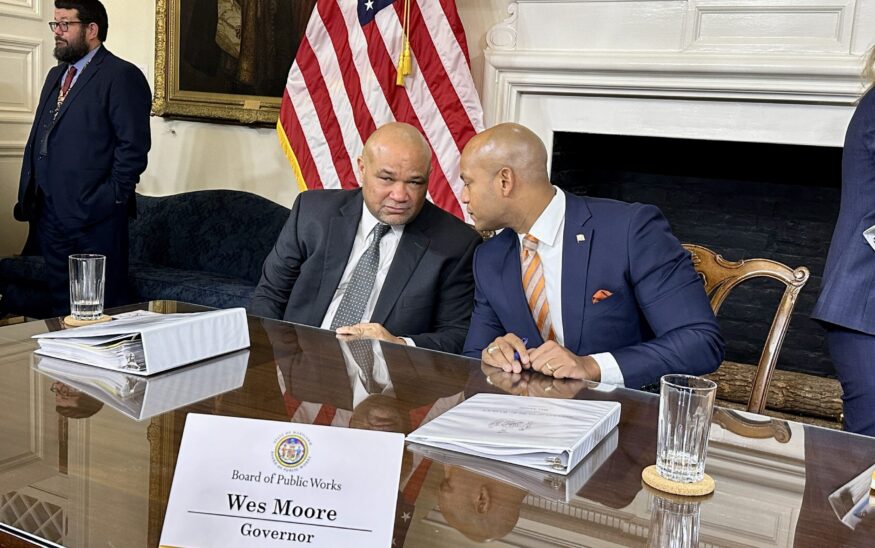
State Treasurer Dereck Davis (left) and Gov. Wes Moore (right) convene after a meeting of the Board of Public Works on Jan. 31, 2024. (Sapna Bansil/Capital News Service)
MD treasurer challenges judicial appointment process as not ‘a reflection of society at large’


The state treasurer questioned the judicial nomination and elections process upon hearing that members of the Appellate Judicial Nominating Commission are only representative of five of Maryland’s 24 jurisdictions.
“It makes it hard to support a retention election because when the outcome seems unfair — and I emphasize seems unfair — what alternative do you have when it’s just a retention?” Dereck E. Davis, a Democrat, asked during Wednesday’s meeting of the Maryland Board of Public Works in Annapolis.
Davis said he was contacted by a Prince George’s County resident regarding concerns over two candidates for the Maryland Supreme Court in 2024.
At the time, three judges from Prince George’s — Krystal Quinn Alves, Tiffany Hanna Anderson and William Antoine Snoddy — were nominated, though none were appointed by the governor. This year, Alves and Anderson were applicants for the appellate court at large but weren’t selected by the commission as nominees.
“They were concerned,” Davis said of his source. “How can you be deemed qualified for, you know, if you will, ‘the major leagues,’ but then the one just below it, you’re not qualified for that? And I didn’t have an answer for him.”
Throughout Maryland, 16 judicial nominations commissions recommend attorneys for the governor to appoint to district and circuit courts. Candidates for judicial vacancies in the appellate courts are nominated by one statewide committee.
The governor appoints members to all commissions for five-year terms.
After nominated, appointed and confirmed by the state Senate, circuit and appellate court judges must eventually be reelected during general elections.
In elections for appellate judges, voters are simply deciding whether they should retain their positions on the bench. In circuit court races, judges can face opponents who apply to run against them in nonpartisan races. If the challenger wins, they do not need to be appointed.
Meanwhile, orphans’ court judges are directly elected by voters.
According to Maryland Judiciary website, law firm websites and LinkedIn profiles, all 17 members of the Appellate Judicial Nominating Commission appear to come from five areas in the state. Ten of them practice in the Baltimore area, three in Montgomery County, two in Prince George’s County, one in Anne Arundel County and another in Calvert County.
The Maryland Judiciary did not answer questions Wednesday.
While being careful to not impugn members of the commission’s competency or integrity, Davis said he “didn’t think that that was a reflection of society at large.”
At a legislative panel during the Maryland State Bar Association’s annual conference in June, Del Jon S. Cardin, D-Baltimore County, said the state should explore the elimination of judicial elections, calling them an “inherent conflict of interest” because candidates can receive money from the lawyers who argue before them.
House Minority Leader Jason Buckel, R-Allegany, responded that reforms would be needed to the judicial appointment process to make them fairer if the elections disappeared.
He added in an interview Wednesday: “I think, overall, it requires more input than just the governor into who goes on to the trial court and judicial nominations commissions. I think that you would have to have a much more open process with input from a variety of stakeholders … and I think the nominations committees would have to reflect the political [affiliations] … of a variety of places.”
Gov. Wes Moore, a Democrat who appointed the commission’s members in 2023, said Wednesday that he has “been overwhelmed by the performance” of the Appellate Judicial Nominating Commission and the “type of jurists that they have pushed and pushed in my direction just during these three and a half years.”
“Something that was a core criteria was: Is it a reflection of our state? It is a reflection of not just the … geographic and demographic but also the excellence of the state?” Moore said Wednesday. “And I’m grateful for the work that they have continued to do for these past three and a half years all throughout the state of Maryland.”
This story has been updated.