Sign In
 Free Newsletter

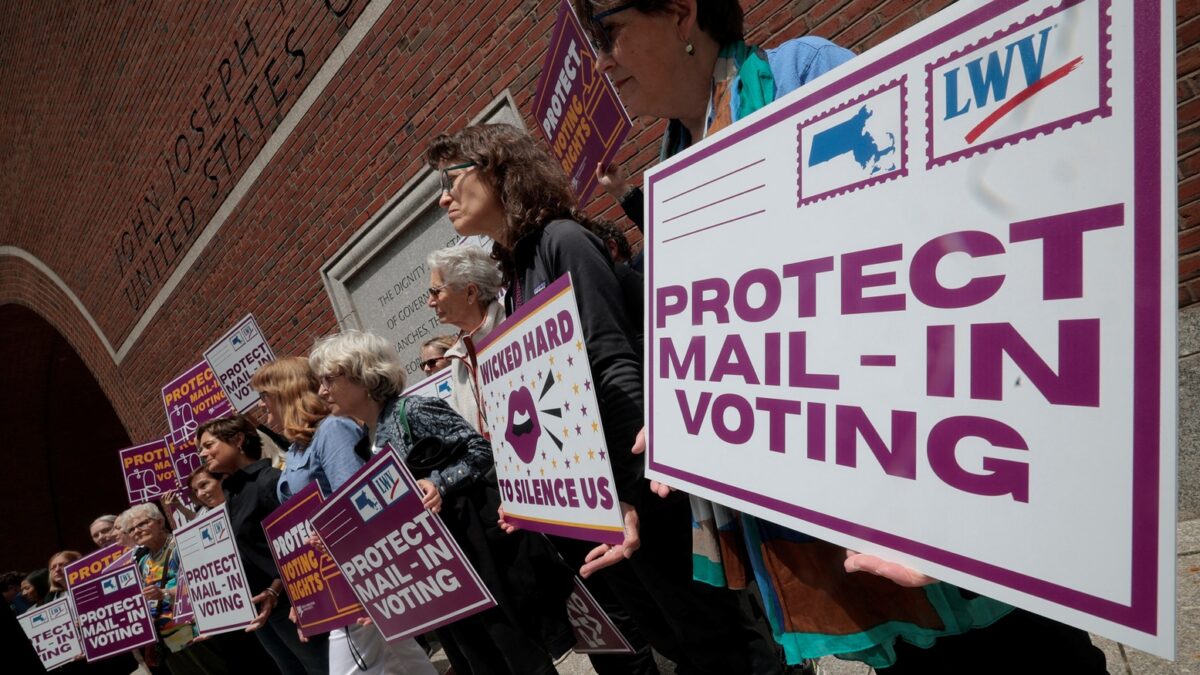
Supporters gather outside the federal courthouse after a hearing in a lawsuit brought by a coalition of Democratic state attorneys general seeking to block President Donald Trump's executive order tightening rules on mail-in voting, in Boston on June 2, 2026. (REUTERS/Brian Snyder)
Judge blocks Trump executive order restricting mail-in voting


Key takeaways:
- Judge Indira Talwani blocks Trump‘s mail-in voting order
- Order found unconstitutional for exceeding presidential authority
- DHS directed to compile voter eligibility lists under order
- USPS required to deliver ballots only to approved voters
BOSTON – A federal judge in Boston on Thursday blocked implementation of President Donald Trump’s executive order aiming to tighten rules for mail-in voting, preventing it from taking effect ahead of November elections that will decide control of Congress.
U.S. District Judge Indira Talwani sided with a coalition of Democratic-led states that argued that the Republican president is trying to unlawfully interfere with the states’ administration of federal elections.
The judge declared key parts of Trump’s order unconstitutional as she found that Trump had exceeded his authority in trying to overhaul procedures for elections, which since the republic’s founding in 1789 have been run by states and local governments.
“The Constitution does not grant the President any specific powers over elections,” wrote Talwani, who was appointed by Democratic President Barack Obama.
She said the president lacked any authority to direct the U.S. Department of Homeland Security to compile voter eligibility lists for each state to use and that the U.S. Postal Service had no statutory authorization to adopt any binding regulations on mail-in voting.
Talwani barred the administration from enforcing Trump’s order ahead of the November 3 midterm elections that are set to decide whether Republicans can retain control of Congress and ordered it to submit a report by next week describing steps it has taken to comply with her ruling.
James Percival, DHS’ general counsel, in a social media post called the ruling “judicial sabotage.”
“The president’s executive order lawfully protects our elections, and we are confident that we will ultimately prevail in its implementation,” White House spokeswoman Abigail Jackson said in a statement.
Series of Trump actions targeting elections
The ruling came a day after another judge in Boston permanently blocked parts of an earlier executive order Trump had signed that would overhaul federal elections by requiring proof of U.S. citizenship to register to vote and barring states from counting mail-in ballots received after Election Day.
That 2025 order along with the more recent mail-in voting one he signed on March 31 followed a years-long campaign by Trump to undermine faith in U.S. elections, including the false claim that his 2020 election defeat was the result of widespread voter fraud.
Trump has made winning approval in Congress of a divisive package of voting restrictions called the SAVE America Act his top priority and on Wednesday stunned lawmakers by abruptly cancelling a signing ceremony where they hoped to showcase newly passed bipartisan legislation to address housing costs.
His mail-in ballot order directed DHS to compile and transmit to the states a list of confirmed U.S. citizens eligible to vote in each state, derived from citizenship and naturalization records and other federal databases.
Talwani, in siding with a group of 23 states and the District of Columbia that had sued over Trump’s order, said any list DHS compiled of citizens would necessarily be incomplete due to privacy restrictions governing the sharing of sensitive personal data collected by government agencies.
Trump’s order also required the USPS to only deliver ballots to voters on each state’s approved mail-in ballot list. USPS recently moved to implement Trump’s directive by issuing new proposed rules requiring states to provide the names and barcodes tied to their mail-in ballots.
U.S. Postmaster General David Steiner told Congress on Wednesday that under its proposal USPS would not deliver ballots in states where officials refuse to provide lists of voters who received mailed ballots, but said he would comply with any court order blocking restrictions.
Trump’s order also directed the U.S. Department of Justice to prioritize the investigation and prosecution of state and local election officials who issue federal ballots to people deemed “not eligible” to vote.
But Talwani said Trump lacked authority under the U.S. Constitution to create new criminal offenses and attempt through his order “to intimidate local election officials to use the necessarily incomplete confirmed citizenship lists as a resource, lest they face criminal prosecution.”
Reporting by Nate Raymond in Boston and David Shepardson in Washington; editing by David Bario, Nia Williams and Mark Porter.