Sign In
 Free Newsletter

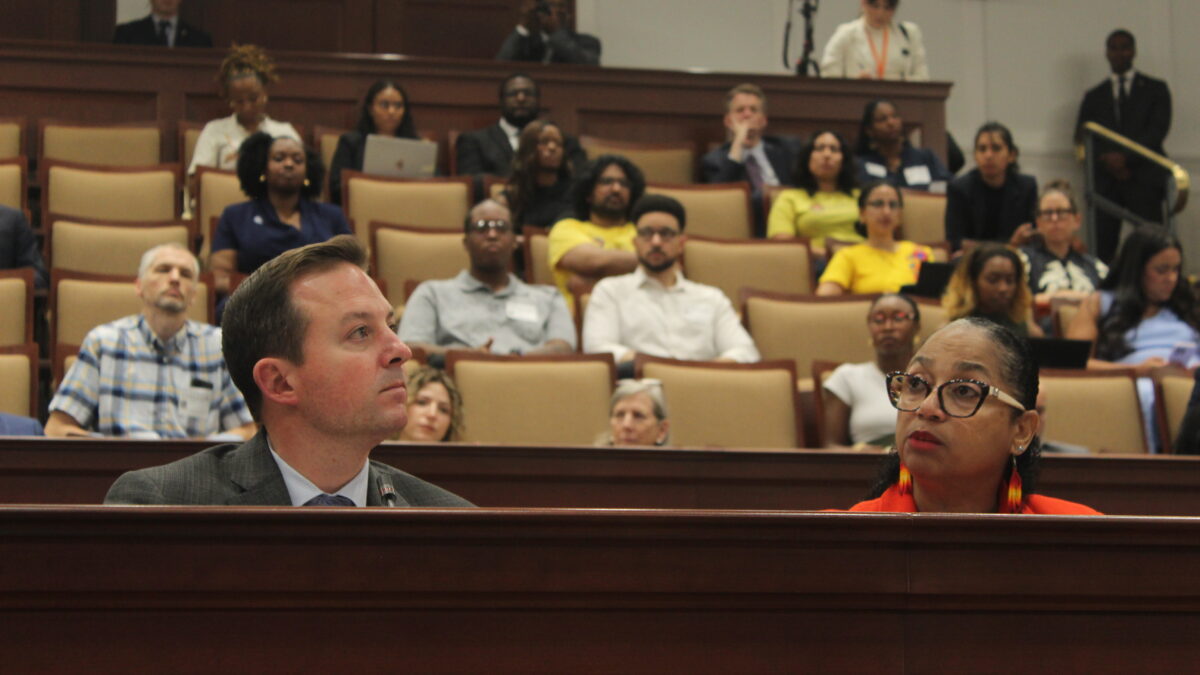
Senate President Bill Ferguson and House Speaker Joseline Peña-Melnyk testify in favor of a ballot initiative to clarify the standards for drawing congressional districts on Aug. 3, 2026. (Hannah Gaskill/The Daily Record)
MD General Assembly special session: Democrats defend redistricting as way of combatting ‘uncertainty’


ANNAPOLIS — As the legislature’s special session heated up Monday, Maryland General Assembly leadership defended legislation to clarify congressional redistricting, while Republicans accused them of pursuing a partisan power grab.
UPDATE: Redistricting ballot question passes in MD House after Eastern Shore secession amendment fails
“I want to focus on what this legislation does and does not do,” House Speaker Joseline Peña-Melnyk, D-Anne Arundel and Prince George’s, said as she testified before the House Government, Labor and Elections and the Senate Education, Energy and the Environment committees. “House Bill 2100 and Senate Bill 2100 do not contain a congressional map. It does not draw a single district line or make any changes ahead of the 2026 election. It does not.”
The General Assembly is convening for a special legislative session Monday to Wednesday to debate a ballot question that would allow November voters to determine whether the state constitution should be amended to clarify the criteria for congressional districts.
In 2022, Judge Lynne A. Battaglia, a retired state Supreme Court justice who was assigned the case, issued an opinion that requires congressional districts to be “geographically contiguous” and “compact.” Prior to that ruling, only state legislative districts had to follow that criteria.
MD General Assembly special session begins Monday: What to know
If passed by lawmakers and approved by voters, the legislature would have sole authority over the congressional map’s configuration of districts as long as they follow federal guidelines. Maps could still be challenged, but the General Assembly would have the authority to directly bump any lawsuits up to the state Supreme Court.
Earlier in the day, Senate President Bill Ferguson, D-Baltimore City, said that unless lawmakers address the “uncertainty” that Battaglia’s opinion cast over the process of congressional redistricting, “any action would jeopardize our state’s current map.”
“We’ve known from the beginning what is at stake, and most importantly, we have known that in this moment of American history, it is insufficient to act with haste when the consequences of missteps are so impactful,” he said.
He and Gov. Wes Moore, a Democrat, stood on opposite ends of the redistricting issue for months. Asked Monday if he is handing the governor a win by entertaining the ballot question, Ferguson said, “That’s for commentators to talk about.”
Moore said Monday that the special session is “not about a victory lap” and that he disagrees with Ferguson’s opinion that moving forward with a new map would have inevitably led to a legal battle.
“I’m very happy that we’re moving right now,” Moore said. “It’s never too early to fight for justice; it’s never too late to fight for justice.”
During the hours-long joint-committee hearing, Peña-Melnyk and Ferguson fended off barbs from Republicans, who argued that the ballot question is a gateway to partisan gerrymandering.
“Just please, do you understand the outrage and the strong opposition to those who would have their voice eliminated due to an 8-0 map?” Sen. Mary Beth Carozza. R-Lower Eastern Shore, asked the presiding officers.
Sen. Chris West, R-Baltimore County and Carroll, said the legislation seeks to alter the state’s Declaration of Rights “to eliminate certain of the rights accorded to the citizens of Maryland.”
“This represents a huge carveout,” West said.
Ferguson responded that prior to 2022, the “application of the Declaration of Rights was not valid on congressional map-making.”
“For the first time in Maryland history, in 2022, a district court judge sitting on behalf of the now-Supreme Court of Maryland, interpreted that differently — not in a binding way and not that we believe is applicable — and so what was created was uncertainty because, at every point prior to that, the Declaration of Rights were not applicable,” he said.
West noted that congressional districts did not exist when Maryland’s Declaration of Rights was adopted in 1776.
Republicans made clear their intentions to drag out the process of legislating over the three-day session, with Senate Minority Leader Stephen S. Hershey Jr., R-Upper Eastern Shore, saying that his party plans to “make this as uncomfortable as possible for the Democrat supermajority to push something through.”
“We’re going to try to take up as much time as we possibly can to make the Democrats stand up for what they want — if they truly want it — or go home,” Hershey said. “If we can send them home early without getting the results they want, then that’s our No. 1 goal.”
Former Del. Dan Cox, who received the Republican gubernatorial nomination earlier this summer, criticized Moore and General Assembly leadership Monday, saying Maryland is responding to federal court decisions by “actually reducing protections for our own citizens.”
“Our Constitution belongs to the people — not to politicians — and constitutional amendments should therefore strengthen the rights of citizens, not weaken the standards that protect fair representation,” he said.
This story will be updated.