Sign In
 Free Newsletter

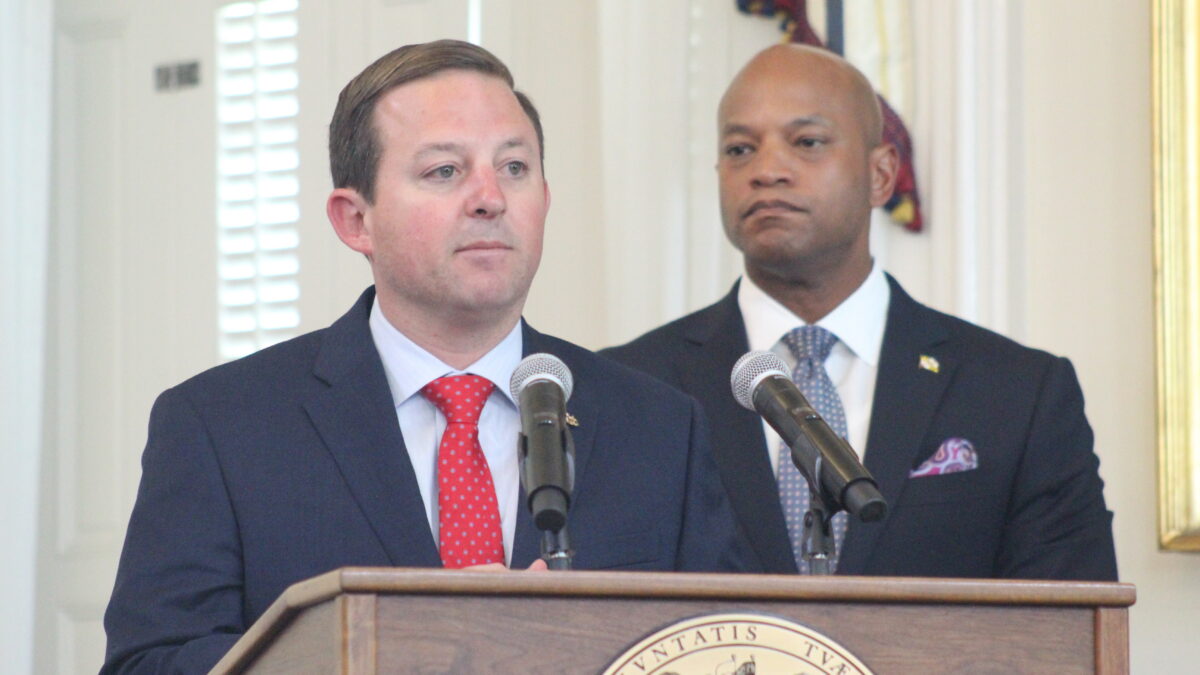
Senate President Bill Ferguson and Gov. Wes Moore speak at a bill signing on April 14, 2026. (Hannah Gaskill/The Daily Record)
Bill Ferguson softens redistricting stance amid campaign, Democrats’ pushback


 Listen to this article
After months of combatting high-profile Democrats, Maryland Senate President Bill Ferguson has softened his stance on midcycle redistricting as he faces the most intense reelection cycle of his political career.
In late May, Ferguson, D-Baltimore City, announced that he was “in active conversations” with the Senate Democratic Caucus regarding the introduction of a constitutional amendment during a special legislative session.
Todd Eberly, a political science professor at St. Mary’s College of Maryland, believes the referendum language will likely clarify the state constitution’s requirement that districts be compact, contiguous and respectful of natural and subdivision boundaries. Doing that would make a more Democrat-favored congressional map less subject to court scrutiny.
Ferguson said he intends to have the referendum before voters in November.
“We’ll meet after the Primary to prepare — we must do this right, without risking what we have already won,” he said.
This revelation was an apparent shift from his previous stance. Although he faced constant pressure this session from Gov. Wes Moore and others to pursue legislation to implement a new congressional map, Ferguson allowed the bill to wither and die in his chamber.
In May, Moore released a slew of endorsements for seats in the General Assembly that didn’t include Ferguson. Moore endorsed all three incumbent House of Delegates candidates in Ferguson’s district.
Ferguson is facing the toughest primary challenge of his career on June 23 in Bobby LaPin, a boat captain and social media personality who supported a vote to redraw the congressional map.
Asked if he believes Ferguson’s slow approach to redistricting could hurt his chances at reelection, Roger Hartley, a professor of public and international affairs at the University of Baltimore, said it’s possible.
“It seems that it hurts because he got an active challenger,” Hartley said. “Someone like a Bill Ferguson is not going to get an active challenger. He got more of a serious candidate.”
In a statement after the endorsements, the Moore campaign said the governor and Senate president “continue to communicate consistently, and work alongside one another to accomplish big things in Maryland.”
Ferguson reaffirmed at a May bill signing his commitment to working with Moore.
“This moment calls for unity and collaboration and is exactly what each and every one of us will continue to deliver,” said Ferguson, flanked by Moore and House Speaker Joseline Peña-Melnyk, D-Anne Arundel and Prince George’s. “Regardless of the noise — regardless of everything else — I want to stand here and full-throated make it clear that the Maryland Senate and I are 100% supportive of the incredible work of the Speaker of the House, the House of Delegates and the governor of Maryland.”
Ferguson and Moore work closely on policy that impacts the whole of Maryland — particularly during Maryland’s annual legislative session. But should both be reelected, will their working relationship be impacted?
“I think maybe that movement towards a constitutional amendment on the ballot might be one of those things that heals that a little bit if that was a major problem for the governor and Sen. Ferguson,” Hartley said. “I don’t recall them being in disagreement” over other things.
Neither could Eberly, who noted that although Moore didn’t endorse Ferguson, he also didn’t endorse LaPin.
“It would have been a huge boost for his opponent; I think that would have been a harder thing to come back from,” he said.
“I imagine that that professional relationship is maintained even though this is something that Moore really wanted to get done,” Eberly said. “I can’t imagine that there would be a degree of animosity that would prevent them on working together on other issues.”
How did we get here?
In November, after several states pursued new congressional maps ahead of the midterm election, Moore convened the Governor’s Redistricting Advisory Commission to gauge Marylanders’ interest in reconfiguring the state’s own map.
Prior to the 2025-26 redistricting push, congressional maps nationwide were typically redrawn after the completion of the U.S. Census, which occurs every 10 years.
Maryland’s congressional delegation consists of 10 members, nine of whom are Democrats. Congressman Andy Harris, the lone Republican representing the Eastern Shore up to a sliver of Baltimore County, is an ally of President Donald Trump‘s.
“My commitment has been clear from day one—we will explore every avenue possible to make sure Maryland has fair and representative maps,” Moore said in a news release announcing the commission. “This commission will ensure the people are heard.”
It had five members, three of whom Moore appointed. The remaining two were to be designated by Ferguson and House Speaker Emerita Adrienne A. Jones, D-Baltimore County. Jones tapped former House Economic Matters Committee Chair C.T. Wilson, D-Charles. Ferguson appointed himself.
After hundreds of Marylanders testified across several virtual hearings, Ferguson broke the news that the commission would vote in favor of redrawing the maps.
“Clearly, the Commission’s work was pre-determined from the moment the GRAC was announced,” he said in a December statement.
“The cumulative oral and written testimony received to date demonstrates by a large margin that Marylanders oppose mid-cycle redistricting,” Ferguson continued. “Pushing forward a pre-ordained recommendation outside the public eye is irresponsible and lacks transparency.”
In spite of critique, Moore later defended the Governor’s Redistricting Advisory Commission as “the most transparent and above-board redistricting advisory commission inside the entire country.”
The commission received submissions for new congressional maps to present before the General Assembly in 2026. Its members approved such a map in January during a closed meeting.
The selected map redrew Harris’ district to encompass a geographic area spanning from Ocean City up to portions of Anne Arundel, Baltimore, Harford and Howard counties.
This drew further criticism from Ferguson, who in a January statement said it was “objectively unconstitutional and jeopardizes Maryland’s existing map.”
Maryland’s current map has never been reviewed by the courts. Ferguson expressed concerns that approving a new map could lead to the loss of more than one democratically controlled district via a court-drawn map.
Legislation to implement the new map was ultimately introduced and approved in the House of Delegates.
In spite of pressure from Moore, a visit from U.S House of Representatives Minority Leader Hakeem Jeffries and support from Peña-Melnyk, the bill never saw the light of day in the Senate.
Shifting ground
So after all the pushback, why is Ferguson now expressing interest in a ballot referendum?
“The math changed,” Eberly said. “Protections in our system that protected minority voters are gone, and I think there’s sort of a recognition given how much the ground has shifted.”
Hartley said the measured approach Ferguson is pursuing now maintains the message he was conveying when he rejected the 2026 legislation.
“This is more a slower, deliberative manner of doing what people wanted done, which I think he was in favor of” rather than moving bill forward and electoral chaos, he said. “This is a way for him to say, ‘I’m listening; I do care about this.’“