Sign In
 Free Newsletter

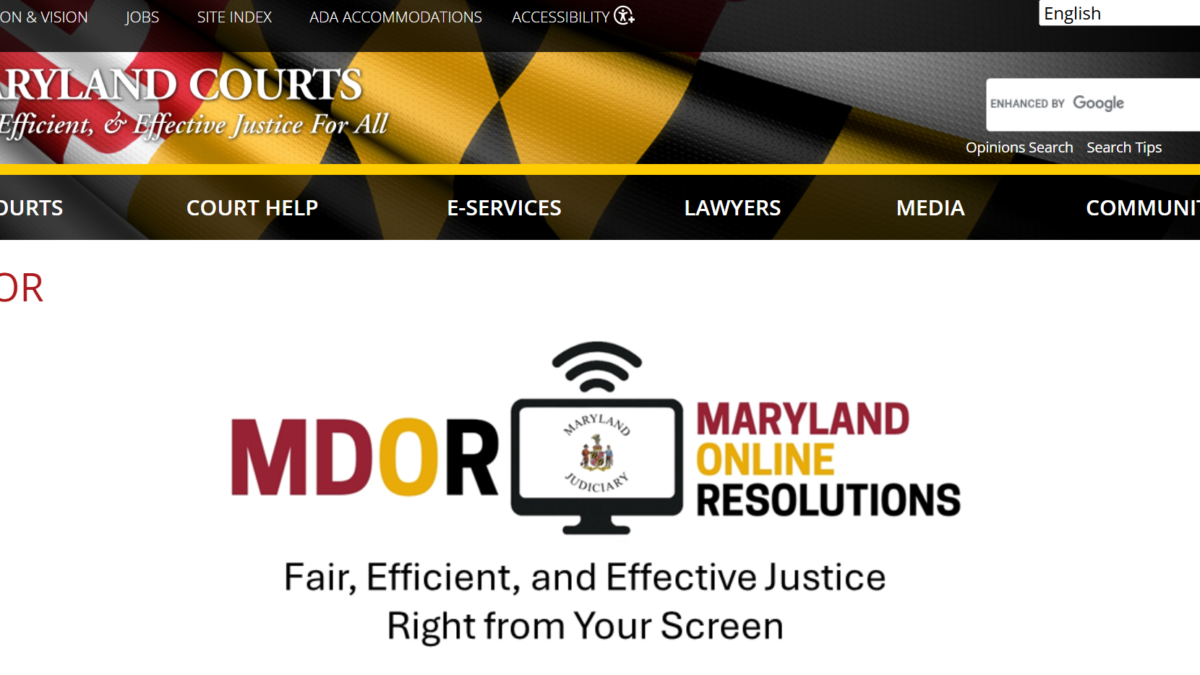
Screenshot of the Maryland Online Resolution, or MDOR, platform from the Maryland Judiciary.
MD Judiciary pilots online dispute resolution, but future unclear


Key takeaways:
- Maryland Judiciary piloted MDOR for minor traffic cases
- MDOR platform closed mid-August with no new cases accepted
- Spokesperson Nick Cavey cites subcontractor potential closure
- Judiciary plans to expand to civil cases like small-claims and child-access
The Maryland Judiciary piloted an online dispute resolution platform that would allow more cases to be handled outside the courtroom, but the tool’s future is uncertain.
Starting last year, minor traffic cases in Talbot, Montgomery, Howard, Allegheny and Garrett counties could be managed through online dispute resolution 24 hours a day. But the Maryland Online Resolutions, or MDOR, platform closed down in mid-August.
In Maryland, a person who intends to plead guilty and pay the entirety of a traffic fine has long had the option to submit payment online, by mail, by telephone or in person at a district courthouse. The MDOR pilot broadened online accessibility for other types of pleas. A person issued a traffic ticket in a covered county could submit an online plea template in the following circumstances:
- When pleading guilty with an explanation, seeking a lower fine.
- When pleading guilty, seeking a payment plan for a fine of $150 or more.
- When pleading not guilty, requesting an in-person trial.
But for now, however, those options are on hold. As of Friday, the online system was not accepting new cases. A note on the Maryland Judiciary website explains that the system is only processing cases that have already been filed.
The judiciary didn’t answer why MDOR has stopped, but the pilot might have reached its natural end. Prior to shutdown, however, spokesperson Nick Cavey wrote in a July email exchange that the potential closure of a subcontractor has thrown a wrench in the plans. The judiciary is evaluating options, such as securing a new vendor, before moving the program forward.
Cavey also said the judiciary will use the pilot data to evaluate the effectiveness and efficiency of the online system before expanding statewide. At a June panel during the Maryland State Bar Association conference, judiciary officials said they planned to expand this summer.
Apart from traffic cases, the judiciary is also eying online dispute resolution for certain types of civil cases. It intends to establish pilots for small-claims and child-access cases, Cavey said, but additional programming is needed before those pilots are ready to launch.
When those pilots do kick off, they have the potential to increase access by allowing parties to resolve conflicts without the financial and emotional costs of going to court.
This is one of the key benefits to online dispute resolution in civil cases, said Irma Raker, a retired justice of the Maryland Supreme Court who now works as a private mediator and arbitrator. Online tools broaden accessibility, she said, especially for those who may otherwise have to travel long distances to appear at an in-person proceeding.
“I think most of the time, online resolution and mediation is just as effective as in-person,” she said. “Not all the time.” Sometimes, she said, there are benefits to being face-to-face.
Before the coronavirus pandemic, online dispute resolution was more limited. “And then COVID came and changed the world,” Raker said. As the American Arbitration Association explains, “online mediation went from grudging acceptance to hesitant tolerance to guarded approval,” serving as a sort of proof-of-concept for a post-pandemic world.
Now, states and localities across the country are increasing access. The pandemic was a driving force behind the change, but other benefits are propelling further adoption. According to an article by Mitchell Hamline School of Law professor David Allen Larson, such online systems can provide significant cost-savings to courts with limited financial resources. An article in the Oklahoma Bar Journal explains how online dispute resolution can help pro se litigants navigate the court system. And a report from the Florida State Courts System noted that such services can speed cases up — a benefit for both courts and litigants.