Sign In
 Free Newsletter


The next Maryland campaign finance reports are due Tuesday and will cover the final weeks before the June primary election and Aug. 18. (Dan Belson/The Daily Record)
In MD courthouse elections, incumbents fundraised large amounts from staff


Facing tough challenges in Maryland’s 2026 primary elections, incumbents in local courthouse races received sizeable amounts of campaign funds from a reliable source: their employees.
Anne Arundel County State’s Attorney Anne Colt Leitess‘ campaign received over $29,000 from her staff before the June 23 primary. Other incumbent prosecutors, registers of wills and clerks of local circuit courts received thousands in donations from their staffs. And outgoing Baltimore Sheriff Sam Cogen received over $60,000 from his employees — after vowing at the end of the last campaign cycle not to accept staff donations going forward.
The Daily Record reviewed hundreds of pages of campaign finance reports for the current four-year election cycle, comparing them against employee rosters obtained through public records requests.
It’s not illegal for elected officials to receive campaign donations from their employees, but doing so can lead to ethical questions about political patronage and conflicts of interest.
Such contributions could make government officials feel indebted to certain employees, for example, or give incumbents more of a campaign advantage. But public ethics laws bar certain candidates from using public resources to solicit political contributions, and campaign committees are required to disclose the occupations and employers of donors who give more than $500.
The reports reviewed cover contributions through June 7, slightly more than two weeks before the primary election. The numbers will change after the next round of campaign finance reports are submitted Tuesday.
John Dedie, a political science professor at the Community College of Baltimore County, said that such contributions might “sound terrible” and look like a conflict of interest, but the behavior makes sense — employees might be seeking job security, especially during “tough economic times.” A transition in leadership usually means staffing changes, and candidates “know who gives to whom.”
“People are real concerned for their jobs, and they hedge their bets” in elections, he said. “It’s not a good look, but it makes sense.”
“When the boss is coming around and his daughter is selling Girl Scout cookies, you may not want Girl Scout cookies, but you’re going to buy Girl Scout cookies,” Dedie said.
The issue has been a tension point in the Baltimore City sheriff’s office, where the former longtime sheriff, John Anderson, raised significant amounts of campaign cash — around 22% of his fundraising over the four-year election cycle — from employees and also had members of his staff regularly worked for the sheriff’s campaigns.
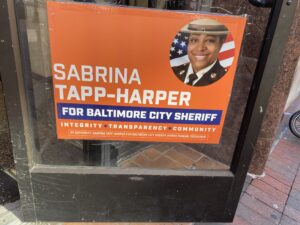
Cogen, who unseated Anderson in 2022 but lost this year’s Democratic primary to Sabrina Tapp-Harper, told The Baltimore Sun after his last campaign that he aimed to end the practice, saying his administration sought to “avoid the perception of political patronage.”
The campaign finance reports for this cycle don’t include any payments to sheriff’s office staff members for fundraising events. This year’s campaign was also more expensive across the board, and contributions from employees made up only about 15% of Cogen’s fundraising. And most of the money came from a handful of higher-ranking sheriff’s deputies who gave more, while Anderson’s contributions in 2022 included more small-dollar donations from lower-level staff.
Cogen said in a statement this week that he stood by his 2022 comments and was “proud we changed the culture of this office so that no employee felt like their job depended on whether they came to a political fundraiser or not.”
“I am grateful to have received over a thousand individual contributions from supporters who believed in our vision of a community centered Sheriff’s Office working for the people,” he said.
The pattern extended beyond local sheriffs, into county prosecutor races and other down-ballot campaigns for courthouse offices. Baltimore City Register of Wills Belinda Conaway got about $12,000, about a third of all of her campaign’s contributions, from people named as register of wills employees in state salary rosters — that database does not delineate between jurisdictions. Her son, Baltimore Clerk of the Circuit Court Xavier Conaway, made $3,900, or a fifth of his total receipts, from his own employees as well as register of wills staffers. Baltimore County State’s Attorney Scott Shellenberger‘s employees donated raised 10% of his campaign’s individual contributions reported before his loss to Democratic primary challenger Sarah David.
In Anne Arundel County, Leitess netted more than a fifth of her campaign funds from attorneys and support staff at her office before she beat her former employee, Carolynn Grammas, in this year’s Democratic primary.
Leitess said in a statement that nobody has been promised anything for their support or “faced consequences for their political views or choices.”
During this campaign cycle, Leitess’ top employees contributed the most: Her deputies, Brian Marsh and Jessica Daigle, donated the $6,000 maximum before the primary. (Marsh was appointed by Gov. Wes Moore last month to become a district court judge.) More than 30 other staff members in the 155-employee state’s attorney’s office donated smaller amounts.
Leitess said “the majority of those who donated to my campaign are people I have known and worked with for decades and whom I also consider friends.” Fundraising calls, texts and event invitations extend to “members of the bar association, attorneys in the county, my office staff, and former co-workers, colleagues, friends, acquaintances, political figures and other candidates for office,” she said.
There’s not an office policy specifically for donations, but “the office follows the law, which prohibits political activity at work,” she said. In her position, “the most important thing is running a professional office filled with hard-working individuals dedicated to victims and justice.”