Sign In
 Free Newsletter

Budget deal cuts don’t diminish health care CO-OP leader’s plans


News that a third of the money proposed to help create health care cooperatives was cut as part of the effort to prevent a federal government shutdown has not diminished the hopes of those looking to create the first such organization in Maryland.
Included in the spending cuts agreed to Friday night was a $2.2 billion reduction in the $6 billion set aside to fund low-cost loans to health care cooperatives came to light.
“It will be tough to tell what the impact will be on the CO-OPs,” said Bradley Herring, a health policy expert with the Johns Hopkins University Bloomberg School of Public Health’s Department of Health Policy and Management. “A lot of it is going to depend on what other organizations and other states are doing and the number of organizations looking for funding.”
The Affordable Care Act, or health care reform act, created a new business segment for regional nonprofit consumer-operated and oriented plans, or CO-OPs. These nonprofit companies were created to expand the availability of insurance and will compete with traditional health care providers on state-run exchanges to act as one-stop shops for individual and business shoppers.
The Evergreen Project is the first organization in the state looking to create a CO-OP, and the group is in the midst of a studying if it can succeed in Maryland.
Dr. Peter Beilenson, Howard County health officer and Evergreen Project founder, said the drop in loans was concerning but would not affect the group’s decision as it moves forward with its plans.
“The issue, for us, is not a problem,” Beilenson said. “We will be able to get our share of the loans even with the cuts.”
Beilenson said the reduction in the loan amount might limit how widespread the cooperative idea gets.
“We should be fine, but it’s going to be tough to do these across all 50 states without the full amount,” Beilenson said.
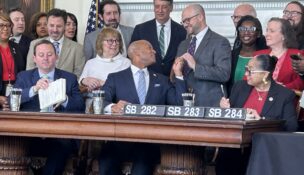
Along with the news of the funding cuts came news that Maryland lawmakers easily passed a bill that provides the framework for the health care exchange that needs to be in place by 2014.
The Evergreen Project would be a health plan with its own doctors, nurses and clinics. Beilenson said it is vital for the Evergreen Project’s plan to be offered on the state exchange for it to compete with established health care providers.
“The CO-OP would need an exchange to offer it for it to exist,” Herring said.