Sign In
 Free Newsletter


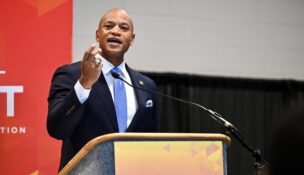
“We've been very clear that we can focus on pathways to work, wages and wealth for all Marylanders. We can make sure we’re investing in industries of the now and industries of the future and make Maryland a real leader in the field,” Gov. Wes Moore said. “And, by the way, do it and not raise taxes on a single Marylander.” (AP Photo/Susan Walsh)
On TV or serving as Democratic surrogate, Wes Moore finds the national spotlight


Whether he’s wading into the national conversation about book banning, responding to Florida Gov. Ron DeSantis‘s comments about Baltimore or showing up on TV news shows as a spokesman for the Democratic Party, Gov. Wes Moore increasingly is creating a national profile.
As a candidate with a captivating personal story who became the first Black governor in Maryland’s history, the country’s only current Black governor and just the third ever elected, Moore already had been sought out by the networks after he won in November.
But the interview requests ramped up in recent weeks, the governor’s office acknowledged. Moore has appeared lately on several MSNBC shows, on CNN with Jake Tapper and on CNBC.
Part of his pull is the state’s proximity to Washington, D.C.
RELATED: Moore blames Hogan for ‘surge of violence,’ seeks new approach
“A governor of Maryland, like Virginia, benefits from being so close to the national stage in D.C. All media cables lead to the national studios there,” said Larry Sabato, a best-selling author and national political analyst who frequently appears on news shows.
Todd Eberly, a professor of political science and public policy at St. Mary’s College of Maryland, said networks may prefer having their interviewees in the studio, rather than on a video call, which plays to Moore’s advantage.
“I think the press is always on the lookout for who the next star is,” Eberly said. “Moore is absolutely one of them.”
Moore also is one of several governors who are among the 50 members of a national advisory board for President Joe Biden’s reelection campaign. The board members are expected to do media appearances, among other things, to promote the campaign.
RELATED: Poll: Most Marylanders oppose Moore’s plan to ban gas vehicle sales
Republican leaders in Maryland have been skeptical of Moore’s increased airtime and questioned whether the administration’s priorities are misaligned.
“You raise your eyebrows a little bit. Do they have Pennsylvania Avenue on their mind? Or Prince George’s County?” said House Minority Leader Jason Buckel, who also said “it doesn’t bother me” that Moore takes the time for the televised interviews.
“I hope in the coming next few years that the focus is on (Maryland’s) problems, not on national politics,” Buckel said.
House Minority Whip Jesse Pippy pointed to a poll from Annapolis-based Gonzales Research & Media Services that showed nearly 89% of people surveyed support making the possession of a stolen firearm a felony. Republican lawmakers tried unsuccessfully during the last legislative session to increase the penalties for gun theft.
More than 60% of people who participated in the poll said they oppose Moore’s plan to ban new gas-powered vehicle sales by 2035, which Pippy said demonstrated the governor is “outside the mainstream of Marylanders” on electric vehicles.
“It’s clear that the governor should spend more time focusing on issues in Maryland,” said Pippy.
In a commencement speech in May at Morehouse College, a historically Black and all-male school in Atlanta, Moore officially entered the national discourse about how conservative states like Florida are banning certain books and restricting what parts of U.S. history is taught in schools.
RELATED: Moore announces revival of Red Line transit project
DeSantis, a Republican running for president, began his campaign by highlighting measures that’ve made it easier for parents to challenge teachers and their curriculum, saying he’s out to dismantle “woke” culture.
“When politicians ban books and muzzle educators, they say it’s an effort to prevent discomfort and guilt. But we know that’s not true,” Moore said to Morehouse graduates. “This is not about a fear of making people feel bad, it is about a fear of people understanding their power.”
Last week, Moore went on MSNBC to share a similar sentiment and to respond to U.S. Sen. Tim Scott, also a Republican running for president, who has said he doesn’t believe in systemic racism.
“His thesis is not true,” Moore said of Scott. “In the state of Maryland, we have an 8-to-1 ratio wealth gap. We don’t have an 8-to-1 ratio wealth gap because one group worked eight times harder. That’s not what happened.”
Moore has also been asked to respond to DeSantis’ comment that children are “more likely to get shot than to receive a first-class education” in cities like Baltimore and Chicago. Moore used an appearance on MSNBC to contrast bipartisan support for progressive policies that Maryland’s legislature passed with DeSantis’ feud with Disney.
“We are going to be a state that is not gonna pick fights with our largest employers and is not going to make, people who are creating jobs, make life more difficult for them,” Moore said.
During his roughly five months in office, Moore has made “quite a positive impression on the political community,” said Sabato, also the founder and director of the Center for Politics at the University of Virginia.
“I assume a two-term governorship, then the menu would include a Cabinet post, a Senate seat, and even a presidential (or vice presidential) run,” Sabato said. “I have heard his name brought up in many political discussions — unprompted. That’s always a good sign of future promise.”
Amy Walter, the publisher and editor-in-chief of The Cook Political Report, a newsletter analyzing elections, campaigns and political trends, said she expects to see Moore “on the campaign trail in 2024 and wouldn’t be surprised to see him with a prominent role at the [Democratic National Committee] Convention next summer.”
Moore’s predecessors had presidential aspirations. Democratic Gov. Martin O’Malley ran for president in 2016 after two terms and former Gov. Larry Hogan — who decided against running for president in 2024 — emerged as a prominent Republican voice for rebuffing President Donald Trump.
Asked on MSNBC whether he planned to run for higher office, Moore demurred.
“No, I’m good,” Moore said. “When I say I love what I do, I love what I do. I’m so excited about making this Maryland’s decade.”
“I’m gonna ask you this question again in a few years,” said host Jen Psaki, a former White House press secretary.