Sign In
 Free Newsletter


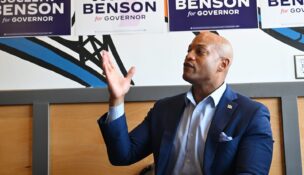
“This is one of the issues that, when we go across the state, we do town halls, we do various events, that we hear from Black Marylanders and community members that they want to see repair of the harm and the impacts of enslavement in our state,” says Del. Jheanelle Wilkins, a Montgomery County Democrat and chair of the Legislative Black Caucus of Maryland. (The Daily Record/Jack Hogan)
Legislative Black Caucus of MD urges study of reparations among 2025 priorities


ANNAPOLIS — The Legislative Black Caucus of Maryland on Thursday introduced its priorities for the 2025 session and, for the first time, included a state study of reparations for African Americans among its top bills.
During a press conference in a packed state Senate media room, caucus members promoted policies to tackle wealth inequality, housing discrimination, health disparities, education gaps, over-sentencing, criminalization and the impacts of enslavement.
Studying reparations was the first bill discussed during the press conference, and Del. Jheanelle Wilkins, who chairs the caucus, said that it will be among the foremost items on the priority list.
“This is one of the issues that, when we go across the state, we do town halls, we do various events, that we hear from Black Marylanders and community members that they want to see repair of the harm and the impacts of enslavement in our state,” Wilkins, a Montgomery County Democrat, said in an interview after the press conference.
Caucus members have in years past pushed for Maryland to study reparation proposals, but the full caucus hasn’t previously included those measures in its priorities.
A 2024 proposal would have set up a Maryland Reparations Commission, staffed by the Maryland State Archives, to develop and administer a program to provide the descendants of enslaved people with cash, tuition reimbursement and help with low-interest loan and mortgage applications. The proposal stalled early in the legislative process.
The program would have potentially cost millions of dollars each year.
Maryland hasn’t undertaken any major statewide attempts to acknowledge or make amends for the profound consequences of the systematic economic exploitation and physical mistreatment rooted in the legacy of slavery, segregation and discriminatory practices, Del. Aletheia McCaskill, a Baltimore County Democrat, said during the press conference.
Under the proposal the caucus is championing, Maryland would establish a commission to evaluate a range of reparation proposals and consider financial restitution, as well as “strategies to support and uplift vulnerable communities” who have been prevented from accumulating generational wealth and achieving economic stability because of discriminatory practices, McCaskill said.
Maryland doesn’t currently have any laws on reparations, but at least two local jurisdictions have moved in a direction similar to what state legislators are considering.
In 2021, voters in Greenbelt approved a referendum to establish a 21-person commission tasked with reviewing and recommending reparations for African American and Native American residents of the city.
In October, the volunteer-led commission was looking for city funding to hire two historians, a genealogist, a legal assistant and an administrative assistant to help with its work, according to a 2024 report from the Greenbelt News Review.

In the neighboring city of College Park, a Restorative Justice Commission has since 2022 worked to recommend reconciliation and restoration for Lakeland, an historically Black area where urban renewal in late 20th century displaced 104 of the community’s 150 households, according to a 2023 report from The Diamondback, the student newspaper at the University of Maryland, College Park.
Government-led reparations programs or studies are sparse. While there have long been discussions about atoning for the enslavement of Black Americans, it wasn’t until 2021 that Evanston, Illinois, became the first city to establish a reparations plan.
California became the first state to study reparations after it created a task force the same year.
Support for reparations varies widely between Black and white Americans, according to the Pew Research Center. While more than three-quarters of Black adults support reparations for the descendants of enslaved people, just 18% of white people agree, a 2021 Pew Research study showed.
The top of the Legislative Black Caucus’s list will also include the Second Look Act, which would allow adults incarcerated for a crime they committed as a teenager to petition for a sentence reduction after at least 20 years in prison.
“The Second Look acts on what we know about the immaturity and impulsivity of young people, yet believes in their capacity for growth and change,” Del. Cheryl Pasteur, a Baltimore County Democrat, said during the press conference.
On the criminal justice front, the caucus has also thrown its weight behind proposals to remove the governor from parole decisions; to allow incarcerated elderly people who no longer pose a threat to society to be released; and to repeal Maryland’s felony murder rule.
Among other priorities, caucus members on Thursday discussed their bills to limit law enforcement traffic stops unrelated to road safety, including for violations like expired registrations, inspections or emissions, and to create a new designation on drivers’ licenses indicating whether someone has a disability, like autism, that may not be immediately apparent but may influence how they react to verbal instructions from a police officer.
They outlined plans for incentives for commercial banks to lend to socially and economically disadvantaged entrepreneurs, additional protections against rising prescription drug costs and insurance coverage for calcium score testing.
Caucus members will also look to prohibit landlords and housing providers from including questions about criminal history on applications and to help more Black people to work in the appraisal industry, among other bills on health, wealth, housing education, public safety and justice reform.