Sign In
 Free Newsletter

Full psychiatric hospitals challenge MD


 Listen to this article
Key takeaways:
- Maryland psychiatric forensic hospitals operate at 95% capacity
- Court-ordered patients wait months for admission
- Industry professionals call for more supports for children in particular
Maryland’s state psychiatric system is under mounting pressure as hospitals statewide continue operating at near full capacity.
According to Amanda Hils, a spokesperson for the Maryland Department of Health, the state’s five adult psychiatric forensic hospitals operate at an average capacity of 95%, above the national average.
As more people struggle with mental health issues, experts say the demand for services continues to outpace available resources.
RELATED: Mental health experts talk stigma, AI on panel
Filling a court-ordered void
Maryland’s five state psychiatric hospitals primarily serve individuals with mental illnesses who are involved in the criminal justice system and are deemed dangerous, Hils said.
“The majority of admissions ordered to these hospitals wait in detention centers until a bed becomes available,” she said.
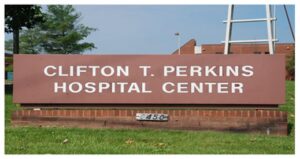
Wait times vary depending on the facility and patient needs. According to Hils, court-ordered patients awaiting admission to Clifton T. Perkins Hospital Center for competency restoration and treatment can wait as long as nine or 10 months.
Meanwhile, patients awaiting placement at Maryland’s four minimum-security psychiatric hospitals — Eastern Shore Hospital Center, Thomas B. Finan Hospital Center, Spring Grove Hospital Center and Springfield Hospital Center — typically face waits of two to four months, Hils said.
The backlog adds pressure throughout the system.
Compounding the issue, Maryland Criminal Procedure §3-106 requires MDH to transfer an individual into an appropriate state hospital for competency restoration services within 10 business days of when a judge finds the individual incompetent to stand trial, according to Nick Cavey, a spokesperson with the Maryland Judiciary.
RELATED: What’s MD doing for mental health in schools?
Early treatment
Shannon Hall, executive director of the Community Behavioral Health Association of Maryland, said stronger early intervention services could help.

“To take pressure off the system, we need to strengthen reimbursement rates for Medicaid intensive in-home services,” Hall said. She pointed out that Medicaid estimates that approximately 1,800 individuals could benefit from the services, but only 34 are using it.
Hall said low reimbursement rates discourage providers from offering the highly specialized and expensive service. Foster children, in particular, need additional support, she added, including more highly trained foster parents and greater flexibility in state licensing rules that can create barriers to care.
Maryland should expand same-day access to behavioral health services, she continued.
“Maryland has the many pieces needed but would benefit from a stronger, unified vision to prioritize and scale solutions across the state,” she said.
RELATED: Baltimore Police launch ‘neurodivergent individuals database.’ Advocates are wary.
Building community infrastructure
Harsh Trivedi, president and CEO of Sheppard Pratt, one of the nation’s oldest and largest private nonprofit mental health systems, said Maryland also needs a dedicated children’s psychiatric hospital and stronger youth treatment infrastructure overall, including residential treatment centers and group homes.
“We’ve seen the numbers of youth residential treatment centers dwindle to four in the state,” Trivedi said.
Lawmakers passed legislation aimed at ending the practice of “hoteling” of youth and improving voluntary placement agreements after a 16-year-old foster girl was found dead in a Baltimore hotel in September. But Trivedi said additional funding is still needed to support treatment centers and group homes.
Trivedi also called for consistently funded school-based mental health services and outpatient clinics to ensure communities have adequate levels of care.

“As people wait longer to receive services, we witness strain throughout the public behavioral health system caused by insufficient rate increases, while costs and inflation related to care and services have increased,” Trivedi said. “The bottleneck causes a destabilization in communities for our most vulnerable and complex patients.”
RELATED: Mental healthcare gaps persist in MD rural, urban areas
Efforts underway
The state health department is working on multiple initiatives aimed at expanding treatment capacity, including plans to add 25 beds at Springfield and 68 beds at Clifton T. Perkins hospital centers.
The department is also working to prioritize community-based alternatives and housing stability, since a lack of a home address can be a barrier to treatment compliance and appointment attendance. MDH is partnering with the Maryland Department of Housing and Community Development to open 25 beds and fund an additional 50 beds through the Capitation Project in Baltimore City.
In May 2025, the Maryland Judiciary, in partnership with the Governor’s Office of Crime Prevention and Policy and MDH’s Behavioral Health Administration, hosted a statewide summit on behavioral health to bring together representatives from all 24 of Maryland’s jurisdictions to assess needs and identify strategies across the behavioral health and justice system.
Following the summit, the judiciary and executive branch established a steering committee to address the priorities identified during the meetings.
Hall said the initiatives underway are encouraging, noting that untreated mental illness often leads to worsening symptoms, repeated crises, high emergency department overuse and social isolation.
“Many of these interventions cost far more than delivering outpatient mental health or addiction treatment,” she said.