Sign In
 Free Newsletter

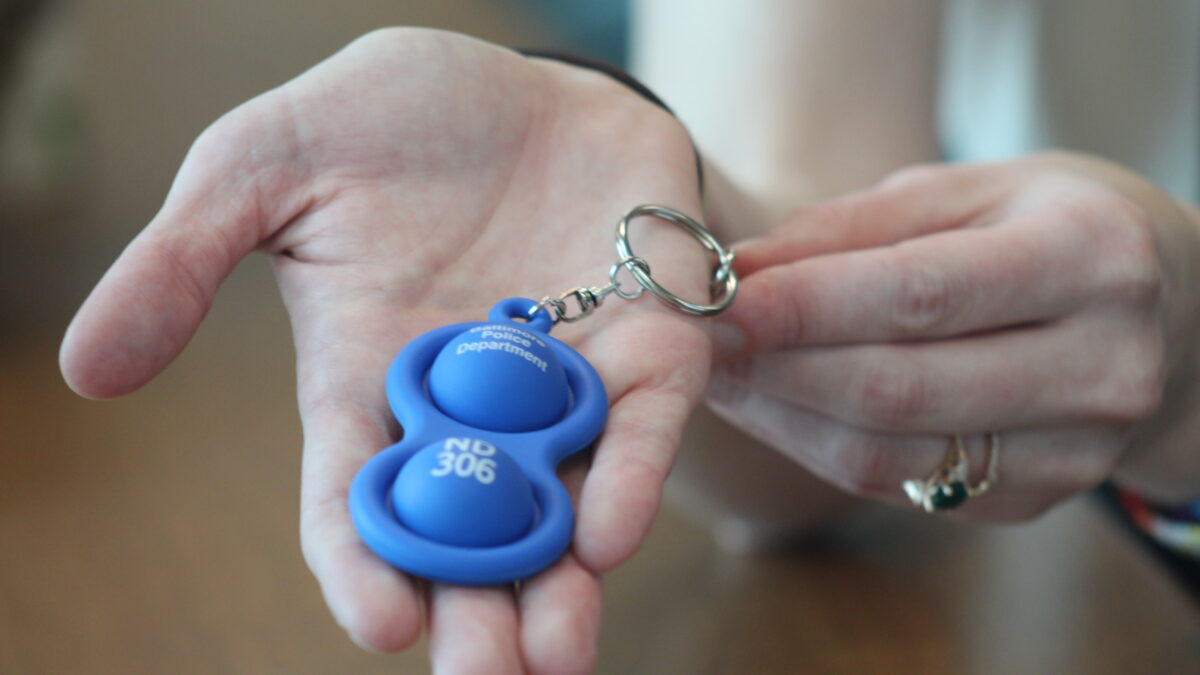
Deanna Bracken, special liaison for the Baltimore Police Department's Community Partnerships Unit, holds a tactile keychain given to people who register on a recently launched database for neurodivergent people. The keychain is intended to help officers identify people who are neurodivergent during interactions and find their emergency contact information using a unique identifier number. (Dan Belson/The Daily Record)
Baltimore Police launch ‘neurodivergent individuals database.’ Advocates are wary.


Attempting to improve officers’ interactions with people who have mental health conditions and neurodevelopmental differences, Baltimore Police launched a database last month of “neurodivergent individuals.” The announcement was quickly met with scrutiny online.
The department’s database, which police officials said is secure and limited to people and caregivers who voluntarily disclose the information, raised alarm from people on the autism spectrum and their advocates, as well as civil rights attorneys and activists. Dozens expressed their displeasure in comments and shares on the department’s Facebook post.
Some noted that although the registry might have been rolled out with good intentions, government databases carry the risk of falling into the wrong hands and being misused. Others said the database seemed like a small patch on the much larger problem of how law enforcement officers interact with people who have mental health conditions, putting the onus on them rather than police.
As of last week, the registry only had 10 people’s information, according to department spokesperson Lindsey Eldridge. Police officials stressed that inclusion on the database is voluntary and doesn’t require specific health information to be disclosed, and said that for some people, the benefits could outweigh the risks.
The initiative was launched at the start of April, which is World Autism Acceptance Month. It comes as police departments work to better handle interactions with people who can react differently to high-stress encounters like traffic stops due to developmental disabilities.
“Unfortunately, neurodivergent people have higher rates of police interaction than the general population, and those interactions don’t always go well, especially for autistic people, who may not respond in expected ways in that kind of interaction,” said Rachel Loftin, a psychologist and autism specialist who is the chief clinical officer of Prosper Health.
What’s MD doing for mental health in schools?
Loftin said there are “absolutely” people with high support needs who could be helped by a registry if they get lost — “I can see a need for that,” she said. But, she noted, there’s “so much diversity within” neurodivergent populations, even just within the autism spectrum.
“I think they generally come from a good place when they try to make a registry,” Loftin said. But what ends up happening with that information is “another question.”
Baltimore civil rights attorney Cary Hansel said providing sensitive personal information for a list, “especially one maintained by the government,” also subjects the person to the unanticipated future uses of that data — including if the federal government demands that information.

He noted that the Department of Justice, under the second Trump administration, has issued subpoenas for confidential patient information from doctors and clinics that provide gender-affirming care to transgender youth. Federal agencies have been purchasing location data from online advertisers to track peoples’ movements. And the Department of Health and Human Services, now led by Robert F. Kennedy Jr., has said that it is collecting private health information from Medicare and Medicaid, as well as data from wearable devices with health sensors, for a database that officials said would be used to find the root causes of autism.
“God forbid that the current HHS secretary sees” the police department’s database, Hansel said. “We live in a world where things are happening to our friends and neighbors that, you know, not long ago we could have never imagined.”
Hansel said signing up could be a “terrible mistake” if the database falls into the wrong hands.
“Understand, even if you wholeheartedly trust the Baltimore City police, and even if you credit them that all they want to use this list for is to help, it is subject to seizure and subpoena by people who view the world very differently,” said Hansel. He said that the private information volunteered to the police database and could be used several decades from now “in ways that we can’t now predict.”
Mental health experts talk stigma, AI on panel
Courtney Hart, a neurodiversity-affirming therapist and owner of Healing Hart Wellness, said that although she’s “not necessarily opposed to police trying to do better by neurodivergent people,” the department’s announcement raised privacy concerns as well as questions about how effective the program could be.
“I think we’re trying to solve structural problems with these individual workarounds that don’t have a lot of evidence behind them,” said Hart, a certified clinical social worker. “So if we’re asking disabled people to carry a responsibility or burden for their own safety and police encounters, I think you have to look at a greater system structure there” — specifically, looking at who is responding to such calls for service and what training they receive.
To register for the database, people or their caregivers only need to provide basic contact information: their name, address, phone number and emergency contact information, but they can provide additional details about specific conditions or needs. People who are registered on the department’s database are given a tactile keychain with a unique number tied to the database.
Deanna Bracken, a special liaison at the police department who works on initiatives aimed at helping special populations, said officers are being trained to recognize the tactile keychain and adjust their response if necessary. The identifier number can be used by officers to identify the person and link them with their caretaker if needed, she said.
“I do understand both sides and both concerns,” said Bracken. She said the initiative was a “riff” from a successful program aimed at older adults with dementia or other cognitive conditions. The information in the database is only accessible by law enforcement in Baltimore City, she said.
“… something that I keep stressing is that this is all voluntary,” she said, noting that individuals can request for their data to be removed.
Full psychiatric hospitals challenge MD
Maj. Arnold Jenkins, who leads the department’s Youth and Community Partnerships Division, said the keychain system and database would make the reunification process more efficient when a nonverbal person goes missing and is found.
“Every moment that that person is away from their family can be traumatic, not only for the family themselves but also for the person who’s been encountered, and also, it’s frankly very time-consuming as well,” Jenkins said. “So we want to reduce that nature of how time-consuming that is and reunite people with their loved ones faster, so that’s really what this does.”
Hansel also noted that the department has a history of bad encounters with people with mental health issues.
Mental healthcare gaps persist in MD rural, urban areas
The Justice Department‘s 2016 report on its probe of Baltimore Police‘s unconstitutional policing practices concluded that officers were routinely using “unreasonable force against individuals with mental health disabilities or those experiencing a crisis.” The investigation found that rather than employing deescalation tactics, officers often resorted to using force too quickly — and those uses of force were often “precipitated by officers’ perceived need to bring the individual into immediate custody at all costs.” The Justice Department estimated that over a six-year period, mental illness played a role in at least 1 in 5 of the department’s use-of-force cases.
“There was a massive abuse of people with that were neurodivergent or had mental health issues,” Hansel said.
Last year, officers fatally shot Pytorcarcha Brooks, a 70-year-old woman who was wielding a knife at her home during a mental health crisis, prompting calls for accountability. Just hours before officers shot Brooks, another man died in Baltimore Police custody after officers detained him during a mental health crisis. And earlier this year in Howard County, police came under scrutiny for fatally shooting an autistic 25-year-old man who was wielding a knife after calling police about an alleged extortion scam.
Hansel added that police “are permitted to attempt to excuse their actions using anything they know.”
“The more information they know about you, the more they have to choose from in attempting to explain away abuses,” he said.
Bracken said that there are other options for people who are uncomfortable with the database. The department is receiving materials as part of Pathfinders for Autism’s Blue Envelope Program, a communication support tool that allows neurodivergent people to provide law enforcement officers with an envelope of information to help facilitate interactions. Officers are also being outfitted with “communication facilitator” booklets created in partnership with the Autism Society of Maryland, which use illustrations to assist communication with people who are nonverbal.