Sign In
 Free Newsletter


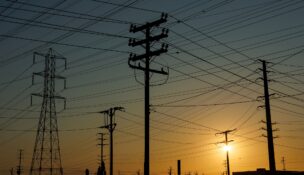
Maryland farmers are expressing concerns over plans to construct 70 miles of power lines that would traverse Baltimore, Carroll and Frederick counties. (Nathan Schwartz/Capital News Service screengrab)
Piedmont power line sparks preliminary eminent domain questions


A planned high-voltage power line that would run 67 miles through Baltimore, Carroll and Frederick counties has put the concept of eminent domain in Maryland headlines.
Enshrined in the Fifth Amendment to the U.S. Constitution, eminent domain is the legal power of government to take private property and convert it to public use, even over owners’ objections. In return, the government must compensate owners for their property.
It sounds straightforward. It’s not.
Power line plan
Joanne Frederick owns 100 acres in Baltimore County that once belonged to her great-grandparents, who ran a dairy farm. The property was sold in 2004 to pay for her grandmother’s medical care, but Frederick bought it back in 2020.
“My grandfather was born in the room sitting below me,” Frederick said in a phone interview. “This was home; this was the center of the family.”
Four years after she regained the property, a power line developer announced it would begin site surveys in the area for a 500-kilovolt transmission line. The Maryland Piedmont Reliability Project would deliver electricity from northern Baltimore County to a substation near Frederick and then link to a power line looping from Maryland to Virginia in tunnels under the Potomac River.
RELATED: Utility rate-setting is ‘Catch-22,’ MD lawmakers, advocates say
The developer, PSEG Renewable Transmission LLC, was chosen for the job by PJM Interconnection, the operator of the power grid that serves Maryland and 12 other states.
In its December 2024 filing with the Maryland Public Service Commission seeking permission to build the power line, PSEG warned that without additional transmission capacity, the grid would be perilously overloaded, especially as power-hungry data centers continue to be built in Northern Virginia. Marylanders, as well as millions of electric customers in the surrounding region, could face blackouts and possible system collapse, the developer said.
Preliminary eminent domain?
More than 400 Maryland properties are in the path of the proposed power line, said Frederick, president of Stop MPRP, a grassroots advocacy group. Outraged landowners refused to allow surveyors onto their properties, maintaining it would constitute a form of premature land access, as state regulatory approval for the project had not been secured.
In June 2025, PSEG filed the first of two omnibus lawsuits in federal court, naming 117 property owners as respondents. U.S. District Judge Adam Abelson granted a preliminary injunction – the first of several – to permit the surveys, which, he noted, were necessary so the Maryland Public Service Commission could evaluate whether to grant PSEG a certificate to build the power line.
RELATED: 100% clean electricity by 2035: Can MD meet climate goals?
An attorney for landowners addressed the paradoxical nature of the surveying quandary.
“PSEG is in this interesting position,” said Harris Eisenstein, of Rosenberg Martin Greenberg in Baltimore. “It might at some point in time proceed to condemn property in Maryland, but it doesn’t yet in our view have that right. They can’t, present-day, exercise a right of eminent domain.”
The question, he said, is this: “Can the developer do surveys in anticipation of the right to condemn?”
Bill Smith, a spokesperson for PSEG, dismissed the notion of land surveys as a form of preliminary eminent domain.
“There’s no permanent status given here,” he said. “This is a temporary right of entry to conduct surveys.”
RELATED: Maryland’s new energy law intertwines with data center boom
Key Maryland statute
Landowners appealed Abelson’s injunctions to the U.S. Fourth Circuit Court of Appeals in Richmond. A three-judge panel heard arguments May 5.
PSEG’s argument focuses on a Maryland statute, Real Property Article Section 12-111, which authorizes land surveyors, among others, to enter private land to make surveys, run lines or levels, or obtain information relating to the acquisition or future public use of the property.
Joseph Suntum, an eminent domain attorney at Miller, Miller & Canby in Rockville, noted that the key issue for a court, when considering an owner’s objection, is whether the intrusion will affect the owner’s use of their property or cause any damage.
Suntum, who is not involved in the transmission line case, pointed out that the leading Maryland case defining the permissible scope of precondemnation entry is Mackie v. Mayor and the Commissioners of Town of Elkton (1972), in which the town sought to conduct geological surveys on farmland in connection with a proposed dam. The surveys would have involved drilling far into the ground and digging deep pits. While precondemnation surveys do not constitute a “taking” under the Fifth Amendment, the court held that the Maryland statute did not authorize such invasive activities.
The key question, Suntum said, is, “Where does the court draw the line between invasive and noninvasive?”
The Fourth Circuit panel, noting that the issue of land surveys in the MPRP case hinges on the Maryland statute, debated whether it should certify the question to the Maryland Supreme Court.
Until the panel issues a final ruling, Abelson’s injunctions remain in effect, and surveying continues.