Sign In
 Free Newsletter

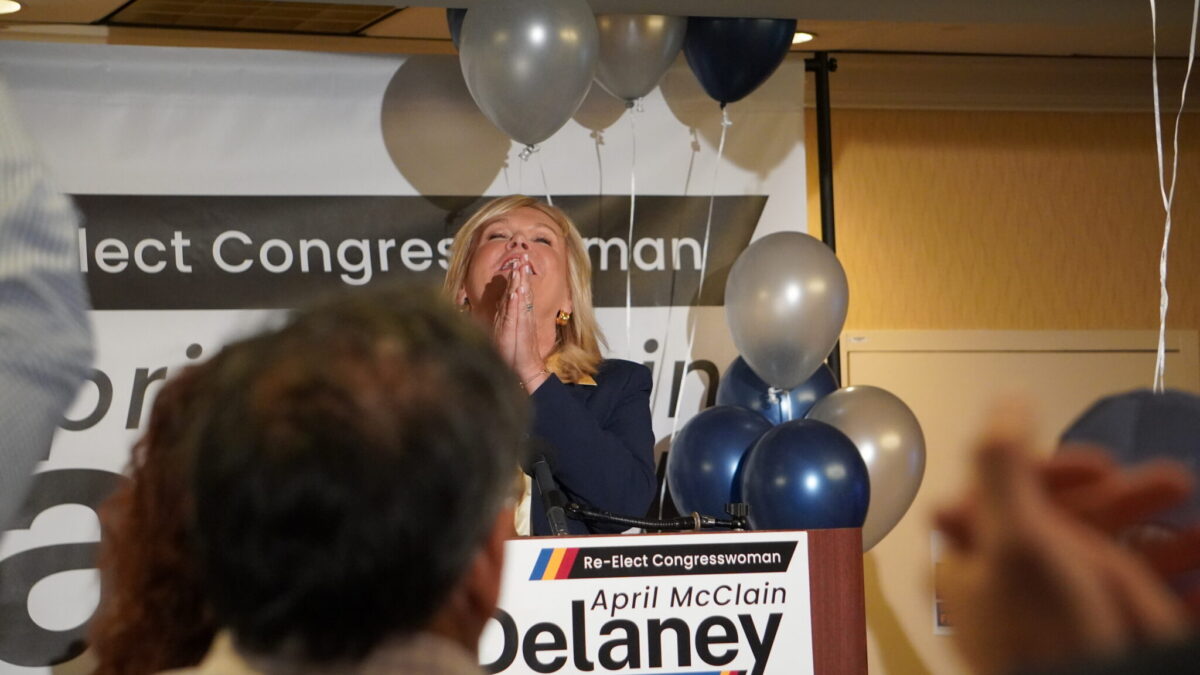
U.S. Rep. April McClain Delaney (D-6th) speaks to supporters at a watch party at the Holiday Inn in Gaithersburg, Maryland, on Tuesday, June 23, 2026. (Photo by Danielle J. Brown/Maryland Matters)
U.S. Rep. April McClain Delaney projected to win Maryland 6th Congressional District


 Listen to this article
After a bitter, expensive and largely self-funded campaign, freshman U.S. Rep. April McClain Delaney (D-6th) has held her seat against David Trone, who was trying to reclaim it after a two year absence.
Early returns showed McClain Delaney with 16,979 votes to Trone’s 14,556 with 92% of the precincts reporting election day results as of 11:35 p.m. The Associated Press called the race for McClain Delaney soon after.
She’ll face off in November against one of three Republicans: longtime candidate Robin Ficker, newcomer and Marine veteran Chris Burnett and Air Force veteran Mariela Roca, who ran unsuccessfully for the nomination in 2024. Ficker appeared to be leading in early returns.
McClain Delaney said she was feeling positive about the early counts but did not declare victory when she addressed her campaign team at 10:43 pm at the Holiday Inn in Gaithersburg.
“I’m feeling good,” she said, noting that she was leading in early votes, mail-in ballots and day-off votes. “I’m very enthusiastic — we’ll see where it goes.
“This is just the first step … towards flipping the House, bring in this administration and start getting things done for the American people,” she said. “It’s been an honor over the last year and a half to represent you … and I look forward to the years ahead.”
At 11:42 p.m., the AP called the race in her favor. Most of the watch party had already left for the evening but the about two dozen attendees who remained celebrated her win.
Early into the night, the energy was high as supporters at Trone’s watch party at a Frederick brewery buzzed with anticipation, sipping beer and wine. As the night progressed and polling numbers turned unfavorable, attendees began to shuffle out of the room.
Trone did not speak to the room, which was fairly empty towards the end of the watch party at 11 p.m. In a statement posted to X, before the announcement that AP called the race, he did not concede the election and instead said his campaign will continue to monitor the polling numbers as they come in.
“From the moment we entered this race, we knew it would be a close one,” the post read. “There are still tens of thousands of votes still uncounted. This is democracy at work, and it is critical that every legal vote is counted.”
A contentious and expensive race
There were eight Democrats in the race, but from early on attention was focused almost exclusively on the fight between Trone and McClain Delaney, two millionaire Democrats who live in Montgomery County, outside the district that stretches from upper Montgomery all way through the Western Panhandle of the state. (House members are not required to live in their districts in Maryland.)
Besides fighting for endorsements — McClain Delaney was backed by Democrats in the state’s congressional delegation and most statewide officeholders, while Trone attracted support from local officials — the campaigns quickly became a fight over which candidate was more opposed to President Donald Trump, and most able to take him on.
Trone’s campaign consistently tried to question McClain Delaney’s voting record, arguing that she aligned with “MAGA Republicans” on certain issues, including immigration enforcement, citing her vote for the Laken Riley Act, which makes it easier to detain undocumented immigrants on the slightest of charges.
McClain Delaney raised issue with Trone’s campaign messaging, saying he was misleading voters with campaign materials that implied he is the incumbent, not her, and even sent a cease-and-desist letter to the campaign. She claimed his business, Total Wine, has given hundreds of thousands of dollars to Republican candidates and accused Trone of “buying and lying” to get the seat back.
The most remarkable part of their campaigns, however, was the money that each poured into them. Trone funneled $25 million of his own money into the race, according to his latest filing with the Federal Election Commission, while McClain Delaney reported loaning her campaign $7.2 million.
It’s not the first time Trone has sunk millions of his own money into a campaign. He spent almost $18 million in 2018 to win the 6th District seat that was being vacated by three-term Rep. John Delaney — McClain Delaney’s husband — who mounted an ill-fated bid for president. In 2024, Trone spent $62 million of his own money in a failed bid for the U.S. Senate, losing the Democratic primary to then-Prince George’s County Executive Angela Alsobrooks, who is now the state’s junior senator.
Trone’s Senate bid opened the door for McClain Delaney — a lawyer and former Commerce Department official in the Biden administration.
According to voter data from the 2024 general election, Republicans made up 33% of the nearly 522,000 6th District registered voters at that time, and Democrats accounted for about 39% of voters. That makes the district winnable for Democrats, but it is a narrower lead than Democrats enjoy in most of the other districts in the state — with the exception of the 1st District on the Eastern Shore, which has a Republican plurality. Still, most election watchers and analysts anticipate that the district will favor the Democratic nominee in November.
A struggle for voters
For some voters, like 64-year-old James Gibbs, the messaging soured the campaign efforts.
“I thought their campaign was ugly and I did not enjoy it,” Gibbs said outside the Evangelical Lutheran Church in downtown Frederick. “I’m getting spammed by and phone calls all day from both of these campaigns.”
Gibbs said he went with Trone, partially because Gibbs sees him out in the community more and because Trone has had more experience in the position.
Leah Ermarth, a 60-year-old retired federal government worker, said she struggled to land between McClain Delaney or Trone as well, but one endorsement helped make up her mind.
“It was a tough one,” she said outside the Lutheran church after voting, “but what came down for me was that (Rep.) Jamie Raskin endorsed McClain Delaney; I think he’s a national hero.”
But for Ermarth and Gibbs, it wasn’t the congressional race that brought them to the polls Tuesday, focusing more on local elections for school board, county council and policies that would impact their own lives.
For Ashley Foltz, 43, her driving force to the ballot was the local school board race, with a plan to vote for McClain Delaney as she walked up to her precinct at Lincoln Elementary School.
She was stopped by members of Trone’s campaign team, who were posted outside several precincts in Frederick with large tents urging voters to “re-elect Democrat David Trone.” They talked about Trone’s previous work as a representative.
“Honestly, I was leaning towards one, however, information I received me made me go towards that (Trone),” Foltz said.
Based on that quick conversation, she changed her mind and voted for Trone.
Danielle J. Brown is a new Maryland resident covering health care and equity for Maryland Matters. Mayah Nachman is a summer intern at Maryland Matters.