Sign In
 Free Newsletter

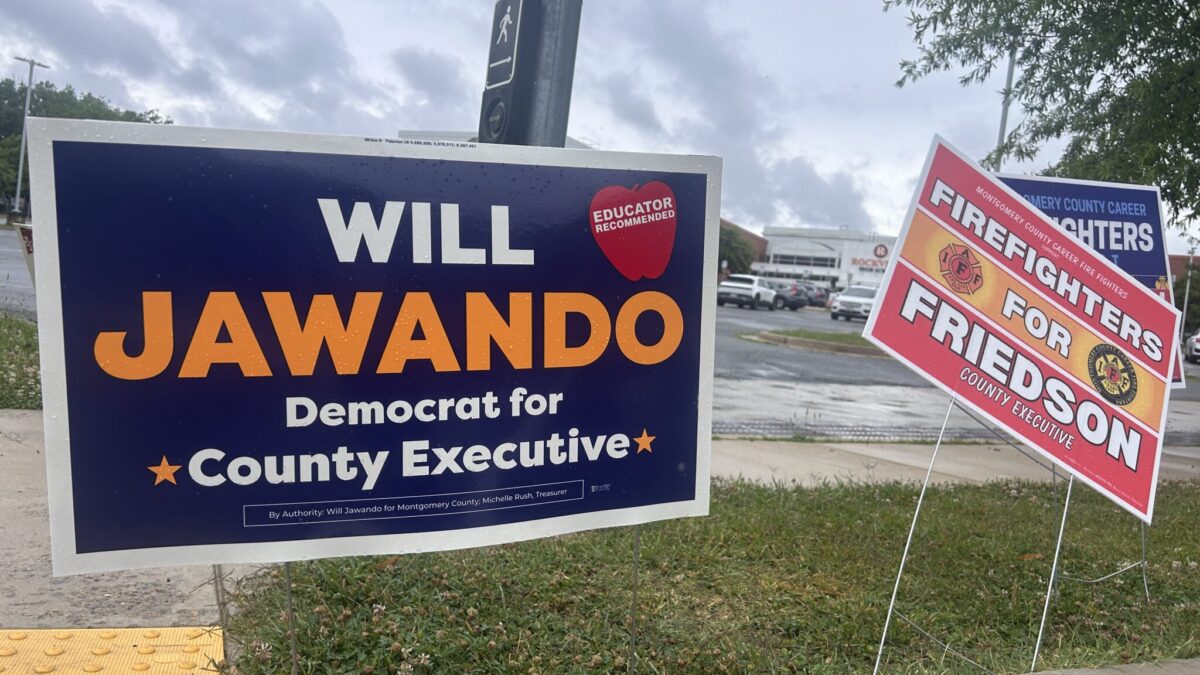
Campaign signs for Montgomery County Council members Andrew Friedson and Will Jawando outside Rockville High School on Tueday. (Photo by Mayah Nachman/Maryland Matters)
Expensive, contentious executive races to lead big counties into the future


 Listen to this article
Democratic voters in four counties selected a new generation of leaders Tuesday, making history in at least two of them.
Five of the state’s “Big Eight” jurisdictions had hard-fought primaries for the top positions in county government. Four counties held open-seat Democratic primaries for county executive; the winners of each will be overwhelming favorites in the general election.
In Harford County, the Republican county executive, Bob Cassilly, beat back an aggressive primary challenge from the County Council president, Patrick Vincenti. Cassilly is heavily favored to win a second term in November.
Voters in Anne Arundel, Howard and Montgomery counties are replacing term-limited county executives who are leaving after two terms. In Baltimore County, voters are replacing an interim county executive who is completing the term of an executive who moved on to Congress at the beginning of 2025.
Those open-seat races were expensive, contentious, multi-candidate affairs that will help chart the future of those jurisdictions – and will produce high-profile local leaders who are almost certain to become future players on the statewide political stage.
In Howard County, former Del. Vanessa Atterbeary won a resounding Democratic primary victory over three foes, including two county council members.
In Baltimore County, Councilmember Julian Jones was also in a commanding position in a five-way primary, while in Anne Arundel County, Councilmember Allison Pickard appeared to have an insurmountable lead.
In Montgomery County, the county executive race was closer: Two candidates were neck and neck for part of the evening, but as more votes rolled in, Councilmember Will Jawando opened up a lead.
Anne Arundel
Pickard, who is completing her second term on the council and also served on the Anne Arundel County Board of Education, jumped ahead in the early voting and mail-in ballot tallies Tuesday evening, and never looked back.
James Kitchin, a political newcomer and top aide to outgoing County Executive Steuart Pittman (D), was fighting for second place with County Councilmember Pete Smith.
Pickard enjoyed the support from several powerful women in Anne Arundel politics, including U.S. Rep. Sarah Elfreth (D-3rd), state Sens. Pam Beidle (D) and Dawn Gile (D), and Del. Dana Jones (D).
Smith was the favorite of many Black leaders and tried to capitalize on his military service in a county with many military veterans.
Like his political mentor Pittman, Kitchin ran as a political reformer, participating in Anne Arundel’s new public financing program for candidates, and riding the grassroots energy of his endorsement from the county teachers’ union.
Pickard and Smith, familiar faces on the local ballot, ran more conventional campaigns. Each raised more than $750,000 for the race.
With all 196 Election Day precincts reporting, Pickard claimed 42.54%, to 28.42% for Kitchin and 26.54% for Smith. A fourth Democrat, regional planner Kyle Nembhard, dropped out of the race and endorsed Kitchin but remained on the ballot. He had 2.51%. The vote tallies include early voting numbers and some mail-in ballots.
While Anne Arundel until recently was a Republican-leaning purple county, Pickard will be heavily favored in November over Dave Crawford, a firefighter and business owner who was unopposed in the GOP primary.
Baltimore County
Jones, a member of the County Council since 2014, is one step closer to becoming the first Black county executive in Baltimore County history. With 246 of 258 Election Day precincts reporting, he had 40.85% of the vote in the Democratic primary.
Councilmember Izzy Patoka, another veteran of local government, was running second in the primary with 26.5% of the vote. Nick Stewart, a lawyer and former county school board member who captured the fancy of some political insiders but could not expand his political base, had 19.01%. County Councilmember Pat Young, who previously served in the House of Delegates, had 9.47%, while Mansoor Shams, a Marine Corps veteran and county recreation official, had 4.17%.
Those results include early voting totals and some mail-in ballots.
Jones and Patoka had been preparing to run for executive for years, and both amassed war chests of well over $1 million for this campaign. Jones had been a lieutenant, captain and battalion chief in the Anne Arundel County Fire Department for many years before winning office in Baltimore County.
“He’s been in public service all his life, did the hard work as a fireman, and after that, he reached out in the political aspect of it. But he’s always been in public service in Baltimore,” said Jerry Johnson, a Jones supporter who was interviewed outside Chapel Hill Elementary School in Perry Hall.
In the Republican primary, Pat Dyer, who owns a financial services firm, appeared headed to victory over Kim Stansbury, a former retail manager and PTA president, 65.79% to 34.21%.
A Republican hasn’t been elected county executive in Baltimore County since 1990. The next county executive will replace Democrat Kathy Klausmeier, who took over in 2025 on an interim basis after then-Executive John Olszewski was elected to Congress.
Also of note in Baltimore County: Five-term State’s Attorney Scott Shellenberger was handily defeated in the Democratic primary by Sarah David, a former prosecutor in Baltimore City. With 246 of 258 precincts reporting, David had 52.46% to Shellenberger’s 26.98%. A third candidate, Lauren Lipscomb, took 20.57%.
Howard
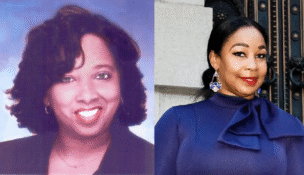
Atterbeary is also on the road to making history, after winning the Democratic primary with 57.96% of the vote. She faces no opposition in November, so she’ll be the first Black woman to serve as county executive, replacing term-limited Executive Calvin Ball (D) – who was the first Black person to hold the job.
Atterbeary, the former chair of the House Ways and Means Committee in Annapolis, was the favorite of developers, business leaders and many of the county’s political insiders, besting Councilmember Deb Jung, who had 21.45%, and Councilmember Liz Walsh, who had 18.82%. Businessman Bob Cockey, whose campaign website featured AI-generated photos of him standing next to the late President John F. Kennedy, took 1.77% of the vote.
U.S. Rep. Sarah Elfreth (D-3rd) stumped for Atterbeary on Tuesday outside Murray Hill Middle School in Laurel.
“I think she’s the one with the most experience, and the one who’s built the best coalition,” Elfreth said. “I think that speaks to her leadership style when she gets there.”
Campaigning alongside Elfreth, Maryland Comptroller Brooke Lierman (D), while remaining neutral in the Howard County primary, said she appreciated the historic nature of the campaign.
“I’m really excited that Howard County residents have three awesome women who stepped up,” Lierman said.
One voter, Divya Singh, said she was swayed in part to vote for Atterbeary after she won the backing of Gov. Wes Moore (D).
“That endorsement, and also seeing what she’s done for women’s rights,” Singh said.
Montgomery
Three 40-something County Councilmembers in their second terms led the Democratic field in the race to replace term-limited Marc Elrich (D) – who is returning to county government as a member of the County Council.
With all precincts reporting, Councilmember Will Jawando was ahead with 40.84% of the vote, followed by Councilmember Andrew Friedson with 33.51% and Councilmember Evan Glass at 21.57%. Rounding out the field were corporate manager Mithun Bannerjee, with 2.43%, and Peter James, the owner of a robotics and AI business, with 1.65%.
Friedson was heavily supported by Realtors, developers and other big-money business interests, who flooded his campaign coffers with almost $2.5 million and separately funded independent ads criticizing Jawando and Glass. He also received support from public safety unions and retired teachers, and most of the Montgomery County state Senate delegation.
Jawando had the support of many unions and progressive groups, and also ran with Elrich’s endorsement, while Glass nabbed the Sierra Club endorsement.
Glass and Jawando tried to emulate Elrich by relying on public financing, which limited the donations they could receive.
At Thomas S. Wooton High School in Rockville, one voter, Jean-Luc Tessier, a recent college graduate, said he voted for Friedson in part because the councilmember had vowed to improve housing and expand job opportunities.
At two polling places in Rockville, four people who declined to give their names said they liked Glass more, but ultimately voted for Friedson because they felt he had a better chance of winning.
Voting at Thomas S. Wootton High School in Rockville, Gayle Levin said she voted because she was concerned about an uptick in antisemitism in Montgomery County. She declined to say who she decided to vote for, but she said it was difficult for her to differentiate among Friedson, Jawando and Glass because they all serve on the county council.
“It’s been a hard choice,” Levin said. “But as each one has shared what is important to them and what they think is important to the community, it’s made the decision clearer for me.”
In 2018 and 2022, Elrich’s Democratic primary victories over free-spending businessman David Blair were nail-biters, each won by just a few dozen votes and requiring recounts that lasted several days. It’s possible that the same may be true in the battle between Friedson and Jawando, because some mail-in and provisional ballots have yet to be tallied. But Jawando’s raw vote lead of almost 6,000 votes is considerably more comfortable than Elrich’s were.
In November, the Democratic primary winner will face Esther Wells, president of the Montgomery County Taxpayers League, who handily won the Republican primary over Shelly Skolnick, an 82-year-old attorney who has run for other offices in the county.
Harford
Cassilly, a former state legislator, beat back a challenge from Vincenti, 59.98% to 35.24%. A third Republican, Spencer Dagner, took 4.77%. Public employee unions and certain business groups attempted to boost Vincenti, but Cassilly, a hardcore conservative, prevailed relatively easily.
In November, Cassilly will be the overwhelming favorite over the winner of the Democratic primary, which was too close to call Tuesday night and may require a recount. With all Election Day precincts reporting, education employee Matthew Brown led former state legislator Barbara Kreamer, who has regularly been looking to make a political comeback since losing a bid for lieutenant governor in 1994, by four votes.
Other counties
Two other “Big Eight” counties held primaries for county executive Tuesday.
In Prince George’s County, County Executive Aisha Braveboy (D), who took office after a 2025 special election, was renominated overwhelmingly, taking 70.21% of the vote against a quartet of lesser-known challengers. She’ll face a political independent, Tonya Sweat, in November.
In Frederick County, former Frederick Mayor Jeff Holtzinger was leading former county procurement official Diane Fouche in the Republican primary race to take on County Executive Jessica Fitzwater (D) in November. With all 66 Election Day precincts reporting, Holtzinger had 57.18% to 42.82% for Fouche. Fitzwater, who faced no opposition in the Democratic primary, is favored to win a second term in November.
Maryland Matters founder Josh Kurtz is a veteran chronicler of Maryland politics and government. Mayah Nachman is a summer intern at Maryland Matters. Will Hammann is a general assignment news and data reporter for Maryland Matters.
Maryland Matters is part of States Newsroom, a network of news bureaus supported by grants and a coalition of donors as a 501(c)(3) public charity. Maryland Matters maintains editorial independence. Contact Editor Steve Crane for questions: [email protected]. Follow Maryland Matters on Facebook and Twitter.