Sign In
 Free Newsletter

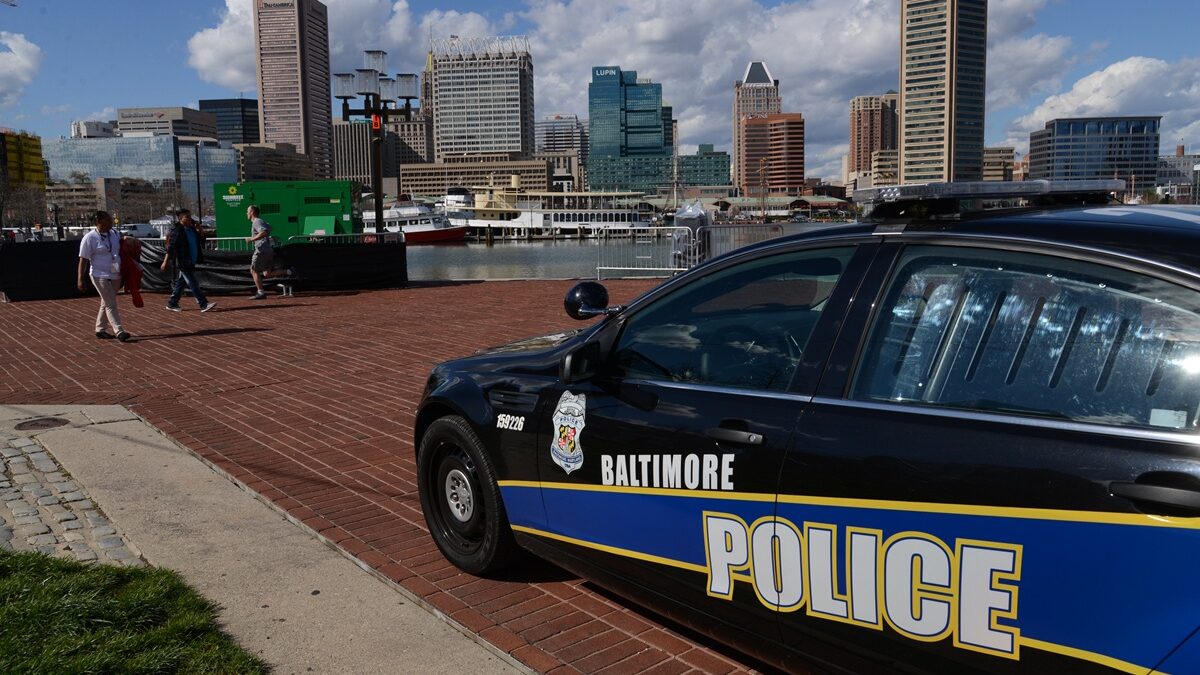
File photo of a Baltimore Police Department car parked along the harbor. (Maximilian Franz/The Daily Record)
U.S. homicides could fall to a historic low this year, report shows


Homicide rates are falling precipitously in many cities, including Baltimore, across the United States, dropping by 18% since the same period last year, and by the end of 2026 the murder rate could plummet to its lowest nationwide in more than a century, according to a new midyear crime trends report.
Reported carjacking incidents also have declined sharply, dropping by 47% since last year, the Council on Criminal Justice said in its report. The far-reaching decline in violent offenses is welcome news for the many communities that were affected by an extraordinary spike in the crime rate during the coronavirus pandemic.
The report from the nonpartisan think tank analyzed incident reporting data for 13 common criminal offenses in 36 large and midsize U.S. cities during the first half of this year.
On July 1, Mayor Brandon Scott announced that Baltimore had the fewest homicides through the first six months of a calendar year with 50 in 2026. The city has seen a 23.1% decrease in homicides and a 2.5% decrease in non-fatal shootings according to a press release.
The rates for four offenses – homicide, carjacking, residential burglary and motor vehicle theft – dropped by more than 50% compared with their peaks over the past nine years. The drop in carjackings was most dramatic, with the rate falling by 73% in the first half of 2026 compared with its peak in 2023.
The spikes and declines are easier to explain for some crimes than others. For example, residential burglaries went down during the pandemic because everyone was at home, and shoplifting incidents went down because many stores were closed, said Adam Gelb, the Council’s CEO and president.
“The opportunities change dramatically,” Gelb said.
But the roots of other crime trends, including the unprecedented rise and subsequent decline of carjackings, are harder to discern.
Founded in 2019, the Council on Criminal Justice started publishing semi-annual trend reports in 2020 amid the pandemic-related spike in violent crime, as well as the racial justice protests that put a spotlight on legal injustices. The country needed an unbiased source of comprehensive data on public safety, Gelb said.
The analysis released this week draws on monthly incident-level data collected from the online portals of city police departments. The federal government also publishes reports on crime rates, using data from thousands of communities nationwide, but many analysts complain that they take too long to produce, making their findings less relevant.
Reliable crime statistics are more critical today, scholars and experts say, as public safety is politicized in statehouses, courthouses and by politicians of both parties, leaving policymakers to search for evidence of what is working and what is not.
New technologies appear to be playing a role. But the overall question of what is behind such a dramatic drop in crime is far from simple, Gelb said, despite the sometimes simplistic prescriptions of both parties.
“We are seeing changes in criminal justice policy and strategy, advances in technology and surveillance, and broad shifts in society and culture – all happening at the same time,” he said. “Crime is falling across too many different kinds of cities to credit any one policy, party or program.”
The consistency of the downward trend nationwide, Gelb said, means that “macro-level forces are playing a major role.”
President Donald Trump decried the violent crime rate when he ran for president in 2024. Figures suggest the current decline began in 2023, under President Joe Biden, as the pandemic’s effects faded, and have continued under Trump.
The Council’s analysis compared crime rates from the first six months of this year with the first six months of 2025; to the first six months of 2019, before the pandemic spike; and to several offenses’ peak over the past nine years.
Across all time frames in the assessed cities, overall violent crime is down.
When comparing the first six months of 2026 with the same period last year, the Council’s analysis found that homicides fell by an average of 18% – a decrease experienced in D.C., Atlanta, Philadelphia, Los Angeles, Detroit, Baltimore and New York. Non-fatal shootings and aggravated assaults also decreased slightly.
A handful of cities, however, did not do so well: Homicide rates in the first half of 2026 increased by 64% in Norfolk; 55% in San Francisco; 30% in Dallas; and 20% in Salt Lake City, compared with the first half of 2025.
Across the sample cities, domestic violence incidents increased by 8% and sexual assaults by 3%, the report said, although domestic violence rates were still overall lower than pre-pandemic. Reported drug-related crimes were also up 12% compared with the first half of last year, but again lower than the pre-pandemic period.
Gelb said it is difficult to assign meaning to the uptick in drug-related incidents. He noted that arrests for drugs can be highly discretionary and dependent on the policies, procedures and priorities of law enforcement at any given time.
More cities are embracing prevention programming and “violence interruption” tactics. Some, like Baltimore, have launched crime-fighting strategies that encourage targeted policing and treat gun violence as a public health crisis.
Separately, new law enforcement technologies – such as surveillance video, facial recognition software, license plate readers and artificial intelligence – are enabling authorities to investigate some crimes faster.
Katie Mettler reports for The Washington Post.