Sign In
 Free Newsletter


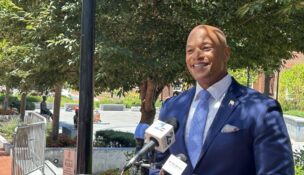
Maryland Gov. Wes Moore smiles as he gives reporters an update on negotiations with the Baltimore Orioles about a new lease during a news conference on Dec. 13, 2023, in Annapolis. (AP Photo/Brian Witte)
Gov. Moore announces full funding for RENEW environmental study, reversing course


Key takeaways
- Gov. Moore reverses course on veto, fully funding $500,000 RENEW Act study.
- Study will analyze economic impact of climate change in Maryland.
- Funding includes $470K from state and $30K from philanthropic sources.
- Study aims to guide policymakers on storm damage, health, and resilience costs.
Gov. Wes Moore announced Friday that Maryland will fully fund the $500,000 RENEW Act study to analyze the economic impact of climate change on the state, reversing course on the veto he issued for legislation that initially proposed the research.
“This study will give us a clear, data-driven look at the real burden taxpayers are shouldering as climate change drives more extreme and costly weather events,” Moore said in a statement. “Building on the historic progress we’ve already made in tackling climate change, Maryland will continue taking a whole-of-government approach to building a cleaner economy.”
Moore is partnering with Comptroller Brooke Lierman, whose office would complete the study, in this initiative. The project aims to employ philanthropic and existing state funds to give Maryland policymakers critical information about the costs related to storm damage, health outcomes tied to hotter summers and the damage extreme weather events cause.
“Every dollar we invest in climate resilience today saves Marylanders from paying exponentially more tomorrow,” Lierman said in a statement. “By quantifying the impact of greenhouse gas emissions on our communities, this report will build a roadmap for financial resilience in Maryland amid the challenges of climate change.”
The study was initially brought forth in a bill sponsored by Del. David Fraser-Hidalgo, D-Montgomery, which Moore vetoed.
In a statement Friday, Fraser-Hidalgo called the study “imperative to understanding the real fiscal impacts climate change is having.”
“Identifying and quantifying these costs is essential to figuring out how to mitigate them,” he said.
During the 2025 legislative session, Maryland lawmakers contended with a nearly $3 billion budget deficit.
In his May 16 veto letter, the governor stated that Maryland’s poor budget situation “requires us to reconsider bills that create expensive and labor-intensive studies.”
“While such bills can be a first step to addressing complex issues and allow the signaling of support for an issue, the practice has become so commonplace that it is now a significant financial and staff burden on the state government,” the governor wrote.
Additionally, Moore said that reporting requirements “at times” have “delayed prompt action on important issues.”
“Studies can serve a purpose, but their overuse is a drag on the State government,” he wrote.
The initial bill would have required a $500,000 allocation for the study in the state’s fiscal year 2026 budget. Moore additionally vetoed that line item in the budget.
Now, Moore plans to fully subsidize the study through a memorandum of understanding between the Maryland Energy Administration and the Office of the Comptroller. That incorporates $30,000 in philanthropic money and $470,000 from the Strategic Energy Investment Fund, which reinvests money garnered from greenhouse gas emissions auctions and Alternative Compliance Payments from utilities.
The $470,000 from the state will be allocated across two fiscal years rather than one.
Additionally, an official from the Moore administration told The Daily Record on Friday that the governor’s office worked over the fall to find and secure philanthropic support for the study.
“Governor Moore has maintained that Maryland doesn’t have to choose between a green economy and a growing economy,” Moore spokesperson Rhyan Lake said. “By leveraging both philanthropic funding and existing state funding sources to fully fund this study at no expense to Maryland taxpayers, Governor Moore is continuing to take action on climate and build a more sustainable Maryland.”
Maryland has seen the physical and fiscal effects of extreme weather in recent months, when May floods ravaged areas in Allegany and Washington counties.
The state applied for financial disaster recovery assistance from the Federal Emergency Management Agency in the wake of the floods. President Donald Trump’s administration ultimately denied the request.
The Moore administration put the damage estimate from the flooding at $33.7 million, which is nearly three times the qualifying threshold for federal assistance.
Climate advocates are pleased by the governor’s change of heart.
Manish Bapna, the president and chief executive officer of the Natural Resources Defense Council, called the study “essential” to helping to protect state taxpayers from the increasing costs associated with flooding and extreme weather.
“States have no choice but to begin taking action on their own to respond to the real-world impacts of climate change they are facing,” Bapna said. “By taking this first step, Governor Moore is committing Maryland to a more resilient and sustainable path forward.”
Brittany Baker, the director of the Chesapeake Climate Action Network Action Fund, said her organization appreciates Moore’s commitment to moving the study forward “with an ambitious funding plan” that supports the work that legislators put into the issue.
“Maryland suffered devastating losses this summer due to climate change,” said Baker. “From extreme flooding to heat deaths, the impacts of climate change are costing Marylanders now.”