Sign In
 Free Newsletter

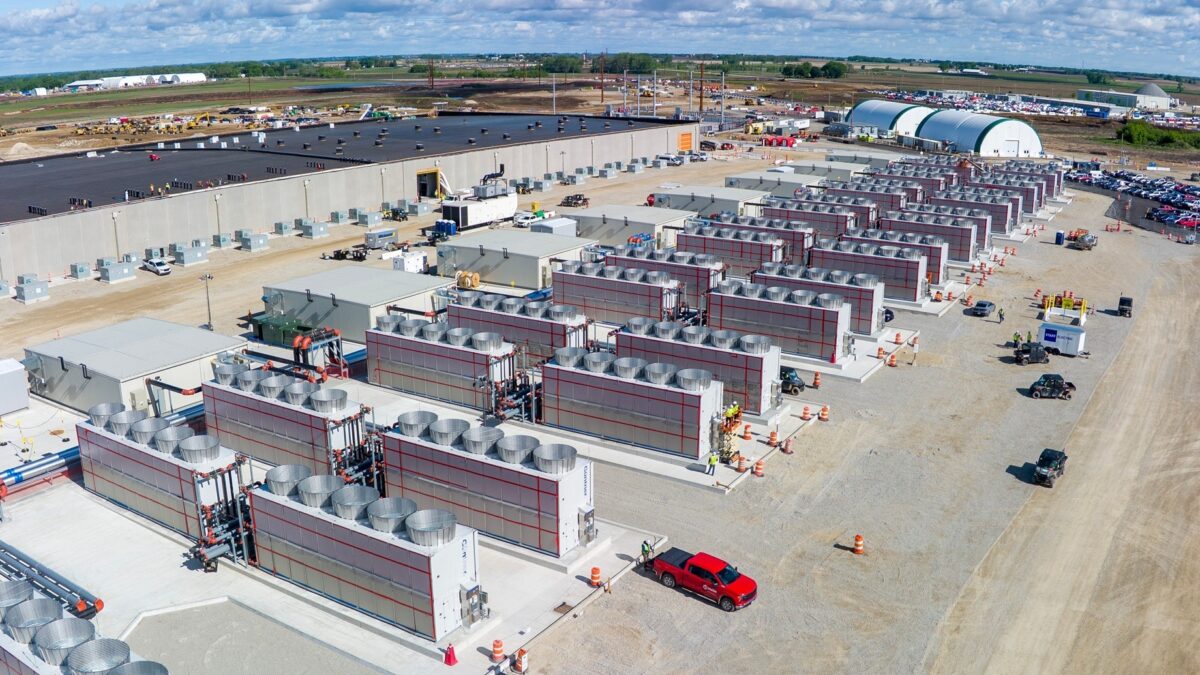
Construction continues on a $1 billion, 520-acre data center Wednesday, May 20, 2026 in Beaver Dam, Wisconsin. It is being built for Meta, the trillion-dollar company that owns Facebook and Instagram. It's one of seven major data center projects pending in Wisconsin that combined are worth more than $57 billion. (USA TODAY Network via Reuters Connect)
Western MD county approves data center moratorium


Key takeaways:
- Washington County commissioners vote 4-1 for 12-month moratorium
- County staff recommend 18-month moratorium for comprehensive study
- Public concerns focus on water use, noise and zoning compatibility
- County plans to modernize zoning ordinance to define data centers
The Washington County commissioners voted 4-1 on Tuesday to approve a yearlong moratorium regarding data center applications after listening to several residents’ concerns during a public hearing.
The commissioners’ agenda called for a six-month moratorium, with the commissioners deciding on its actual length. The time is for staff to study the suitability of data centers here. A majority of commissioners approved a 12-month pause with three commissioners saying they want to get it right, according to a YouTube livestream of the county meeting.
At least one development-related organization in Washington County has received inquiries about exploring the possibility of a data center there.
Commissioners Randy Wagner, Randy Leatherman, Vice President Jeff Cline and President John Barr voted for the yearlong moratorium. Commissioner Neil Parrott voted against it.
County Administrator Michelle Gordon told the board that staff’s initial assessment was the moratorium should be for 12 to 18 months, with staff recommending an 18-month moratorium.
Staff “indicated that they needed to do some analyses, review analyses being done in other counties such as Montgomery County, (Prince George’s) County, maybe other states and jurisdictions. To review the potential impact not just on the economy, but on residents and our water resources, our utility resources, to determine if things like alternate power sources should be built into the ordinance so that the data center potentially, or the developer that would be looking at us, should be more self-supporting versus relying on our resources,” Gordon said.
A draft of the moratorium ordinance states the board wants “to study data centers in light of changing consumer demand, and changes to existing infrastructure in the County to evaluate their suitability and economic, social and environmental risks.”
Among the challenges and effects data centers can present, according to the draft ordinance, are:
• Straining existing utility infrastructure due to high energy consumption
• Generating significant noise from their cooling systems and backup generators, affecting nearby residential areas and the general quality of life
• Substantial water usage for cooling purposes
• Potential environmental effects, including hazardous materials storage and electronic waste disposal
• Land use compatibility concerns, particuarly in rural or agriculturally zoned districts
Data centers are not adequately addressed in the county’s local laws, including the zoning ordinance.
The county’s latest comprehensive plan, which guides future rezoning, became effective last Oct. 1.
Jennifer Kinzer, the county’s interim director of planning and zoning, said Monday, June 29, that she hopes to begin the process of modernizing the county’s zoning ordinance before the end of this year.
That modernization will include defining what a data center is, Kinzer said. County officials also would determine what zoning districts would permit or prohibit a data center. That is all still undecided, she said.
The proposed moratorium ordinance defines a data center as “a facility consisting of one or more buildings used primarily for the storage, management, processing, and transmission of large amounts of digital data and which houses computing infrastructure, such as computers, network equipment, systems, servers, appliances, and other associated components related to digital data operations.”
Public feedback
Commenters during the Tuesday morning public hearing focused not only on concerns about potential data centers in the county, but also about the length of the moratorium and advocated for transparency regarding the county’s study of the issue.
Kathleen Thompson, a county resident and geologist whose work area includes Washington County, said wells like those in the county are hit harder by the current drought than wells in other parts of Maryland.
“We are in that condition right now and a data center, most of them being open- or closed-looped with water, would result in a greater groundwater drought. It would hurt our famers and it would hurt the residents of our county,” Thompson said.
While a closed-loop cooling system would use far less water, the water is chemically treated, and she expressed concerns about potential leaks.
Thompson said “there’s nothing separating our groundwater from the surface” and that leaks could end up “in our water for our residents and our farmers and our food.”
“We either spend water we cannot spare or we contaminate our own drinking water,” she said.
The City of Hagerstown draws water from the Potomac River to supply its public water system, which extends beyond city lines. However, there are many wells in the county.
County resident Jennifer Creter said, “We need to do everything that we can to protect our environment.” Creter also said “data centers do not bring tons of employment for the long term.”
Thompson’s husband, Brandon, said rather than tie the length of the moratorium to a date, it should be tied to outcomes. Thompson, a Democratic candidate for state delegate for legislative District 2A, outlined three things he thinks should be done before a moratorium is lifted.
Those are a water-use study, an electricity grid analysis and updated county zoning.
“My next big ask is … transparency, not just for data centers, but for any project drawing heavily on shared utilities,” Brandon Thompson said.
“A lot of people here don’t trust how the big money deals get done in Washington County and the Williamsport warehouse is why,” said Thompson, referring to the federal government’s purchase of a megawarehouse outside Williamsport for a proposed immigrant processing and detention facility. “You have a choice. You can build that trust or deepen the suspicion. Putting it in the open proves there’s nothing to hide.”
Shaun Porter, a frequent critic of county government, said it was “funny” that the proposed six-month moratorium ends “just after the election.”
“People are going to see through the fact that this is an election stunt, so that you don’t have to come down … for or against data centers,” Porter said.
At least two other people, including Brandon Thompson, noted the proposed six-month length of the moratorium would end shortly after the Nov. 3 general election. Six months from the June 30 vote is Dec. 30.
Several commenters requested the moratorium be extended beyond six months.
Commissioners’ discussion
Wagner, who is not running for re-election, said residents provided “a lot of good comments” and “we have to get this right. We just can’t shoot from the hip …”
Wagner was the first commissioner to say the county might need more than six months to “come up with a good battle plan.”
“Whether it’s pro, con, I just want to make sure we have all of our bases covered,” Wagner said.
Cline said “Washington County is business friendly, but I want to be known to be friendly to the voters and people I represent too. We have to be cautious. We have to get this right. I don’t want the tax bills to go down and all the sudden your electric bills up $500 a month. So, I clearly want to make sure that the infrastructure …. water and the electric is there, and that data centers are bearing the burden, are paying for a lot of that. I don’t want you all back in here a year from now and your electric bill is $2,500 a month.”
“Solar farms came in and took advantage of this county, warehouses came in so fast one could say (they’ve) taken advantage of the county… And nowhere in this ordinance we have now does it say data center …” said Cline, who is running for re-election. So what’s stopping data center developers or others from “coming in and using legalese to run amok in here and take advantage of our antiquated zoning that needs to be updated during this moratorium?” Cline said.
The draft moratorium ordinance said the county Planning Commission and staff want time to study data centers and develop a recommendation. The commissioners also need time to possibly adopt a zoning text amendment, which would require public hearings.
Leatherman said he favored a 12-month moratorium “just so we get it right.” Leatherman is running for election to retain the commissioner seat he was appointed to more than a year ago.
Parrott explained during the meeting why he voted against the 12-month moratorium, saying there’s a great need for data centers in the U.S. Parrott is not running for re-election to retain the commissioner seat he was appointed to earlier this year.
“I want to make sure Washington County sends the message that we’re open for business and I am afraid that by doing this today, we’re sending the wrong message,” Parrott said.
Cline pushed back on that, claiming the county has brought in “billions of dollars of economic development.”
“To even insinuate that Washington County is not business friendly is more rhetoric than it is substance, and I reject that,” Cline said.
Parrott countered, “When it comes to data centers, we are anti.”
“We all know we need data centers, but we have to get this right,” Cline responded. “We cannot just let them come in on ordinances that aren’t updated.”
Data center representatives are looking at Washington County
Kinzer said that as of Friday, June 26, no application for a data center had been submitted to the county — that she knew of. She said no one had approached the planning and zoning department about a data center.
Jonathan Horowitz, director of county business and economic development, said via email Monday, June 30, that he could not comment.
The Herald-Mail also inquired on Monday and Tuesday with the City of Hagerstown, asking if anyone had approached the city about the possibility of wanting to have a data center in Hagerstown or Washington County since the city’s water service extends beyond city lines.
City Administrator Scott Nicewarner, via email on Tuesday morning, responded “we receive inquiries often from companies looking to create development in Hagerstown but none that have gotten to the point where there are any details to share.”
There have been inquiries regarding data centers for the Mount Aetna Technology Park near Hagerstown, according to Greg Snook, chairman and CEO of the Hagerstown-Washington County Industrial Foundation, also known as CHIEF.
There are no plans for a data center at the technology park campus, Snook said Monday. The tech park is near the campuses for Hagerstown Community College and Meritus Health.
Snook said he gets calls from brokers occasionally inquiring on behalf of potential data centers about how much land is available at the technology park, the zoning and the utilities situation.
Snook told The Herald-Mail in March that he did a power study about two years ago to seek what kind of upgrades the technology park would need for various facilities, including a data center. The upgrades would be rather extensive from both timing and cost perspectives.
More recently, brokers have mentioned the data center model has changed to have gas generators brought in to generate power for data centers, Snook said. The power grid would then serve as a backup to the generators. The generators would need a natural gas line, which the park has because Jamison Door needs one, he said.
The technology park has about 100 available acres left. Snook said he didn’t think that would be enough land for a large data center, but it could accommodate a smaller one.
There are large data centers, that can serve around 10 companies, and there are smaller ones, that could serve one or two companies, Snook said.
Asked if CHIEF has a position on data centers, Snook said it didn’t. But data centers are not number one on CHIEF’s list of industries it targets. Snook said he would prefer manufacturing, which is a better fit for “our area.”
CHIEF officials look at the number of jobs and the investment a company will make, Snook said. The number of jobs a data center would have depends on its size.
For a data center, there could be employees working there from each company the data center serves, he said.
Washington County Planning Commission Chairman Jeff Semler said the commission briefly discussed data centers at its June meeting. The item wasn’t on the agenda, but arose because members had questions about the commission’s role regarding transmission lines.
Semler said there has been chatter, or rumors, about the Transource transmission project possibly feeding a data center in Pennsylvania.
Transource announced in May it had filed applications with the Pennsylvania Public Utility Commission (PaPUC) for approval of the proposed Rice-Ringgold Transmission Line Project. “The $113 million project includes building 29 miles of 230-kilovolt (kV) transmission line connecting the proposed Rice Substation in Franklin County, Pennsylvania to FirstEnergy’s Ringold Substation in Washington County,” the release states.
Sarah E. Devin, a spokesperson for American Electric Power, said in a Tuesday afternoon email that the Transource transmission line project “is not being built to serve a data center.
“Nearly 10 years ago, PJM Interconnection, which oversees the power grid in 13 states and Washington D.C., directed Transource to build the Rice-Ringgold Transmission Line Project to reduce grid congestion in parts of Pennsylvania, Maryland, Virginia and West Virginia, which is still the purpose of this project,” Devin wrote.
In Franklin County, several townships that lack zoning have been looking into or moving ahead with proposed ordinances to regulate data centers, according to the Chambersburg Public Opinion.
The Franklin County Commissioners, in late May, adopted an amendment to the county’s subdivision and land development ordinances, collectively known as SALDO, meant to help municipalities set rules for companies that may seek to develop data centers in the area.
No data centers had been proposed in Franklin County as of the May 26 story.
There are plans for data centers in at least two neighboring counties — Frederick County and, in West Virginia, Berkeley County.
West Virginia Gov. Patrick Morrisey announced a 548-acre “high-impact” data center coming to the Bedington area during a Feb. 26 press conference.
The Martinsburg Journal reported that the project is West Virginia’s first high-impact data center under House Bill 2014, which enables those data centers to create their own power grids and be exempt from local zoning laws while diverting a majority of their funding to state-level funds for income-tax reduction.
The Frederick County Council voted last December to enact a 2,615-acre data center zone near Adamstown, according to The Frederick News-Post.
The zone has resulted in significant pushback, including an effort for a November ballot referendum to possibly overturn the zone.
The News-Post reported on June 30 that the Maryland Supreme Court upheld a judge’s ruling that a referendum on the 2,615-acre data center zone near Adamstown cannot be placed on the Nov. 3 general election ballot.
The decision upholds the ruling by Judge James A. Bonifant, who held in Frederick County Circuit Court on June 18 that the ordinance used by the Frederick County Council to enact the map is not subject to referendum under the county’s charter and that the forms used to collect referendum signatures were inadequate.
Reporting by Julie E. Greene, The Herald-Mail / USA TODAY Network via Reuters Connect.