Sign In
 Free Newsletter

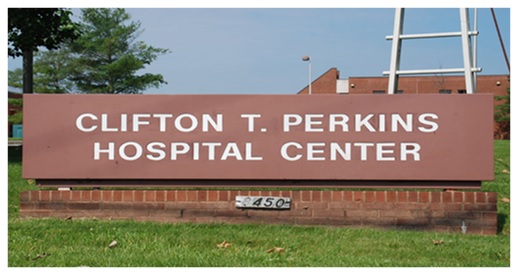
File photo outside Clifton T. Perkins Hospital Center in Jessup, one of the state's adult psychiatric forensic hospitals. (Vickie Connor/Capital News Service)
Fines for slow pretrial mental healthcare upheld against MD Health Department


The Maryland Supreme Court last week upheld fines against the state health department for failing to provide prompt psychiatric care to criminal defendants deemed dangerous and incompetent to stand trial.
As of June 30, 236 people with severe mental illness were incarcerated pretrial as they awaited placement at one of Maryland’s five adult psychiatric hospitals, which are all near capacity, according to the Maryland Department of Health. Of those defendants, 73 were on the waitlist for the maximum-security hospital in Jessup.
While they wait in jail, they are often held in solitary confinement and don’t receive proper care, advocates say.
“They get worse and worse,” Luciene Parsley, litigation counsel at Disability Rights Maryland, said in an interview.
The Health Department is required to find them spots within 10 business days of receiving a commitment order from a court, and judges have fined the department $1,000 or more per day that a mentally ill defendant remains jailed. The department says it is impossible to comply with the law due to funding constraints and increased demand for psychiatric care.
In a 4-3 decision on July 15, the state’s high court upheld a law allowing judges to sanction the department if it fails to meet that deadline. One defendant in the consolidated appeal was charged in Kent County, the other five in Baltimore County.
Justice Jonathan Biran acknowledged that the department faces “significant challenges” in meeting the 10-day deadline.
“Regardless,” he wrote, “the General Assembly has authorized trial judges to impose monetary sanctions that are reasonably designed to compel the Department to admit the defendants before them to designated health care facilities as soon as possible.”
Biran was joined by justices Shirley Watts and Angela Eaves, as well as Senior Justice Michele Hotten, who was specially assigned in place of Chief Justice Matthew Fader.
Maryland Public Defender Natasha Dartigue, whose office represents each defendant, called the ruling a “win for our clients.”
“When individuals are found incompetent to stand trial and dangerous, they cannot be safely treated in local detention centers,” Dartigue stated in an email. “All Marylanders, including those suffering from mental illness, are entitled to dignity and due process.”
The Department of Health declined to comment on the lawsuit. Spokesperson Amanda Hils noted that 80 to 90 patients are ready to face trial but are remaining in the hospital rather than being transferred to jail “to ensure their competency is maintained.” Hils did not answer how much the department has been fined.
In its brief before the Maryland Supreme Court, the department said it’s impossible to find a bed for everyone who needs one within 10 days, despite efforts to increase capacity.
It argued judicial sanctions are not reasonable “where the delay results from an extreme shortage of hospital beds that the department is making extensive efforts to alleviate.”
The department eliminated “inefficiencies” before 2017, allowing more people to get care on time, but then the number of commitment orders skyrocketed, the brief says. Several years ago, around 500 commitment orders were received per year; that jumped to around 1,100 in 2023.
The average stay in the state’s five psychiatric hospitals is 850 days, according to the state’s brief. More than 100 people were eligible to leave as of April 2024 but were being held in the hospitals due to a shortage of less-intensive placements.
Three dissenting justices agreed with the Health Department that sanctions aren’t “reasonable” when the need for beds has increased significantly and the department is trying to increase capacity.
Justice Brynja Booth, joined by justices Steven Gould and Peter Killough, wrote that fines by judges aren’t “reasonably designed to compel compliance” when the department is already trying to increase capacity.
“As it stands, with the waiting list of individuals who need beds, it is mathematically impossible for the Department to place these individuals in beds without constructing more facilities, unless, of course, the need for such beds decreases,” Booth wrote. “That has not occurred. In fact, since 2017, the need for beds has exploded.”
Meanwhile, Disability Rights Maryland is suing the department over the same issue. The parties are engaged in discovery after the state’s federally designated protection-and-advocacy group for disabled people survived a motion to dismiss earlier this year.
Parsley said she was happy with the ruling. Disability Rights Maryland and the American Civil Liberties Union of Maryland filed an amicus brief in the case, arguing the state’s health department has contributed to the problem.
“MDH’s dereliction of duty cannot be excused by simply gesturing at its budget then throwing up its hands,” Parsley wrote in the brief.