Sign In
 Free Newsletter

Anatomy of an airport: Can Hagerstown make it fly without passengers?


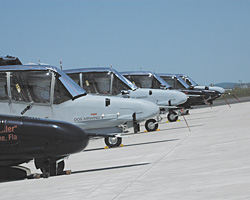
Small passenger planes at Hagerstown Regional Airport.
HAGERSTOWN — The short road that leads from Interstate 81 to Hagerstown Regional Airport is peppered with signs directing visitors to the passenger terminal at the 80-year-old, Washington County-owned airfield.
Three rental car companies still operate out of that terminal, but passenger service halted here last September. The airport has a brand new, $62 million, 7,000 foot runway — longer than any at Ronald Reagan Washington National Airport — but no airlines to use it.
No big deal, say local officials, pointing out that passenger service never made up more than 5 percent of Hagerstown’s flights or airport revenue.
“We’ve always been a maintenance and repair facility,” said airport director Carolyn Motz.
With airport employment and revenue growing, Motz said focusing on the absence of commercial passenger service is “like having a cheeseburger and dwelling on the mustard.”
But one potential benefit of the longer runway is that it will allow larger, heavier planes to take off and land here, and state, federal and local leaders hope that will mean the return of passenger service.
“If we had a good, reliable commercial carrier that went places people wanted to go, it would have a reasonable customer base here,” said state Sen. Donald F. Munson, R-Washington.
In the mid-1990s U.S. Airways flew about 37,000 passengers a year from Hagerstown to hubs in Baltimore and Pittsburgh, but uncertain federal funding and a difficult environment for airlines made it impossible for the airport to keep that service.
Until last year, Air Midwest was making two flights a day from Hagerstown to Pittsburgh for U.S. Airways. That service was halted along with a federal subsidy for service from Hagerstown. Though the subsidy was extended in February, it expires again Sept. 30. Its long-term fate depends on the resolution of a congressional fight over an authorization bill for the Federal Aviation Administration.
| Hagerstown Airport Slideshow from Jackie Sauter on Vimeo. |
Without the subsidy, Motz said it will be a challenge to bring commercial service back to Hagerstown — though she won’t stop trying. She said the new runway, completed last November, was not built only for passenger flights and it will help the airport generate other new business.
The main impetus for the runway, Motz said, was a new FAA rule that required all airports to extend runway emergency areas.
The FAA extended those areas by 500 feet on either side of a runway. Since Hagerstown’s largest runway is sandwiched between 81 and U.S. Route 11, Motz said the airport faced a choice of whether to extend the runway with a bridge over Route 11 or shorten it by 1,000 feet. Once the bridge was in the plans, airport and federal authorities decided it was cost-effective to extend the length to 7,000 feet.
Barney Parrella, managing director of Bethesda-based Innova Aviation Consulting, said the move made sense.
“It’s by no means an excessive runway length,” he said.
The runway length could help the airport attract passenger service in the future, Parrella said, but he also said he’s never seen a worse environment for regional airports like Hagerstown in their search for commercial carriers.
Some around the airport wonder if there’s really a point to having such a long runway.
Tracey L. Potter, president of Hagerstown Aircraft Services Inc., said he believes the only time it has been needed so far was when President George W. Bush visited the airport in a Boeing 747.
Other planes at Hagerstown can use a shorter runway, said Potter, whose company performs structural and engine repair and other maintenance.
“Most of them don’t require a 7,000 foot runway, so nothing really changes,” he said of the planes his business services. “It didn’t benefit us at all.”
Motz said the airport has had other flights that have needed the full runway capacity, mostly corporate jets that can now travel farther because they can carry more fuel.
Washington County Administrator Greg Murray said the runway upgrade was a wise decision. After all, he said, there was a lot of money available from the state and federal governments.
The FAA covered most of the cost of the new runway with a contribution of $48.5 million. The state of Maryland chipped in $11 million, and Washington County supplied the rest.
Though he’d like to see passenger service return soon, Murray said its absence has some benefits. For example, there are more opportunities for planes to land at Hagerstown without regularly scheduled passenger flights, he said.
“We haven’t had a major problem with the passenger service going away at this point,” Murray said.
Sen. Munson, whose district includes the airport, said he’s glad the state helped out with the new runway. He said the airline business was much different in 2000, when discussion began over the new runway.
At that time, he said, some thought Hagerstown might become an “overflow” airport for Baltimore/Washington International Thurgood Marshall Airport. This would follow a model set in New England around Boston’s Logan Airport.
With Logan at capacity, planners began to schedule flights into smaller airports in Providence, R.I., and Manchester, N.H. But BWI can still accommodate additional flights, said Maryland Aviation Administration spokesman Jonathan O. Dean, so that possibility is not in play.
Still, Munson believes the decision to extend the runway has been an economic success.
In 2000, the airfield supported 562 jobs, according to state figures. In 2005, there were 1,036 jobs. During that same period, annual business revenue associated with the airport rose from $26.4 million to $69.7 million.
The airport’s three major industries are navigation and communication instrument manufacturing; maintenance and repair and aviation business services. All have grown since the runway project began, Motz said.
One of the major operations on the airfield belongs to Northrop Grumman Corp., which operates a systems integration and aircraft modification facility here.
Susan Sullam, spokeswoman for U.S. Sen. Benjamin L. Cardin, D-Md., said the FAA bill is held up in the Senate, but not because of the subsidy issue. She said Sen. Cardin was confident the “Essential Air Service” designation would continue.
However, it’s unlikely that an airline would add passenger service based on a subsidy that expires in September, Motz said. The subsidy will likely have to come with a longer commitment.
Motz said that in some ways she’s glad the airport is not exposed to the airline industry, which is facing hard times associated with the rising cost of fuel. Hagerstown’s diversity of business is helping it now, and all of the airport’s hangars and facilities are fully leased, she said.
Sen. Munson agreed, citing Washington County’s former heavy reliance on the transportation sector, until several car, truck, rail and other transportation-related companies slashed employment in the 1970s and 1980s.
“We learned in this county a long time ago that if you’re dependent on one thing, then it is going to be a boom or bust cycle,” said Munson.
Parrella said Hagerstown appears to be doing a good job without passenger service
“That’s something they should aspire to and can once again have,” the airport consultant said. “Setting that aside, the fact that they have a full house at the airport in terms of other aviation businesses … that’s very good.”